Over at “The Australian Legend”, Bill has an interesting interview with biographer Sarah Goldman, author of Caroline Chisholm: An Irresistible Force. I started out my biography in fear someone else would publish one on my subject before me; that actually happened to Goldman, and it was still okay, as she explains in answer to one of Bill’s questions.
Caroline Chisholm: An Irresistible Force by Sarah Goldman is the recently released biography of one of the most interesting and influential women in Australia’s early history. My review copy arrived with a letter suggesting Sarah would be happy to be interviewed, so I sent her some questions to which she has been kind enough to give extensive answers. I didn’t let on, but this is my first interview.
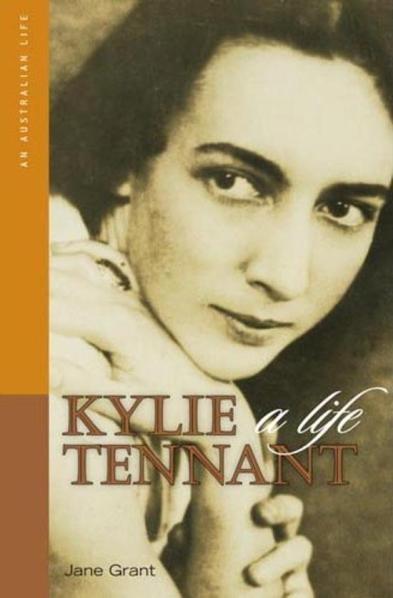
What a character Kylie Tennant was. Her strength and distinctiveness leap out from the pages of Jane Grant’s biography, right from the opening where she walks 500 miles at age twenty during the Depression to visit her university friend Lewis Rodd. Impulsively, they marry. Continue reading →
Athletics carnivals of course, that’s the first thing which comes to mind – the primary school ones. First the faction carnival and then the inter-school. Allanson wasn’t big enough to hold our own faction carnival; we competed as one faction against four Wilson Park factions and we still always, reliably came last. But then we would sometimes win the Forrest District Small Schools Association carnival held on the double-geed ovals of little country localities in southwest WA. Continue reading →
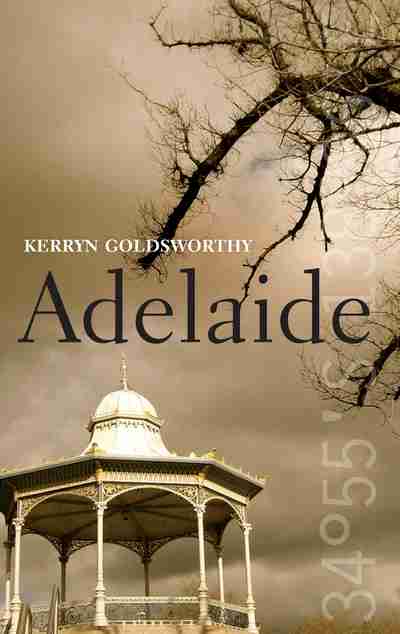
I’ve never lived in Adelaide, but it has a sense of home for me. It’s the city the Hobbys come from; my ancestor Thomas Hobby, who bears the same name as my son, was one of the early settlers of the suburb of Norwood in 1849. It’s also where my in-laws grew up and now they’ve returned there, we’ve visited quite a few times over the last decade. From them, I’ve learned some of the peculiarities and lore of the place and had a sense of the pride Adelaidians hold about their distinctiveness. Continue reading →
I am very concerned by your government’s move to drug testing for welfare recipients. In 2003 when I graduated from university, I was on Newstart allowance for six months while I looked for work and I found dealing with Centrelink alienating and dehumanising. The attitude of the system toward welfare recipients already feels so harsh. I wasn’t on any drugs but the addition of testing would have increased my sense of disillusionment with a state which treated me with suspicion and heavy-handedness.
I can’t believe this measure comes the same week Tony Abbott admits to being too drunk to vote in a crucial bill. It feels to me that your government risks seeming hypocritical. I’m not convinced this measure is actually concerned with helping people with addiction problems – if this is your real concern, increase funding for addiction services.
Yours sincerely, Nathan Hobby.
I didn’t remind my MP of the fact that he was caught drink-driving without a licence two years ago. I don’t know why this testing measure bothers me so much, but it seems just a little fascist and also yet another move of a government which despises the underclass. There are no jobs for people to be getting at the moment. There are actually so many activities / classes of people who receive subsidies or concessions from the government – as someone tweeted, why aren’t the negative gearers being tested for drugs?
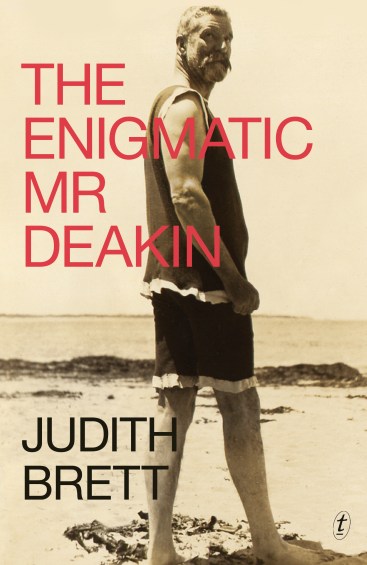
Like many biographers, I have a list of possible future subjects. One of my ten names has been Australia’s second prime-minister, Alfred Deakin (1856-1919). While researching his interactions with Katharine Susannah Prichard, I found him a fascinating character. I was surprised that the only comprehensive biography appeared fifty years ago. But I’ve removed Deakin from my list because Judith Brett has written a superb account of his life in The Enigmatic Mr Deakin, out this month.
Brett begins her biography with a comparison to a more famous Victorian born two years earlier, Ned Kelly:
Deakin is remembered too, but not so vividly, more as a bearded worthy than a national icon. He was Australia’s most important prime minister in its first ten years after federation, but he sits uneasily as a representative Australian figure. He is too intellectual, too respectable, for the larrikin masculinity of the Australian legend… Deakin was never a mate. He didn’t swear and rarely drank. He didn’t play organised sport nor fight in the Great War…. In short, he was middle-class, well-educated, urbane and supremely self-confident, like the city and the colony in which he grew to manhood. (3)
Australia needs more heroes like this, and Brett lays out a strong case for his significance and his achievements, while always alert to the ambivalence which marks him and his legacy. Continue reading →
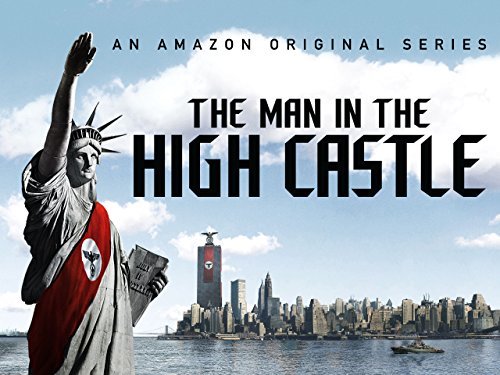
The first season of The Man in the High Castle (2015) isn’t perfect but it’s my favourite television show of the year so far, a moving, engrossing drama which sheds light on our reality by depicting an alternative one. Set in 1962, years after the Axis powers won World War Two, the Japanese control the western Pacific States of America while the Nazis control the east coast. The two empires have their own cold war, and the background of season one is a crisis point as a group within the Nazi regime attempt to provoke Japan into a war Japan cannot win. In an incredible twist of sympathies and political intrigue, by the end the creators have the audience hoping that the aging Hitler will not be assassinated. Continue reading →
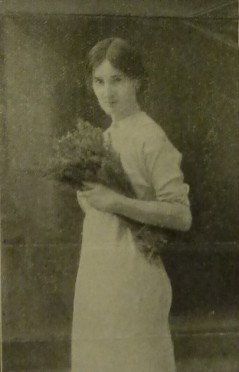
Katharine Susannah Prichard the lavender girl, 1915. A photo from a profile by Sumner Locke in Everylady’s Journal.
I sent my manuscript off two weeks ago. The publisher I think would be best for my biography now runs an annual competition for an unpublished manuscript, so it seemed a perfect goal. I’m catching my breath after eight intense months in which I wrote half of the book. (The first half took more than two years.) Continue reading →
I’m currently doing final revisions on my biography before I send it off for the first time. It’s 100,000 words long and twenty chapters – hopefully the first book of three covering Katharine Susannah Prichard’s life. I’m not certain of the title yet so maybe you can help me. Here’s a blurb for the book, to give you a sense of what the title needs to convey:
When Katharine Susannah Prichard’s father killed himself in 1907, her literary career was just starting to bloom. She was twenty-three, and she’d lived her life in the shadow of his depression, hoping for his approval. This biography is the story of Prichard’s restless early life as she overcame the deaths of her father and brother and many years of literary setbacks to break through as a novelist of the Australian land and people. It is also the story of her political transformation, as her quest for the answer to the world’s problems became urgent in the horrors of World War One and she decided that the only solution was revolution. All of it was tangled with her complicated love life, her long affair with an older man, a romance with a playboy activist that left her heartbroken, and finally her marriage to the Victoria Cross winner, Hugo Throssell. Precocious child, governess, journalist, and finally writer this is the engrossing story of one of Australia’s literary greats.
And the nominations for title are, in alphabetical order, with an explanation:
Astir: The Early Life of Katharine Susannah Prichard
“Astir” is a word which seems to capture the spirit of Katharine: “in a state of excited movement.” It’s not specific to any one strand of her life, but suggestive of them all. I was drawn to it by this passage from her, which I would use as an epigraph:
[S]o strenuously national is the spirit of today, so lively and vigorous the sense of our growing strength in intellectual and artistic life, that Australian literature is abandoning this “imitativeness,” these swaddling-clothes of its infancy, and adopting the toga virilis of originality. It has reached the adolescent stage—it is astir with great things; growing daily in power and freedom… But no-one has completely expressed the characteristic of our country, life and people. We await transfiguration at the hands of a great writer.
“Australian Literary Tendencies.” International 1, no. 3 (March 1908): 344–45.
Katharine Susannah Prichard: Before She Was Any of Those Things
This title comes from the prologue:
In Australia’s cultural memory, Katharine has become the aging, tenacious communist living in her cabin in the hills of Perth, widow of a Victoria Cross winner, author of Coonardoo. This biography is the story of Katharine before she was any of those things. If all of these things have antecedents, none of them were as inevitable as they now seem.
Katharine Susannah Prichard: Beginnings (or, Beginnings: A Biography of Katharine Susannah Prichard, 1883-1919)
This title speaks for itself! The plural is important, suggesting the different spheres of life.
A Rough Path: The Early Life of Katharine Susannah Prichard
In her grief over her brother killed in the war, Katharine wrote a poem called “For Alan”:
My way is like this way
Which goes through the hills—
A rough path—it seems to ascend, ascend:
But I know it will come to the sea,
And long day end.
It’s an image that conveys the pattern of her early life and would make a good epigraph.
Turning Red: The Early Life of Katharine Susannah Prichard
While politics was only one strand of Katharine’s life, it was an important strand and this title conveys the process of transformation.
If this book gets accepted by a publisher, I’m sure they’ll have an opinion on the title. But for the moment, I want to be sure the title captures the attention and respect of whoever is reading the manuscript. Please vote and tell me what you think. I’d also welcome other suggestions (leave a comment) and feedback on the subtitle (“The Early Life of Katharine Susannah Prichard”).
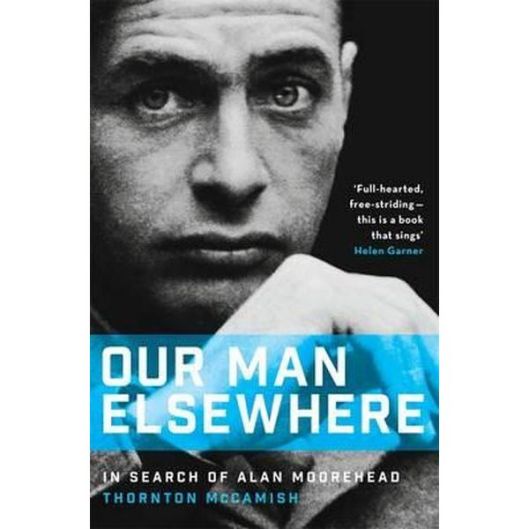
For the second year, I’m working on an annual bibliography and introduction to Australian literature with my supervisor and another co-author for the Journal of Commonwealth Literature. My focus is on non-fiction. I was surprised to find that in 2016 there were just five Australian literary biographies published, at least by our reckoning. Three of them came from UWA Publishing; the other two were both about mid-century middlebrow writers – Paul Brickhill (The Great Escape) and Alan Moorehead. The reviews for the biography of Moorehead (1910-1983) – Thornton McCamish’s Our Man Elsewhere: In Search of Alan Moorehead (Black Inc) – were so glowing about the writing itself that I just had to read it, despite barely having heard of Moorehead.
It truly is an excellent biography. It is a biographical quest as McCamish begins by describing the fever of obsession with Moorehead that came over him and asks why Australia’s most famous writer in the US and Britain in the 1960s has been so forgotten fifty years later. Some of the finest reflections on biography occur within biographical quests and McCamish’s were delightful. His account of looking through Moorehead’s papers at the National Library of Australia described my own experiences there so perfectly. In another scene, he captures so well the sense of the past, the thrill, the anxiety, and the prosaic elements of trying to find Moorehead’s house while on holiday in Italy with his wife and small children. Some quotes:
There isn’t much logic to the in-the-footsteps method. My idea was that if I followed the thread linking Moorehead’s words to the places where he wrote them, I might, with some intuitive effort, some narrowing of the eyes, get a fuller imaginative sense of what his world felt like. (124)
It was unsettling to meet the nieces. Years of document-sifting and note-taking hadn’t prepared me for the warmth of living memory. (148)
The photo of Moorehead with Churchill posed a question, one that is implicit in any book about a writer, but which I have managed to ignore till now. Was the life more interesting than the work? Or more specifically: had the life aged better than the books had? (202)
My Moorehead was constructed from the printed word, mostly, and my own preoccupations. But the actual man existed most truly in what people could remember of him; in what remained in fragile containers of memory. (206)
The focus, though, is on Moorehead’s life itself more than McCamish’s quest. McCamish describes the World War Two years in the most detail, the time when Moorehead turned his war journalism into a bestselling trilogy that made his name as a writer. He had a full, exciting life in the decades which followed, and yet McCamish captures so well an ennui always lurking in the background. It is a relatively short biography for an entire life at 351 pages, and the elements not pursued at length are his family and romantic lives. Moorehead’s wife, Lucy, is glimpsed as a fascinating character in her own right – crucial to his success – and we are only given limited insight into her feelings about his constant infidelity and long absences. With their children still alive, it would have been an area McCamish had to tread carefully.
This is a biography which gives a vivid sense of life and culture in the mid-twentieth century. It reflects in an indirect but profound way on what makes life meaningful and how the past is present – or not – today. It didn’t leave me with a strong desire to read Moorehead’s work but it did leave me with a strong desire to read whatever book McCamish writes next.



 Nathan Hobby, a biographer in Perth