Walter M. Miller shot himself

Tags

,

Walter M. Miller’s A Canticle for Lebowitz is one of my favourite novels. A strange and beautiful work, it spans centuries in telling of an order of monks in a post-apocalypse world who keep knowledge alive – in a way – by tediously copying the blueprints and shopping list of Saint Lebowitz, an engineer from before the nuclear war.

All his life it was the only novel he published; but then in 1997, soon after he died, a sequel appeared – Saint Lebowitz and the wild horse woman.  I don’t know why I failed to read it; I think someone I respected told me it would spoil the brilliance of the first in my mind. But I am going to read it now. How can I not?

I looked him up for some reason yesterday and found this interesting article by Terry Bisson – http://www.sff.net/people/tbisson/miller.html, who finished the novel for Walter Miller after he shot himself.

I was shocked by what I read about Miller in Bisson’s article. From Canticle and its gentle Catholicism, I imagined Miller to be a wise and peaceful religious man. Instead, Bisson paints a picture of a reclusive grump. What did Auden say? Something like, ‘Master of nuance and scruple / Forgive us writers whose words are in better taste than our lives’.

Thomas Hardy – Far from the madding crowd

Tags

I have started a tradition I have kept up for two whole years of reading one Thomas Hardy novel a year. This year it was Far from the madding crowd, an early novel serialised then published in 1874.

Set in Hardy’s beloved Wessex, Bathsheba Everdene is pursued by three men. Gabriel Oak is a good hearted farmer who loses his farm and any chance of marrying her and becomes a shepherd on her farm.  Farmer Boldwood is a boring bachelor in his forties whose heart is brought to life by a Valentine Bathsheba sends as a joke. From thereon, she feels an obligation to him and it is tragic to see the trouble wrought by one careless action. Sergeant Troy is a dashing soldier who flatters and controls Bathsheba and makes her fall in love for the first time in her life.

It was the savage tragedy of Tess of the D’Ubervilles, The Mayor of Casterbridge and Jude the Obscure which drew me to Hardy. He writes tragedy better than anyone else I have read. Madding Crowd is a minor tragedy, diluted with pastoral comedy. The comic aspects are interesting mainly from a cultural perspective, the exchanges of the farm workers in the pub on religion and life giving a picture of everyday nineteenth century life through Hardy’s eyes. But the mix is an uneasy one and left me dissatisfied.

The depth of feeling of those favourite works of mine is not there. Hardy doesn’t seem to care or know these characters as well as those in his later works.

Yet it deserves its reputation as an important novel. Bathsheba is a fascinating, nuanced character, especially for a woman character in the nineteenth century. She is not typecast as either pure or evil, but instead as a complex human being with contradictory drives between desire and obligation.

A street called wall

Tags

My wife Nicole has entered the ABC National Poetry Slam Competition. It’s an excellent political poem called ‘A street called wall’. You can view it online here: http://contribute.abc.net.au/kickapps/_A-street-called-wall/video/372060/32422.html .

I like the interweaving of so many texts in the poem – nursery rhymes, Lewis Carroll, the Beatles, Don McLean, advertisements. For me it captures the milieu of the moment. And I’m in admiration of her rhyme and rhythm.

But I’m biased; judge for yourself.

Don’t be like Donna Tartt

Tags

In 2004 when my first novel was published, a librarian I worked with said, “Just don’t be like Donna Tartt who took ten years to write her second.”

Donna Tartt, the New York author, who debuted with the brilliant The Secret History in 1992 and didn’t publish The Little Friend until 2002.

I might have laughed at the time, but this has been a fear which has animated me ever since. The fear that I could become one of those writers who just did not follow through.

Fear is a terrible motivation for a writer. And a little fame is a terrible thing too. It’s so easy to become sidetracked from the noble reasons to write and covet the spotlight, the spotlight which shifts away so suddenly. (I had attention for about fifteen months after The Fur, and then very little.)

So that is some of the backstory for the six years I’ve wrestled with my second novel. (I started in 2002 before The Fur was published.) House of Zealots has gone on and on and on through nine rewrites. (My poor long suffering wife.)

But this week I sent it off. It’s highly possible it will come back again, but for the moment, it’s in the publisher’s court. And despite all the sidetracks and times of wrong motivation and stress about not getting enough time to write, I think it’s finally come out okay. I’m just embarrassed I was showing people the first draft four years ago, when it wasn’t okay. 😦

Gen Y literary blog, Angela Myers

Tags

A new blog I’m following is Literary Minded, Angela Myers’ excellent blog of all things literary from an Australian perspective at http://blogs.crikey.com.au/literaryminded/. I’m overwhelmed by her energy and prolificy, and feel appropriately old and tired. She’s keeping up with everything!

She describes herself as a Gen Y writer and I realise I’m not sure I can call myself this. Not that it wouldn’t be good to be the voice of a generation (until Gen Z comes along and you’re yesterday’s news). But that I feel a perpetual outsider status to be necessary to my sense of self. I guess I’m disloyal to my generation. There’s a lot I don’t like about it.  (But I don’t think it’s as bad or as monolothic as commercial media makes out, either.) Maybe I need to find more of a sense of generation as part of my identity.

(Part of the problem is that I’m on the cusp of Gen Y and Gen X and so I don’t belong in either. )

Forgive them for they do not know what literary fiction is

Tags

A common question people ask when I tell them I write novels is, ‘What genre?’. Okay, so maybe they don’t use the word genre, but that’s often the gist of the second question. (Sometimes people ask what a novel is, but not every time, or even half the time. But way too many times.)

I usually tell them ‘literary fiction’, but I’m beginning to think that hardly anyone knows what I mean. ‘Like fantasy?’ someone said today.

I don’t mind calling literary fiction a genre. When I was a science fiction nut at sixteen and seventeen, I remember reading an impassioned article in Aurealis, perhaps by Van Ikin, about how literary fiction is just as generic as science fiction. The literary stories he analysed had a number of common features – a journey, introspection, the suggestion of illicit sex and some other things I can’t remember. Maybe not true of everything published as ‘literary fiction’, but the argument has validity.

What I can’t do is explain easily to people what literary fiction is without sounding elitist.

‘It’s a type of fiction which pushes boundaries… it could be about anything… but it explores the experience and meaning of life… often… sometimes… it’s read by highbrow people with English degrees… or just people with better taste… oh dear, I didn’t actually mean that…’

Because let’s face it, us literary fiction readers do look down on the rest of you. At least a little. Sorry.

Anyway, I feel this gulf between me and people who have no clue what literary fiction is. I guess it’s the problem everyone faces who has gone deeper into their field. I mean, I’m not going to appreciate the finer points of distinction between different types of motorbike racing or knitting, am I?

The reckless pessimism of youth

Tags

,

Two quotes I’ve come across in recent weeks sum up something I’ve been trying to capture about youth in House of Zealots. It’s a particular sense of aliveness I thought all of life would have, but which I now fear dries up. I was writing about something I was experiencing when I started the book in 2002, but now I have to look back and write about it from a distance. Ian McEwan said this in an interview on the Book Show regarding the difference between his early writing and mature writing:

I was young, reckless, I had a kind of reckless pessimism which I think you can afford first of all when you’re young and before you’ve had children. You don’t care what happens to the world, you just want to stir it up. You don’t mind a revolution. I wouldn’t even have minded much a nuclear war. I really wanted things to shake up.

He’s exactly right; it’s how I felt for a time. Anything to make a dent in the world. It’s what Leo in House of Zealots wants to do.

And there’s a slightly different mood, but a related one, that Don DeLillo beautifully describes at the end of Underworld:

I long for the days of disorder. I want them back, the days when I was alive on the earth, rippling in the quick of my skin, heedless and real. I was dumb-muscled and angry and real. This is what I long for, the breach of peace, the days of disarray when I walked real streets and did thing slap-bang and felt angry and ready all the time, a danger to others and a distant mystery to myself.

Nick, the character talking, becomes a middle-class, middle-aged man with sadness in his heart, but none of the anger, the readiness and the danger. In a sense the novel is an archaeological dig, taking us back from his present self to the youth that lay behind, as the chapters go circuitously backward in time. How did the boy who shot a man become a manager of a waste disposal company? How do any of us who once were young become what we are now?

Sleeplessness in a house of mourning: Paul Auster’s Man in the dark

Tags

,

Paul Auster, Man in the dark, Faber : 2008. RRP: $29.95

After finishing my favourite author’s latest novel, I’m not sure what I think of it. It’s a slim novel of insomnia as seventy-two year old August Brill reports two of his strategies of dealing with his failure to fall asleep. Brill is living in a house of three generations of mourning, having recently lost his wife, while his daughter Miriam has been abandoned by her husband and the boyfriend of his grand-daughter, Katya has been killed in Iraq.

Brill’s first strategy is to tell the story of Owen Brick, a man summoned from our world to fight a war in an alternate world where the north-eastern states do not accept George W. Bush’s victory in the 2000 election. There was no 9/11 in this world and there is no war in Iraq, but there is instead a second civil war. The nightmarish war-torn America is perhaps a self-parodying indictment against Brill (and Auster) and all the other progressives who are certain that everything would have turned out better if only Bush hadn’t been president.

The story arc of Owen Brick is an engrossing one. Piece by piece he comes to understand more of the alternate world as he tries to escape his mission to assassinate the author of the war : August Brill. These sections are reminiscent of Auster’s lyrical post-apocalypse, In the country of last things. But in an unsatisfying move, Brill extinguishes the story quite suddenly, before Brick has a chance to reach Brill’s own home and confront him.

It’s this sense of a half-finished narrative within the novel that leads me to think Man in the dark is most comparable with Auster’s 2004 novel Oracle night, where a similar thing happens. Both seem deliberately unsatisfying.

Brill’s second strategy is to tell Katya (who can’t sleep either) the story of his marriage. It is a fascinating story, with obtuse parallels to Owen Brick’s story. Brill can now bring the wisdom of seventy-two years to analyse the way he lived as a younger man and the painful mistakes he made:

I’ve thought about this for years, and the only half-reasonable explanation I’ve ever come up with is that there’s something wrong with me, a flaw in the mechanism, a damaged part gumming up the works. I’m not talking about moral weakness. I’m talking about my mind, my mental makeup. I’m somewhat better now, I think, the problem seemed to diminish as I grew older, but back then, at thirty-five, thirty-eight, forty, I walked around with a feeling that my life had never truly belonged to me, that I had never truly inhabited myself, that I had never been real. And because I wasn’t real, I didn’t understand the effect I had on others, the damage I could cause, the hurt I could inflict on the people who loved me. (153)

Brill’s story manages to put Katya to sleep, leaving him to reflect in the last few pages of the novel on the horror of Katya’s boyfriend’s death. Perhaps it’s the shocking horror of the details of this that are actually the animating force behind the rest of the novel and its much slower horrors.

The novel finishes with Brill telling Miriam that the poet she is writing about, Rose Hawthorne, had one (and only one) good line: As the weird world rolls on.

If it sounds like it doesn’t all hang together, that’s because it doesn’t. In this novel Auster presents life as a bundle of narratives, some true, some imagined, some complete, some incomplete and all of them held together by the rather fragile and diverse unity of a person’s mind. Beyond this, I don’t get it. But neither could I put it down.

7/10

Sweet: the novel all Baptists should read

Tracy Ryan, Sweet, Fremantle Press: 2008.

Tracy Ryan’s third novel, Sweet, is the story of three women caught in the thrall of a manipulative pastor of a conservative Baptist church in the outer-suburbs of Perth circa 1986. The Reverend William King is a complex figure, genuinely caring but always controlling.

Cody is seventeen and has just lost her brother in a car accident. In her grief the church offers her a degree of purpose and meaning. Yet she seems to fall into Christianity, rather than converting through conviction. Soon, William is pressuring her to give her testimony in front of the church, the story of her conversion from the darkness of ‘Romanism’. But this story he is trying to impose on her doesn’t ring true; her nominally Roman Catholic background is neutral in her memory.

Kylie is a young mother whose husband Mick is frequently away shearing. Her Baptist neighbours take an interest in her and babysit her children; soon she finds herself sucked into the church. Mick is unimpressed by her heavy involvement and she is torn between the church and him.

Carol has been a Christian much longer and her story is about the disintegration of her externally perfect Baptist family. As problems with her daughter and husband arise, she begins to realise that life isn’t as simple as her faith has taught her.

Capturing the milieu

As someone born into this context of conservative Baptists in the 1980s, I can say that the novel has captured the milieu very well. The church services centre on the sermon where the pastor might rail against Catholics or make an altar call. There are missionary slide nights, and prayer meetings, and discussions about theology or ethics which always sound like the blind leading the blind, pooled ignorance as someone pulls out one Bible verse and another a different one.

Early in the novel, there is a cringe-inducing wedding scene, with the ‘Christians all huddling away from the drinks table with the cardboard wine casks’ (61). Good hearted Carol marches a scandalised church lady across the divide to give the bride a hug amongst the drinkers.

The women attend a group called ‘More Than Rubies’, a reference to the book of Proverbs where a good wife is said to be more precious than rubies. Amongst the women, the stifling of erroneous thinking and behaviour is achieved through gossip disguised as Christly concern and pressure, both subtle and overt.

The novel captures the cliches and language of Baptists too – Cody reflects on them never saying ‘bad luck’ or ‘good luck’, because nothing happens by chance. Kylie is censured for calling a baby an ‘old soul’ – because reincarnation is not true. We read about MKs and PKs – missionaries’ kids and pastors’ kids – the backbone of Baptist churches and always enjoying an unspoken respectability that converts do not have.

As the system begins to unravel for Cody, William asks her:

‘There’s not some kind of problem is there? I mean, in your walk with God.’
Walk with God. William was falling back on all the cliches, countering her worldly jargon with his own. Cody hated that. She preferred it when he talked to her like an ordinary person, without the verbiage. All the church women were full of it, as if they drew from the same phrase book: ‘I have to ask you this because the Lord laid it on my heart…’ ‘The Lord told me that…’ (293-294)

Depicting ‘faith’

Working as I do at what used to be the Baptist Theological College, the parts I liked reading the most were those set there as Cody is pushed by William into studying. As Cody grows in confidence, she challenges the blithe assumptions of some of the other students. She comes to this important insight into Baptists and their claim to read the Bible free of tradition:

Because they couldn’t see how their own traditions ‘gave’ them their way of reading Scripture. They thought they were so pure and free of ritual and tradition, but if you came in from the outside, it looked like nothing but. (262)

The novel’s depiction of ‘faith’ is a confronting one for evangelicals. The three women are a part of the church more out of loneliness than a strong conviction of the truth of the beliefs they take on board. ‘Faith’ in the novel is more a function of conformity to the system. The women want to be loved and accepted. They want the attention of the pastor and the approval of the other people in the system. There are a lot of people within evangelical churches for whom this will ring true.

For evangelicals, then, the novel offers a chance to see their faith explained in psychological and social terms. Of course, evangelicals will conclude that true faith is a response to the living God; but it is important to consider how the system gets in the way of God.

Sweet is a compelling novel. It kept me reading and thinking. The prose is smooth and unintrusive yet filled with flashes of beauty. The structure effectively balances and interweaves the stories of the three women connected by William King. It is at once an engrossing drama of broad interest and yet also an important portrait of the evangelical world, a world rarely depicted in literature.

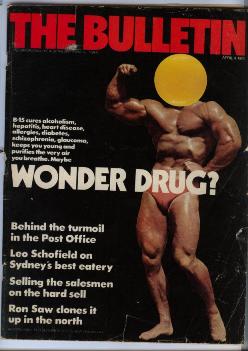
Strange memories of 1978

I just spent a delightful hour looking through a copy of The Bulletin dated 4 July 1978. More than any book or film can, it gave me a snapshot of the world three years before I was born. I find the familiarity and unfamiliarity of the bearded, big haired strangely coloured photographs and articles and advertisements fascinating.

Cassettes are a running theme. Siemens offers a free cassette explaining the benefits of their PABX telephone system – ‘Get your secretary to mail the coupon now’. Send off for the Len Evans Home Wine Tasting Pack and you receive a FREE How-To Wine Guide Cassette. At a sales conference Zig Ziglar (whose signed book I weeded from a library once) proclaims that if you don’t feed your mind with a cassette player, you’re losing $25 000 a year. (I think of The Assassination of Richard Nixon, set in the same decade, the main character obsessively listening to positive thinking cassettes.)

At the same conference, an aging Norman Vincent Peale, author of The Power of Positive Thinking spoke. He’s dead now, of course. ‘There’s no problems in cemeteries,’ he told the conference. ‘Problems are a sign of life.’

There are ads for Asbestos Cement Pipelines at Port Waratah – ‘helping keep coal dust firmly in its place’. Dunhill on the inside cover – ‘Internationally acknowledged to be the finest cigarette in the world’. Craven Mild on the back cover, a golfer swinging – ‘mild as can be… yet they satisfy’.

There’s an article on the demise of the Democratic Labor Party, a strange footnote to the Cold War years, their existence finally sputtering out with Nixon’s detente with the Soviets and the rise of an exciting new party, the Democrats. I say a footnote, and yet they kept Labor out of power for a couple of decades, terrified as they were of the Communist menace. And now no Democrats either.

An article about Alan Bond selling his share in the Yanchep Sun City project to Japanese investors. I didn’t even know this story from my own city, of Bond (that ubiquitous presence in the news bulletins of my childhood in the late eighties) buying up hectares of land and creating the Yanchep suburb sixty kilometres north of Perth. Back then, WA feared being taken over by the Japanese (if not the Communists); both fears have passed away now, only to be replaced.

The gossip page is instructive, the names now a little faded – the release of ‘aging film star’ Joan Collins’ embarrassingly naked memories; a revisiting of Frank Sinatra’s visit to Australia a few years’ previously when he got on the wrong side of union boss Bob Hawke; actor Hayley Mills’ divorce (was she in Parent Trap or something? I think my mum used to talk about her) and also that of Sylvester Stallone, the one celebrity on the page who has kept his place. In another thirty years?

And then there’s an interview by distinguished British novelist V.S. Pritchett of his colleague Graham Greene, both of them reflecting on life in their seventies. I get so sad about people getting old and dying. Greene was just publishing his twentieth novel, one of his best to my eyes, The Human Factor. He published at least one more novel before dying thirteen years later in 1991. Pritchett was to live on another nineteen years, to the glorious age of ninety-seven, well into the period of my own consciousness. But I was an ignorant sixteen year old. I don’t remember him dying. He didn’t publish any books in those nearly two decades, though.

And as of this year, of course, The Bulletin, that given fact of Australian media, is no longer published.