May Holman

Both Bill and Lisa have written helpful reviews of a new biography, The Magnificent Life of Miss May Holman, Australia’s First Female Labor Parliamentarian by Lekkie Hopkins. Both reviews touch on the two concerns of this blog brought up by the biography – Katharine Susannah Prichard and the art of biography. I look forward to seeing how Hopkins has treated the conjectural relationship between Prichard and Holman, a WA Labor parliamentarian. I can’t offer an especially informed opinion on whether they would have known each other – my current biography stops at 1919 just before Prichard arrives in WA! The 1920s and 1930s are the most “silent” period of Prichard’s life for biographers. The weekly letters to her son Ric (covering 1944-1969) have not yet started; and Prichard’s own account of her early life in Child of the Hurricane basically stops at 1919, with a chapter postscript about the 1920s to 1930s written at the editor’s request (I discovered in the archives) and focused on her horse, when the rest of life was too painful to examine. I feel honoured to be quoted by both Bill and Lisa on what makes for good biography from one of my recent posts. As they mention, I wasn’t referring to the Holman biography when I made that observation; I’m yet to read it.


wadholloway's avatarThe Australian Legend

WP_20151227_001

A review of The Magnificent Life of Miss May Holman, Australia’s First Female Labor Parliamentarian by Lekkie Hopkins.

Mary Alice (May) Holman was born in 1893 in Broken Hill, NSW to miner and unionist Jack Holman and his (very) new wife, the 17 yo Katherine. Jack had problems in Broken Hill as the mining companies attempted, successfully, to reduce workers’ pay and conditions during the recession, and moved to the goldfields around Cue in Western Australia, settling at Nannine – a thriving centre then, but these days not even a ghost town – where he was joined by his wife and daughter a couple of years later. Katherine returned to Broken Hill for the birth of their second daughter and when she came back her mother came too and lived with the family for the rest of her life.

Hopkins has Katherine travelling by coach between Nannine and Yalgoo (southwest…

View original post 1,151 more words

Wrap-up of a year’s reading in biography

Tags

,

I wanted to read as much of a particular kind of literary biography as possible – heavily researched but gripping narratives of writers who have been in their graves a while. But I found myself reading well outside the boundaries I’d set myself, gravitating also to memoirs and hybrid life-writing which mixes biography and fiction. I don’t regret these digressions; even as an advocate and practitioner of that certain kind of literary biography, my diet must be more varied. Continue reading

My fiction top 5 for 2015

Tags

, ,


1. The Illumination / Kevin Brockmeier (USA, 2011)

Andrew Hagan’s novel The Illuminations received a lot of attention this year; I haven’t read it even though my Kindle believes I should, but I did read Kevin Brockmeier’s very similarly titled novel from a few years ago. It’s set tomorrow when everyone’s pain suddenly becomes illuminated, and follows a number of interweaving stories. It shows the potential for speculative fiction to explore the meaning of life and it’s a beautifully strange story. My review

2. Crow’s Breath / John Kinsella (Australia, 2015)

John Kinsella’s short, intense stories are haunted and haunting. My review

3. The Privileges / Jonathan Dee (USA, 2010)

My favourite Jonathan Franzen novel of the year was by Jonathan Dee; it manages to be smart and funny and affecting all at once in chronicling the American rich.

4. Purity / Jonathan Franzen (USA, 2015)

Jonathan Franzen’s actual new novel was not far behind – I called it an  “engrossing and ambitious novel about idealism and marriage.” My review

5. The Book of Strange New Things / Michael Faber (Britain, 2014)

Perhaps this book has to make the top five because I’m still so unsure of what to make of it. A strange novel of religion, marriage and aliens. My review

I read as much non-fiction (mainly life writing) as fiction this year, and I’ll be posting my favourites on my other blog, A Biographer in Perth. What was your favourite work of fiction this year?

Hugo Throssell and Katharine Susannah Prichard in the shadow of the Great War

Tags

,

A speech for “Katharine’s Birthday,” Katharine Susannah Prichard Writers’ Centre, Sunday 6 December 2015

In London a hundred years ago Katharine Susannah Prichard met Hugo Throssell in the shadow of World War I. The war brought them together and cost them both so dearly. The Great War radicalised them, leading them to reject militarism and the system which had caused such a disaster. Continue reading

Link: The best biographies of 2015 | Books | The Guardian

The Guardian has a fine trans-Atlantic review of the year’s best biographies, capturing some of the diversity of life-writing in 2015. Not an Australian in sight, but I suppose that’s understandable given the limits of how much one poor reviewer can read in a year. The Young Eliot is on my shortlist to read; T.S. Eliot and Prichard do not overlap in any significant way but are contemporaries and I also want to do some more thinking about the partial biography that tells only of a subject’s early life.

Enthralling Eliot, spellbinding Thatcher and Le Carré unmasked

Source: The best biographies of 2015 | Books | The Guardian

Happy 132nd birthday, Katharine Susannah

KSP-window-from-100-years-of-Bridges

Dear Katharine,

I think of you every day, of course, but I’m especially thinking of you today, on your 132nd birthday. It’s not as if I can imagine you at 132, it’s a decade beyond the reach of the greatest super-centenarian, so instead, I’m remembering your 32nd birthday one hundred years ago on 4 December 1915.

You were in Ceylon, on your way home from London after four years. You spent a some time with your pregnant sister, Beatrice Bridge, and her conservative husband, Patten. You’d missed their wedding the year before – I’m not sure how much that mattered to you. How did you celebrate your birthday that year? Sri Lankan food perhaps, though you wouldn’t have called it that. It was during this stay you visited the Buddhist temple you describe in Child of the Hurricane, and came as close to a spiritual experience as you ever would.

This photo is from much later, but has a connection to your birthday in 1915. It accompanied an article I found this week about your family’s long friendship with the Bridges, culminating in Bea marrying Pack. I had such high hopes for some new information, but it only repeated everything you said, somewhat unreliably, in Child of the Hurricane. It did have this photograph though, one I’ve never seen before and particularly like. You’re looking out of your writing cabin some time in the 1930s; I spent some glorious days in that cabin at the KSP Writers’ Centre earlier this year.

You had no idea what was about to hit you the year you were thirty-two, the year I’m immersed in right now. It was a big year, a year of such immense heartache for you. But there were many years like that. You survived it, like you survived every year but your last. It’s not like I can actually warn you, but please know I’ve seen, as much as anyone can from this distance, and I care.

Until next time, N.

Katharine and Hugo in the shadow of the Great War: speech on Sunday

Tags

, , ,

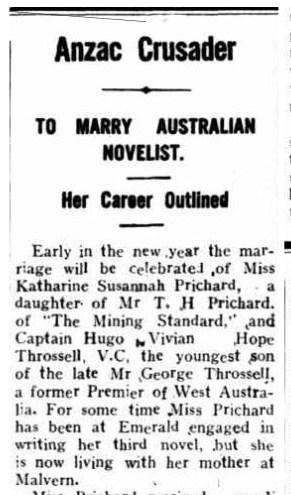
Anzac Crusader to marry Australian novelist

It’s a hundred years ago on Friday since King George V decorated Katharine Susannah Prichard’s future husband, Hugo Throssell, with a Victoria Cross, Western Australia’s first. To mark the occasion, I’ve been asked to give a speech at Katharine’s Birthday, the annual end-of-year celebration at the Katharine Susannah Prichard Writers’ Centre, alongside Chris Horvath, a specialist on the 10th Light Horse. It’s an interesting assignment for a pacifist like me. Continue reading

The childhood of Katharine Susannah Prichard in the new Westerly

I first sent a submission to Westerly last century. It was 1999, and it was a poem about leaving home to move to Perth for uni. It came back rejected with a single word circled – I’d used “obstinately” instead of “ostensibly”. I felt a little mortified. There’s no room for getting a word wrong in poetry. (It wasn’t the only reason for its rejection, I’m sure.) Since then, I’ve racked up a couple more rejections – I think two short stories, one of which nearly made it. And now sixteen years later in a third genre – that of the biographical essay – I have finally appeared in the pages of Westerly. It’s the story of Katharine Susannah Prichard’s childhood, and it’s adapted from chapter two of my PhD. I’ve written about it over on my biographer blog.

Nathan Hobby's avatarA Biographer in Perth

Source: Westerly 60:2 – Westerly

My biography of the early years of Katharine Susannah Prichard is a couple of years from completion, but a modified version of chapter two has just been published in Westerly 60.2. My essay is called “‘The memory of a storm’: The Wild Oats of Han and the childhood of Katharine Susannah Prichard, 1887 to 1895.”

View original post 689 more words

Second Half First by Drusilla Modjeska

Tags

,

modjeska

Before I started reading Drusilla Modjeska’s Second Half First, my father-in-law asked me what it was about, and I couldn’t give a good answer about what I expected. Modjeska herself has some trouble with this when she meets her old lover late in the book and explains it isn’t just about him, even though he’d triggered it, “It’s about a whole lot of other things, my mother, psychoanalysis, reading, writing, New Guinea, living away from where I was born.” (332) It’s a digressive book, rhizomatic, I suppose; tellingly, at one point Modjeska objects to another biographer who has “everything hammered into place.” Continue reading

The childhood of Katharine Susannah Prichard in the new Westerly

Tags

,

Source: Westerly 60:2 – Westerly

My biography of the early years of Katharine Susannah Prichard is a couple of years from completion, but a modified version of chapter two has just been published in Westerly 60.2. My essay is called “‘The memory of a storm’: The Wild Oats of Han and the childhood of Katharine Susannah Prichard, 1887 to 1895.” Continue reading