Link: Following Katharine to Yarram

Source: Katharine Susannah Prichard Writers’ Centre – home | Your KS #9: Following Katharine to Yarram

KSP Writers’ Centre – based in Katharine’s old home in Greenmount – has a great new website, including a blog. I’ve been writing a monthly column for the KSP newsletter, and these columns are now up on the blog. Here’s a link to the most recent one, first appearing in March’s newsletter.

‘The bits that have floated to the surface’: a quote about historical evidence

Tags

,

Toward the end of her biography of Randolph Stow, Suzanne Falkiner offers a beautifully expressed quote from Louis Menand:

How much one can accurately convey of a life lived so much on the interior is debateable. As the American academic Louis Menand has observed, in the matter of historical research (and by extension biography), what has been written about takes on an importance that may be spurious:

A few lines in a memoir, a snatch of recorded conversation, a letter fortuitously preserved, an event noted in a diary: all become luminous with significance – even though they are merely the bits that have floated to the surface. the historian clings to them while somewhere below the huge submerged wreck of the past sinks silently out of sight.

Suzanne Falkiner Mick: A Life of Randolph Stow (UWA Publishing, 2016) 726.

It’s more of a problem for a subject about whom little has survived – Shakespeare as an extreme example, the early Katharine Susannah Prichard as a less extreme example. Yet it subtly affects all biographies. Falkiner’s book would look very different if she her main source wasn’t Stow’s letters to his mother.

Road to Ruin

Tags

, ,

In the textual equivalent of a late-night junk food binge, after baby Thomas woke me when I’d just got to sleep at 10pm, I bought Niki Savva’s Road to Ruin: how Tony Abbott and Peta Credlin destroyed their own government on my Kindle. (I’d resisting doing so for a couple of weeks – I have much more important things to read, like Suzanne Falkiner’s 900 page Stow biography!) I have been ashamedly engrossed in reading about just how dysfunctional the Abbott government was, and Savva’s source-gathering is impressive, but it’s a badly written book. David Marr drew me into polit-lit, and I stupidly assumed that it would tend to be written as well as he writes. Instead, I suspect he’s the high watermark and most of the genre has little literary merit. In this case, the narrative is shambolic, jumping all over the place without the sense of quiet control and ordering the best non-fiction writers show. It’s also repetitive and veers between a journalistic style and chatty, cringing prose. But I grant it had to be written in a hurry and it’s horribly fascinating.

Thirty-three ways of looking at the boglands: Tracy Ryan’s Hoard

Tags

, ,

hoard

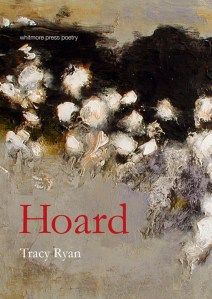
I like poetry collections with a strong thematic unity which hold together as a book. My friend Tracy Ryan’s latest collection Hoard (Whitmore Press, 2015) is a beautiful example, as she examines the Irish boglands and the hoards hiding within from different angles, different times, different voices.

The collection begins with “The changeling addresses Ireland,” a long poem which gives a sense of the patchwork of styles and voices which compose the book as a whole. Thematically, the poem is on a larger scale than the rest of the collection, situating bogs and hoards in the context of the poet as an Australian of Irish descent returning to a place of origin. A century ago, the relationship of Australians to Britain and Ireland was a pressing concern; even if this is no longer the case for most Australians, time has only complicated the dimmed ties:

diverged from your
conflicted history

which even so tries
to persist in me

The perspective in the poems which follow shifts from that of “Hoard hider” to “Hoard finder” to the ‘experience’ of the hoard itself in “Orphaned hoard” – “wrenched out of context / finds itself split and separated”. All these people, all these objects connected across time and consciousness by this landscape. The narrator makes a welcome return, too, providing some sense of the quest through the boglands which are generating these poems in a couple of poems like “Bog conversation”:

I sip from a hot mug big as a chalice
and where we stop is arbitrary
because with bogs we are barely
ever more than scratching the surface

Searching for a comparison point in my limited knowledge of poetry, it’s one of my favourite poems, Auden’s “The Quest”, which comes to mind. The twenty parts of that poem offer a similarly shifting, multi-perspective view of the subject, adding up to a composite narrative that is different – and in certain ways superior – to the more consistent narratives fiction tends to demand. In this multiplicity of ways of looking at the bog and the hoard, the subject begins to turn into a lens for looking at the whole world anew, reimagining things like memory, the passage of time, legacy, belief, identity. It’s this sustained attention to one subject which allows Tracy to drag from it and hide in it so many treasures.

Katharine Susannah Prichard’s The Pioneers, redux part 1

Tags

pioneers-1960s.JPG

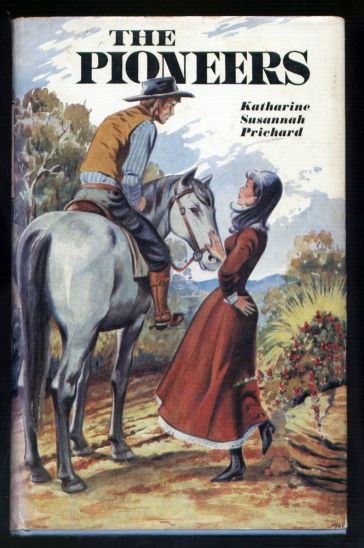
1963 edition of The Pioneers, lightly revised. The comic book style cover is a little unfortunate, but probably captures some of the novel’s spirit.

Two years ago I was trying to decide if Katharine Susannah Prichard was going to be the subject for my biography. I read Ric Throssell’s existing biography first and then John Hamilton’s recent biography of Katharine’s husband, Hugo Throssell. It seemed to me there was room for a new biography, but I needed to know Katharine was a writer I could work on for years. I’d read and loved Coonardoo years earlier, and now I tackled The Pioneers (1915), her first published novel. It was reading it in the arts courtyard at UWA between sessions at the 2014 Perth Writers’ Festival that I decided she really did seem the writer for me. Pioneers is little read today, and yet I found it engaging, an intriguing mix of generational saga and romance set in nineteenth century Australia. It was interesting even in its flaws and cliches, and had moments of beauty and drama.

Two years later, I’ve just finished re-reading it for different reasons. After a flash forward into World War I to prepare a speech, I’m up to 1904 in my biography, the year Katharine spent as a governess in Yarram, South Gippsland, 220km south-east of Melbourne. The tales and landscape of this country inspired her to write the novel nine years later when she was in London. Working out where to fit Pioneers in my story of Katharine’s early life is a challenge. Its writing in 1913 in London reveals much about her development as a novelist and her relationship to Australia, as well as glimpses of her politics and worldview at this time. Its publication and reception in 1915 mark a kind of climax in her story, the point at which she achieves the success she has been chasing since she set out to be a writer as a schoolgirl. (The plots of non-fiction aren’t as neat as fiction – the resolution of  her love life, her radicalisation, and the struggle to write a worthy follow-up to Pioneers form a second climax.) Yet this current 1904 chapter requires some discussion of the origins of Pioneers.

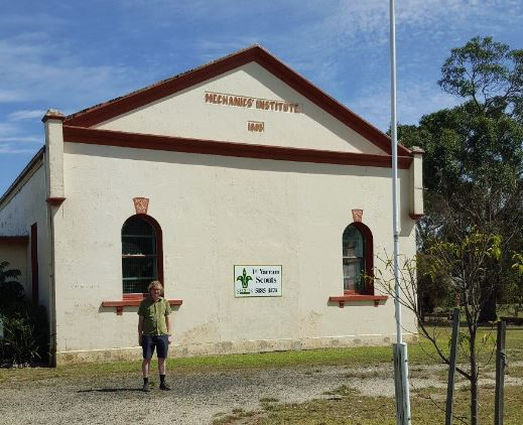
I was in Yarram for two nights last month, staying with Nicole and baby Thomas in a renovated presbytery which dates from the 1890s. It brought my biography alive to imagine Katharine walking past this house on her way to the showground where she was disqualified from the ladies’ trot for racing; or arriving at her first grown up ball, probably held at the Mechanics’ Institute next door to us. I also gained a sense of the land, the hills in the distance, the farm land denuded of trees, the isolation of the town and its nearby settlements, including old Port Albert. (All of this will require its own blog post, another time.)

In the 1960s, Katharine wrote to Len Fox that, “The whole story was woven about stories told to me by pioneers – and an escaped convict – it does not ‘belie its title’, but deals honestly with the pioneering period in South Gippsland from the coast about Tararille, Port Albert and into the hills region.” She complicates any attempt to pinpoint the historical and geographical basis of the novel by renaming all the places, but “Port Southern” is clearly Port Albert, and “Wireeford” is probably Yarram. If the novel is shaped by the contemporaneous conventions of historical fiction it’s only lightly, with some attempt to imagine the pioneering conditions and recount the growth of the area (particularly in an overview in chapter 18). Taking Katharine’s own account of the novel’s origin, it’s more as if she’s shaped the tales of the area she heard to fit the conventions of the romance and the generational saga, the genres she was actually writing within.  (The point of comparison in her oeuvre is her late goldfields trilogy, which similarly weaves in the tales and folklore of a place, but does so within a framework of historical events, from a visit by the premier to the impact of the wars and the depression.)

Pioneers is very relevant to her year in Yarram regardless of how I come to understand her later use of it, and I will be writing about it as one of three biographical “origins” of the novel I’m aware of so far – the other two being her viewing of McCubbin’s painting The Pioneer (also completed in 1904 but not exhibited until a few years later) and the November 1902 Pioneers’ reunion of the many descendants of her Prichard grandparents, who’d arrived in Victoria fifty years earlier.

Quote on the task of the historian

Much of this past has vanished from the landscape, and from memory. For Bottoms, one of the chief tasks of the historian is to re-create the texture of lost experience, or, as his great professional exemplar Robert Darnton writes, to “uncover the human condition as it was experienced by our predecessors.”

Nicholas Rothwell, reviewing Cairns by Timothy Bottoms in the Weekend Australian Review, 6 February 2016, 16.

Biography and wisdom: Hermione Lee’s Virginia Woolf #1

Tags

, ,

lee-woolf

It’s rather unfashionable to look to biographies to influence how we live. It’s the sort of impulse behind nineteenth century hagiographies, for one thing. But reading through a friend’s proposal for her work in progress, she spoke about the hope for her biography to be stimulate the reader into thinking about their life choices and what made for a good life. And she was right – biography can and sometimes should do this. I found Hermione Lee’s Virginia Woolf (1996) doing it to me, whether that was Lee’s intention or not. (I finally finished this 920 page tome last week, many months after beginning it.)

Woolf’s seriousness about reading was the most definable thing which comes to mind. “Reading, quite as much as writing, is her life’s pleasure and her life’s work. It is separated from the rest of her activities by its solitude and withdrawal, but she is always comparing it to other forms of behaviour and experience – relationships, walking, travelling, dreaming; desire, memory, illness.” (loc 9223) She lived to read, it meant as much to her as anything. People sometimes joke about how much books mean to me, yet I’m not nearly as serious a reader as Woolf. Reading Lee’s excellent account of Woolf’s reading (she has a thematic chapter on it) provoked me to think about the role of reading in my own life, and gave me permission to allow it to be meaningful without feeling apologetic.

There were many other ways this biography had me thinking about my own life in areas like decisions, friendships, home. Wise biographies can be instructional in a subtle way . I’m sure it’s one of the pleasures of biography, but it bears no resemblance to the didacticism of nineteenth century biography. And this is one of the wisest biographies I’ve read; perhaps I can add “wisdom” to my checklist of requirements of the great biographer. It’s not the most obvious thing to say about this book, but for some reason it’s where I’ll start.

Soundtrack to a year: my favourite songs of 2015

One album will put baby Thomas to sleep: Tiny Ruins’ Brightly Painted One. Itunes says I played the album’s best song, “She’ll Be Coming Around,” seventy times in 2015, but it wasn’t counting all the times it played in the car at 4am in the pre-dawn dark as I looped around the deserted restaurant strip. It’s a soothing indie-folk album, beauty inflected with a wistfulness, never completely sad like so much music I listen to.

It was the year of the Orbweavers too, a quintessentially Melbourne duo (also indie-folk, I suppose), who don’t sing about predictable themes, but instead draw on stories from their city’s history. Their most recent album, Loom, is superb, but my favourite of theirs is probably “On My Way Home,” a catchy and poignant song.

  1. She’ll Be Coming Around – Tiny Ruins (NZ, 2014)
    https://youtu.be/Up0bhJzi0iU
  2. On My Way Home – Orbweavers (Aust, 2009)
    https://youtu.be/ZycntAtNyWk
  3. Small Plane – Bill Callahan (US, 2013)
    https://youtu.be/Mh5km2xKlfk
  4. Gypsy Candle – Giant Sand (US, 2015)
    https://youtu.be/z3j522N_NNY
  5. My Least Favourite Life – Lera Lynn (US, 2015)
    the best thing about True Detective season 2.
  6. Got You Well – Gabrielle Papillion (Canada, 2015)
    https://www.youtube.com/watch?v=Wr1-SKuNXyg
  7. Vacancy – Aisha Badru (US, 2015) – can you imagine if Sarah Blasko and Lisa Mitchell were the same person?
  8. Confession – Lotte Kestner (US, 2013)
    There’s a beautiful weariness to this song. “Sometimes the moment gets it right / I like the things you say when you drink”
    https://youtu.be/ZyihspIK57A
  9. Black Notebook – Ane Brun (Norway, 2015)
  10. If I Could Tell You – Nev Cottee (Britain, 2015)

Film and television – my favourites in 2015

Our firstborn, Thomas, came into the world in July, and, predictably, I have not been to the cinema since then. If I did go, I would probably fall asleep halfway through. But I’ve still seen some fine film and television this year. We signed up for Netflix to watch series 3 of House of Cards (good but not in my favourites list) and stayed with it for its convenience (the equivalent of a dozen paused DVDs at any time) and interesting range. It started with a well-chosen Australian selection, which I used as an education in some classics I’d missed; alas it hasn’t added many Australian titles since. I’ve reviewed a number of my favourite films, but none of the television series, so I’ll offer some comments on them.

Television

  1. Fargo, season 2 (US/Canada, 2015; SBS) – each episode is a near-perfect short feature film. The crime trappings are just a mode of investigating existence. It’s intelligent, funny, absurd, sometimes brutal. And if you haven’t seen season 1, it stands on its own. But watch season 1.
  2. Black Mirror (Brit, 2011-2013; Netflix) – these short films are extrapolations of our current culture, a couple of years into the future, and offer the most extraordinary critique of our lives today. It’s science fiction at its best.
  3. Toast of London, season 1 (Brit, 2013; SBS) – I cannot convey how bizarre this show is as it follows Steven Toast, the world’s second finest high-winds actor, around his improbable career on stage and film. To give one taste: his arch-enemy exacts revenge on Toast by pretending to be a plastic surgeon and turning a friend of a friend into a Bruce Forsyth look-alike, just to annoy Toast. And you know what he finds funny? He’s not even very annoyed. This will be a cult hit for decades to come but season 2 is not as good.
  4. The Americans, season 2 (US, 2014; DVD) – this is a small masterpiece of the drama and thriller genres, as deep undercover Soviet agents live out their suburban lives in the US of the early 1980s.
  5. Utopia, season 2 (Australia, 2015; ABC) – this satire is so perceptive about how offices function and the groupthink / buzz-words / box ticking which drives too much decision-making in the public service and politics.


Film

  1. Walkabout (Australia, 1971; Netflix)
  2. Wake in Fright (Australia, 1971; Netflix)
  3. Deep Water (Australia, 2012; ABC)
  4. Compliance (US, 2012; SBS)
  5. The Imitation Game (Brit, 2014; cinema)
  6. Far from the Madding Crowd (Brit, 2015; cinema)
  7. Wild (US, 2014; cinema)
  8. Foxcatcher (US, 2015; cinema)