• About
  • The Red Witch: A Biography of Katharine Susannah Prichard
  • My novel: The Fur

Nathan Hobby, a biographer in Perth

~ The lives of John Curtin & Katharine Susannah Prichard, the art of biography, and other things

Nathan Hobby, a biographer in Perth

Category Archives: Series: Thursday 3pm feature posts (2009)

[Thursday 3pm #5] Message in a bottle : a letter found in The Unbearable Lightness of Being

30 Thursday Apr 2009

Posted by Nathan Hobby in found objects, life, Series: Thursday 3pm feature posts (2009)

≈ 7 Comments

Tags

love letter, Simpsons

foundletter

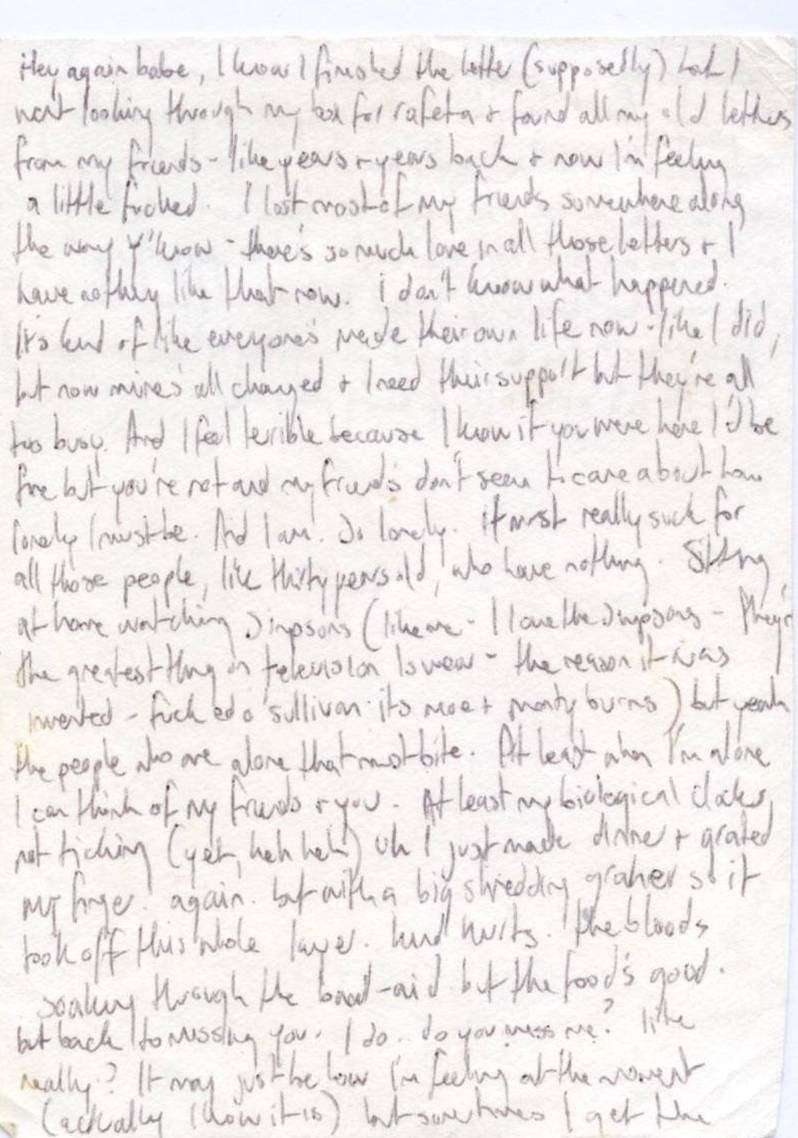
In 2002, when I borrowed Milan Kundera’s The Unbearable Lightness of Being from Murdoch University library (it is in South Wing Level 2, if you wish to borrow it yourself) there was a beautiful postscript to a letter tucked between the pages midway through.

It is unfinished; instead of sending it, the writer cast it out into the world, like a message in a bottle. She thought the next reader of Unbearable Lightness would be the appropriate reader, as I hope the readers of this blog are appropriate readers too. It is written on a postcard size piece of white card in black pen printing, small and crowded. This is what it says.

[front]
Hey again babe, I know I finished the letter (supposedly) but I went looking through my box for rafeta & found all my old letters from my friends – like years + years back & now I’m feeling a little fucked. I lost most of my friends somewhere along the way y’know – there’s so much love in all those letters +I have nothing like that now. I don’t know what happened. It’s kind of like everyone’s made their own life now – like I did, but now mine’s all changed + I need their support but they’re all too busy. And I feel terrible because I know if you were here I’d be fine but you’re not and my friends don’t seem to care about how
lonely I must be. And I am. So lonely. It must really suck for all those people, like thirty years old, who have nothing. Sitting at home watching the Simpsons (like me – I love the Simpsons – they’re the greatest television show I swear – the reason it was invented – fuck ed o’ sullivan its moe + monty burns) but yeah the people who are alone that must bite. At least when I’m alone I can think of my friends & you. At least my biological clocks not ticking (yet, heh heh) oh I just made dinner + grated my finger. again. but with a big shredding grater so it took of this whole layer. And hurts. the bloods soaking through the band-aid but the food’s good.
but back to missing you. I do.. do you miss me? like really? It may just be how I’m feeling at the moment
(actually I know it is) but sometimes I get the

[back]
feeling you don’t really. or not as much as I want you to. anyway. Am I being foolish trying to push on you something that doesn’t exist? not really anyway. I’ve no doubt you want to love, to love and be loved, you seem so much like you want to be in a long type relationship but do you with me? like honestly? honestly. I need to know. I feel like I’m just reaping the benefits of you wanting to have someone. I fit the bill after all. of being someone.

Why didn’t she finish the postscript? Why didn’t she give it? Did she start again and give him another? What did the first letter say? What’s changed in her life? Is her lover far away?

It starts off calmly. Sadly, but thoughtfully – I think she was writing it slowly. Yet with my knowledge of what is to come, I picture her straining to avoid mentioning the doubts and fears and hurts about her lover that are actually at the forefront of her mind. The first seventeen lines (until the ‘do you miss me?’) scream about what they do not say, rather than what they do say.

Yet from then she drops the pretense. (I’m saying this because this is what I’ve known in my own life – the unexpected phonecall which tries to be polite, which insists it’s about nothing in particular, and then suddenly explodes at some flashpoint; the brooding silence insisting it is not brooding which suddenly turns to accusation; I have done these things and had them done to me.) What had not been said is now said!

And then at this climax, at this point of intensity – it ends! What a poignant line – ‘I fit the bill after all. of being someone.’

I hope, all these years later, you’ve found the right person. I hope you still watch the Simpsons. I’m glad you left the letter in the book. It’s the most interesting thing I’ve ever found, a window into a stranger’s heart.
[Thursday 3pm #4] The tragedy of Robert Wadlow, world’s tallest man?

23 Thursday Apr 2009

Posted by Nathan Hobby in history, Series: Thursday 3pm feature posts (2009)

≈ 7 Comments

Tags

Guinness World Records, Robert Wadlow

robertwadlow1For my eighth birthday, my uncle gave me a discarded library copy of the 1983 Guinness Book of Records. It became one of my favourite books. To my child mind, conditioned by test scores and sports statistics, it told the whole story of the world, of everything important.

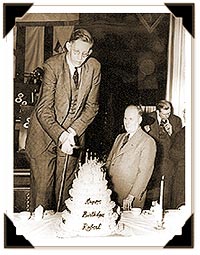
One of the few records I remember vividly was that of the world’s tallest man, Robert Wadlow. The book featured a photograph of a plastic model of him, with Britian’s tallest living man and a man of average height standing next to it. At 8 foot 11 inches or 282 cm (and of course I memorised this measurement) he stood over a metre taller than a typical man.

He seemed a figure from the distant past, with nothing more to be known of him than his height, his date of birth in 1918 and his death at age 22. Twenty-two sounded quite old to me at eight. I wished I was the world’s tallest man and found my way into the Guinness Book of Records. Now, 22 sounds so young and I realise that he was born the year after my grandfather. And I would hate to be the world’s tallest man.

Last week I saw Robert Wadlow mentioned in passing and I went looking for him on the internet. I discovered there was so much to his story.

He was born in small town America – Alton, Illinois – and it seems the town has never got over its only claim on world attention. Today a bronze statue, life-size, of Robert is found at a local university, as well an exhibition at the museum.

Robert was normal height when he was born, but started growing rapidly in the first few months of his life because of an over-active pituitary gland. He attracted attention in newsreels as the world’s tallest boy scout; but he tried to be a normal American boy, collecting stamps and joining the Freemason youth club (presumably this what one did in small town America).

One source says he was happy at high-school and lived semi-normally, but when he got to college, people were not so understanding, and he returned home after one semester.

Accounts of his life on the internet and contemporaneous media have the glow of one-dimensional quirky human interest stories. He was called the ‘gentle giant’ and the photos show him smiling. Yet the suggestion of tragedy lies beneath the facts of his life. On imdb.com, a user-contributed biography (offering no sources and complete with many spelling errors, but having a certain passionate appeal) insists he lived a miserable life:

A tragic figure who hated his size and his life. He was forced into the role of a first-class freak by his father, who paraded him around the country in a specialized Ford Model T (it had the front passenger seat removed, and Robert sat in the back.) His father quit his job as worker at an oil company to devote himself to Robert and his career. In all, Robert made 747 personal appearances around the country, appearing at everything from store grand openings to Ringling Brothers/Barnum&Bailey Circus. He was born of normal size, but early in his life he developed a problem with his pituitary gland, and by age 9, he was 6 feet tall. He lived in a racist time in America, growing up in lilly white Alton, IL. He listened to the radio a lot and followed the rise of Hitler. He was fascinated by Germany enough to switch his foreign language class in high school from Latin to German. He was experimented on for many years at Washington University in St. Louis by a doctor who was from Germany. Robert would always insist on the doctor sharing stories of his homeland. His intelligence was limited. He graduated from high school, but dropped out of college after one semester. That is when he began his career. In his first job he promoted a shoe company, which supplied him with his size 37 shoe. For most of his life he was the center of attention. He made the newsreels anually on his birthday. The Alton Telegraph, the local newspaper, often followed his life. In July 1940, in Manistee, Michagan, Robert was being paid to appear in a 4th of July parade. The tempature was sweltering and the humidity unbearable. His father wrote a book along with a ghost writer in 1945 about Robert. It was a PR puff piece which glowed with anecdotes about what a great father Robert had. But, great father, or not, Robert had an infection on his left ankle which was left untreated, and on that hot summer day, the tallest man who ever lived finished his 4 hour appearance in the parade (he rode in the back of a truck,) and when he got back to the hotel room, he collapsed, and a doctor was summoned. He lingered in the hotel room for 3 days before he died. Two beds had to be placed end to end to accomodate him. In Alton, it was reported that 30,000 people attended his funeral. Remarkable only for his size, Robert Pershing Wadlow died an unfulfilled soul.

If nothing else, the imdb.com account is a fascinating embellishment of Wadlow’s life. I can’t find any other reference to the Nazi flirtations or the experiments. The official account agrees that he did spend the last years of his life promoting shoes. The circumstances of his death are also relatively uncontested. But most accounts stress how his parents did everything they could to prevent him becoming a freak. They sued a newspaper that described him as a ‘freak’; they destroyed all his belongings upon his death (the museum claims ‘We want to continue to honor their wishes, and are displaying what items we have in our museum with pride and dignity’) and they filled his grave with concrete to prevent his body being excavated for medical experiments. I keep thinking of his body lying under all that concrete.

The only book that seems to have been published about him besides the ‘PR puff-piece’ is an Alton published one from 2003 called ‘Boy Giant’. I think his story is worth exploring in a novel. And a film.

An interesting post on Robert can be found here. A short documentary can be found here.

[Thursday 3pm #3] ‘I don’t believe in God but I miss him’ : Julian Barnes’s Nothing to be frightened of

16 Thursday Apr 2009

Posted by Nathan Hobby in book review, death, Series: Thursday 3pm feature posts (2009)

≈ 6 Comments

Tags

death, Julian Barnes

Nothing to be frightened of / Julian Barnes (2008)

I couldn’t put this memoir down. I didn’t mean to read it all but I couldn’t help it. I could discern no structure at all, but just followed Barnes for two hundred pages of reflections on death and God through the lens of his family. The whole memoir has the sort of wistfulness of the opening line quoted in the title of this post: ‘I don’t believe in God but I miss him.’

Despite the constant humour, it is a frightening book to read. I have never thought through so fully the consequences of not believing in life after death. Even in my moments of strongest doubts about Christianity, I haven’t sustained the outlook that death means the permanent extinguishment of my consciousness. No wonder he’s even more scared of death than me. I think it’s immensely brave of atheists and agnostics to live with hope, meaning and purpose. I don’t know how I would. (Indeed, at times Barnes seems to be suggesting that he has to suspend thinking about the way things actually are in order to live with meaning.)

The title is even cleverer than it sounds; it’s nothingness, extinction that he’s frightened of.

He mentions his wife only once, yet about the time the book was published, she died. I wonder if he wrote with a knowledge that she was dying. If he did, he is a remarkably disciplined writer, probably marshalling all the insights his wife’s dying brought him, but recasting them to protect her privacy. The amazing achievement of the memoir that seems to tell all, that so casually reveals so much about his mother, father, brother, self – and yet keeps hidden bigger parts of his life that he didn’t want to or couldn’t tell us about.

Perhaps my favourite passages were the ones reflecting on the art of writing from the perspective of not only our own deaths but the ultimate forgetting of our work. Every work, he tells us, must have a final reader:

For writers, the process of being forgotten isn’t clear-cut. ‘Is it better for a writer to die before he is forgotten, or to be forgotten before he dies?’ But ‘forgotten’ here is only a comparative term, meaning: fall out of fashion, be used up, seen through, superseded, judged too superficial – or, for that matter, too ponderous, too serious – for a later age. But truly forgotten, now that’s much more interesting. First, you fall out of print, consigned to the recesses of the secondhand bookshop and dealer’s website. Then a brief revival, if you’re lucky, with a title or two reprinted; then another fall, and a period when a few graduate students, pushed for a thesis topic, will wearily turn your pages and wonder why you wrote so much. Eventually, the publishing houses forget, academic interest recedes, society changes, and humanity evolves a little further, as evolution carries out its purposeless purpose of rendering us all the equivalent of bacteria and amoebae. This is inevitable. And at some point – it must logically happen – a writer will have a last reader. I am not asking for sympathy; this aspect of a wrtier’s living and dying is a given. At some point between now and the six-billion-years-away death of the planet, every writer will have his or her last reader. (225)

Barnes then addresses his last reader, at first thanking them but then realising that by definition this last reader has not passed on his work to anyone else, and so cursing them. A sobering thought. This reasonably insignificant post, my one book, this entire blog, everything I have ever written will have a last reader. Is it you?


[Thursday 3pm #2] The marathon is on: reading War and Peace

09 Thursday Apr 2009

Posted by Nathan Hobby in books, reading, Series: Thursday 3pm feature posts (2009)

≈ 4 Comments

Tags

Tolstoy, War and Peace

I wasn’t going to tell you about this, because I was afraid you might hold me to it. I think I harboured secret intentions to give up a few hundred pages in. I don’t have a very good record with Big Books. I only made it halfway through Les Miserables, even though I thought it was wonderful. Last time I attempted War and Peace three years ago, my bookmark only made it to page 208.

I don’t even know why I impulsively decided to start last week. I was actually suffering the dreaded False Start disease in my reading: pulling books off my shelf, reading a few chapters and then having no desire to go on. Five books are still sitting discarded by my bed. And so what was my answer to this disease? An incredibly stupid one: pull out the biggest book on my shelf, so big it’s in two volumes. Fourteen hundred pages in total. I’m up to page 142.

If I’m going to finish War and Peace I’m going to have to train my mind. The marathon book requires that I keep my mind immersed in the moment, in the experience. As soon as I start calculating how many pages I’ve got left, I’m a goner, I may as well pull out.

Reading in general and the marathon book in particular require that I don’t treat the book like a marathon. Or a mountain. If the book’s a notch to add to my belt, an achievement to brag about, I’m reading it for the wrong reason.

This is what concerns me: how much of War and Peace am I going to remember? Am I going to carry some remnant, some impression of it in my head for the rest of my days? Or is too huge to leave a trace? Will it be like trying to hold a whole world in my head? Because I only read Anna Karenina six years ago, and all I can remember of that is that she throws herself under a train at the end. (Sorry to spoil it, if you’ve just invested months of your life getting near to that point.) Was reading it a waste, then?

Well, not entirely. Most of the point is in the journey itself, the experience of reading it. It would be wonderful to retain more of the book itself, but I’ll have to face the fact that I may not.

(Which brings to mind another possible approach to reading: I might start re-reading a lot more until more novels have lodged themselves in my mind, until I have absorbed their structure, their feel, their characters. Because the few novels I have read over and over again – the Tripods, The Collector, The Catcher in the Rye, Moon Palace – are the most rewarding, are the ones I can intepret life through. I have this hunch that it would be far better to know a handful of books intimately than to whiz through a hundred in a year. What do you think?)

I’ll finish with Percy Lubbock’s beautiful description of the attempt of the reader to hold the whole book in his or her mind:

To grasp the shadowy and fantasmal form of a book, to hold it fast, to turn it over and survey it at leisure – that is the effort of a critic of books and it is perpetually defeated. Nothing, no power, will keep a book steady and motionless before us, so that we may have time to examine its shape and design. As quickly as we read, it melts and shifts in the memory; even at the moment when the last page is turned, a great part of the book, its finer detail, is already vague and doubtful. A little later, after a few days or months, how much is really left of it? A cluster of impressions, some clear points emerging from a mist of uncertainty, this is all we can hope to possess, generally speaking, in the name of a book. The experience of reading it has left something behind, and these relics we call by the book’s name; but how can they be considered to give us the material for judging and appraising the book?

– The Craft of Fiction, p. 1

[Thursday 3pm #1] The tide of books

02 Thursday Apr 2009

Posted by Nathan Hobby in books, news, Series: Thursday 3pm feature posts (2009)

≈ 4 Comments

Tags

secondhand books

Saturday is the annual booksale for the seminary where I work. So this post starts out as an ad to try to get you along, but will turn into a reflection on books.

First the ad: 20 000 books on every subject, from 9am to 2pm at Vose Seminary, 20 Hayman Rd, Bentley, Western Australia. If you miss out on the big day, come along during business hours Monday to Friday until the 24 April and we’ll be selling the left overs.

Now the reflection. Working as a librarian and helping on the booksale, books, paradoxically, begin to lose their value. When boxes and boxes of books are donated every week, their physicality begins to get overwhelming. They become bulky, heavy objects, rather than the miracles of thought and language which they truly are. The physical problem of storing and handling thousands of books risks making me forget the respect I feel for each (or at least many) of those books.

Books were appreciated fully when they were hand copied scrolls, each copy representing hundreds of hours of labour – the production of the book echoed the writing of it. But mass production, the volume of books in the world today, the cheap paperbacks, they make books too common, too easy.

(I don’t actually want to roll back the clock to medieval times. It’s great that people no longer have to be rich to afford books. But this advance does come at a cost. And I am provoking myself and my readers to re-value books, to not let the miracle of books be diluted by their proliferation.)

The other problem is the tide of unworthy books which flood secondhand sales. Most bestsellers are fads, and fads fade, washing up on the shore thousands of copies of books which, now that the hysteria has passed, are recognised to be insubstantial . Alas, no books seem more unworthy than discarded popular Christian fads – anyone for a hundred copies of Left Behind or the Prayer of Jabez? (Secular books aren’t so far behind; imagine how many copies of The Da Vinci Code are already choking op shops around the world.)

I always find myself frustrated at people’s book buying habits: I want to ask people, ‘Why did you jump on that bandwagon? Couldn’t you see how crap that was without buying it? Thousands of years of books and you have to just go for the very latest thing, as if books were newspapers?’

But if people didn’t do this, if people showed what I regard as good taste, I wouldn’t have any reason to fool myself into feeling culturally superior.

I realise I haven’t expressed any of the joy I feel about being surrounded by so many books in my job. I love the quaintness of secondhand books, the moments in time captured just in the covers of even many of the worst books. I was looking at a delightfully camp book called ‘The Adventure of Stamps’ from the 1950s yesterday, with an Enid Blyton style drawing on the cover of three private effeminate school boys engrossed in a stamp album. I love the way old books make me feel like a time traveller, because someone in 1973 or 1904 was handling this precise book, with the same words and, besides some physical deterioration, the same appearance. It’s as if everything in between might not have happened.

Newer posts →

Enter your email address to follow this blog and receive notifications of new posts by email.

Join 287 other subscribers

Nathan on Twitter

My Tweets

Categories

  • academic (9)
  • archives and sources (10)
  • autobiographical (62)
  • biographers (10)
  • biographical method (28)
  • biographical quests (18)
  • biographies (21)
    • political biography (2)
  • biographies of living subjects (2)
  • biographies of writers, artists & musicians (12)
  • biographies of writers, artists and musicians (20)
  • biography as a literary form (9)
  • biography in fiction (2)
  • biography in the news (2)
  • books (236)
    • authors (19)
    • book review (173)
    • reading (23)
  • Covid (2)
  • creative nonfiction (11)
  • daily life (2)
  • Daily Prompt (2)
  • death (21)
  • digital humanities (3)
  • family history (1)
  • fiction (8)
  • film and television biographies (5)
  • film review (48)
  • found objects (3)
  • historical biographies (1)
  • history (20)
  • In the steps of KSP (4)
  • John Curtin (12)
  • Katharine Susannah Prichard (114)
    • Glimpses of KSP (7)
    • My KSP biography (31)
      • deleted scenes (1)
  • Katharine Susannah Prichard's associates and connections (16)
  • Katharine Susannah Prichard's writings (34)
  • libraries (5)
  • life (20)
  • link (23)
  • links (41)
  • lists (28)
  • local history and heritage (1)
  • media (4)
  • memes and urban myths (1)
  • memoirs (10)
  • meta (2)
  • music (18)
  • news (9)
  • news and events (43)
  • obituary (1)
  • Old writing found on a floppy disk (1)
  • poetry (5)
  • politics and current affairs (26)
    • climate change (1)
  • prologues and introductions (2)
  • psychological aspects of biography (3)
  • quotes (22)
  • R.I.P. (10)
  • reading report (3)
  • religion (1)
  • religious biography (1)
  • research (5)
  • role of the biographer within the biography (2)
  • Series: A-Z of Katharine Susannah Prichard (26)
  • Series: Corona Diary (1)
  • Series: Saturday 10am (14)
  • Series: Short Stories (2016) (6)
  • Series: The Tourist (2013) (6)
  • Series: Thursday 3pm feature posts (2009) (35)
  • structure of biographies (3)
  • technology and the digital world (2)
  • television (4)
  • the nature of biography (4)
  • this blog (10)
  • Uncategorized (33)
  • Western Australia (26)
  • writing (41)

Archives

Recent Comments

Nathan Hobby's avatarNathan Hobby on Katharine’s birthday tou…
Nathan Hobby's avatarNathan Hobby on Review – The Good Fight:…
Nathan Hobby's avatarNathan Hobby on Katharine’s birthday tou…
David J. Gilchrist's avatarDavid J. Gilchrist on Katharine’s birthday tou…

Bookmarks

  • Adventures in Biography
  • ANZ LitLovers LitBlog
  • Bernice Barry
  • It only goes up to your knees
  • Jane Bryony Rawson
  • Jenn Plays Recorder
  • Katharine Susannah Prichard Writers' Centre
  • Laura Sewell Matter: Essayist and Biographer
  • Mutually said: Poets Vegan Anarchist Pacifist
  • Resident Judge
  • Speaking Thylacine
  • The Australian Legend
  • Timothy Parkin Poetry
  • Treefall Writing – Melinda Tognini
  • Whispering Gums
  • Wrapped up in books: the home of Guy Salvidge

Top Posts

  • The Little Free Library
  • Liking Tim Winton
  • Red Witch review in the Australian Journal of Biography and History
  • Two years in: an update on my Katharine Susannah Prichard biography
  • '1940 handwritten diary / unknown female / New York'

Blog Stats

  • 208,899 hits

Tag Cloud

9/11 19th century 33 1920s 1921 1930s 1950s 1970s 1971 1981 2000s 2004 2011 2015 2017 20000 Days on Earth A.S. Byatt Aboriginals activism Adam Begley Adrian Mole adultery afterlife Agatha Christie Alan Hollinghurst Alberto Manguel Alfred Deakin Amazing Grace Americana Amy Grant An American Romance Andre Tchaikowsky Andrew McGahan angela myers anne fadiman Anne Rice Arabian Nights archives art arts funding A Serious Man Ash Wednesday ASIO atheism Atonement Australia Australian film Australian literature Australian Short Story Festival autism autobiography autodidact Barbara Vine beach Belle Costa da Greene Bell Jar best best-of Bible Big Issue Bill Callahan biographical ethics biographical quest genre biographies birthday birthdays Black Opal Bleak House Blinky Bill blogging blogs Blue Blades Bodega's Bunch bog Booker book launch booksale Borges Brenda Niall Brian Matthews Brian McLaren Britney Spears Burial Rites Burke and Wills buskers C.S. Lewis C.S. Lewis canon capitalism Carol Shields Carson McCullers Catcher in the Rye Catholicism celebrities Charles Dickens Charlie Kaufman childhood Child of the Hurricane children's books Choir of Gravediggers Christianity Christian writing Christina Stead Christmas Christopher Beha Cinque Terra Claire Tomalin classics cliches climate change Coen brothers coincidence Collie Collyer coming of age Communism concert Condensed Books consumerism Coonardoo Cormac McCarthy Corrections cosy fiction Dara Horn David Copperfield David Ireland David Marr David Suchet death Death of a president definition demolition Dennis LeHane dentist diaries divorce doctorow Doctor Who documentaries donald shriver Don DeLillo Don DeLillo Donna Mazza Donna Tartt Don Watson Dostovesky doubt drama dreams of revolution Drusilla Modjeska E.M. Forster ebooks editing Eichmann Eisenstein Elizabeth Kostova email empathy ensmallification existentialism faith Falling Man fame families fantasy fiction film and television folk football Frank Barscombe Fremantle Press G.K. Chesterton Gabrielle Carey Gallipoli genealogical fiction Genesis Geoff Nicholson George W. Bush Gerald Glaskin Gilead Golden Miles Goldfields Trilogy Graham Greene grandad great novels Greenmount Guinness World Records Guy Salvidge Hannah Arendt Hannah Kent Hans Koning Hans Koningsberger Harper Lee Haxby's Circus Hazel Rowley He-Man headers heaven Heidegger hell Henrietta Lacks Henry Morton Stanley Herman Hesse heroes Hey Dad! historical fiction history Holden Caulfield holidays Homer & Langley Home Song Stories House of Cards House of Zealots house of zealots Hugo Throssell humour Ian McEwan In between the sheets Indonesia Infamous Inside Llewyn Davis interstellar interview Intimate Strangers Invisible Ireland ISBNs Ishiguro itunes J.D. Salinger J.M. Coetzee J.S. Battye Janet Malcolm Jennifer Egan JFK JFK assassination Joanna Rakoff Joel Schumacher John Burbidge John Fowles John Howard John Kinsella John Updike John Updike Jonathan Franzen journal writing JSB Judgment Day Julia Baird Julian Barnes Kafka Kalgoorlie Kate Grenville Katherine Mansfield Kevin Brockmeier King's Park KSP Writers' Centre language last ride Laurie Steed Left Behind Leonard Cohen Leo Tolstoy Libra Library of Babel Library of Babel Lila Lily and Madeleine links Lionel Shriver lionel shriver lists literary fiction literature Lleyton Hewitt lost book Louisa Louisa Lawson Louis Esson louis nowra love letter Lubbock Lytton Strachey Madelaine Dickie Man Booker man in the dark Margaret Atwood Margaret River Press Marilynne Robinson mark sandman meaning of life Melbourne Mel Hall meme memorialisation memory MH17 Michael Faber Mike Riddell Miles Franklin mining boom missionaries moleskine Moon Palace morphine Mother Teresa movies Music of Chance My Brilliant Career names Napoleon Narnia narrative Narrow Road to the Deep North Narziss and Goldmund Natalie Portman Nathaniel Hobbie national anthem Nick Cave Nina Bawden non-fiction nonfiction noughties novelists novels obituaries obscurity On Chesil Beach Parade's End Paris Hilton Passion of the Christ past patriotism Paul Auster Paul de Man Perth Perth Writers Festival Peter Ackroyd Peter Cowan Writers Centre phd Philip K. Dick Philip Seymour Hoffman pierpontmorgan poetry slam politics popular fiction popular science Possession postapocalyptic postmodernism Pride prophetic imagination publications Pulp Purity Queen Victoria Rabbit Angstrom radio Radio National Randolph Stow rating: 5/10 rating: 6/10 rating: 7/10 rating: 8/10 rating: 9/10 rating: 10/10 ratings reading fiction autobiographically reading report Rebecca Skloot recap red wine reincarnation juvenile fiction rejection review - music reviewing rewriting Richard Flanagan Richard Ford Rick Moody Roaring Nineties Robert Banks Robert Hughes Robert Silverberg Robert Wadlow Robinson Crusoe Rolf Harris romance Rome ruins Russell Crowe Ruth Rendell Sarah Murgatroyd scalpers science fiction Science of Sleep secondhand books Secret River sermon illustration sex short stories Silent Woman Simone Lazaroo Simpsons Siri Hustvedt slavery Smashing Pumpkins social interactions social justice some people i hate sources South Australia souvenirs speculation speech speeches sport status anxiety Stephen Lawhead Stranger's Child subtitles Subtle Flame Sue Townsend suicide Surprised By Hope Suzanne Falkiner Sylvia Plath Synecdoche TAG Hungerford Award tapes teabags Ted Hughes The Children Act The Cure The Fur The Imitation Game theology The Pioneers The Revolutionary Thomas Disch Thomas Hardy Thomas Henry Prichard Thomas Mann thriller time Tim La Haye Tim Winton Tolstoy Tom Wright top 10 Towering Inferno Tracy Ryan Trove Truman Capote tshirts TS Spivet Twelve Years a Slave underrated writers Underworld unwritten biographies urban myth USA vampires Venice Victoria Cross Victoriana Victorian era Victorianism Victoria Park video Voltron w Wake in Fright Walkabout Walter M. Miller war War and Peace war on terror Water Diviner Wellington St Bus Station Westerly Western Australia West Wing What Happened to Sophie Wilder? Whitlams wikipedia Wild Oats of Hans William Wilberforce Winston Churchill Witches of Eastwick Working Bullocks workshop World War One writers writing Writing NSW youth Zadie Smith Zeitgeist Zelig

Enter your email address to follow this blog and receive notifications of new posts by email.

Join 287 other subscribers

Pages

  • About
  • My novel: The Fur
  • The Red Witch: A Biography of Katharine Susannah Prichard

Categories

  • academic (9)
  • archives and sources (10)
  • autobiographical (62)
  • biographers (10)
  • biographical method (28)
  • biographical quests (18)
  • biographies (21)
    • political biography (2)
  • biographies of living subjects (2)
  • biographies of writers, artists & musicians (12)
  • biographies of writers, artists and musicians (20)
  • biography as a literary form (9)
  • biography in fiction (2)
  • biography in the news (2)
  • books (236)
    • authors (19)
    • book review (173)
    • reading (23)
  • Covid (2)
  • creative nonfiction (11)
  • daily life (2)
  • Daily Prompt (2)
  • death (21)
  • digital humanities (3)
  • family history (1)
  • fiction (8)
  • film and television biographies (5)
  • film review (48)
  • found objects (3)
  • historical biographies (1)
  • history (20)
  • In the steps of KSP (4)
  • John Curtin (12)
  • Katharine Susannah Prichard (114)
    • Glimpses of KSP (7)
    • My KSP biography (31)
      • deleted scenes (1)
  • Katharine Susannah Prichard's associates and connections (16)
  • Katharine Susannah Prichard's writings (34)
  • libraries (5)
  • life (20)
  • link (23)
  • links (41)
  • lists (28)
  • local history and heritage (1)
  • media (4)
  • memes and urban myths (1)
  • memoirs (10)
  • meta (2)
  • music (18)
  • news (9)
  • news and events (43)
  • obituary (1)
  • Old writing found on a floppy disk (1)
  • poetry (5)
  • politics and current affairs (26)
    • climate change (1)
  • prologues and introductions (2)
  • psychological aspects of biography (3)
  • quotes (22)
  • R.I.P. (10)
  • reading report (3)
  • religion (1)
  • religious biography (1)
  • research (5)
  • role of the biographer within the biography (2)
  • Series: A-Z of Katharine Susannah Prichard (26)
  • Series: Corona Diary (1)
  • Series: Saturday 10am (14)
  • Series: Short Stories (2016) (6)
  • Series: The Tourist (2013) (6)
  • Series: Thursday 3pm feature posts (2009) (35)
  • structure of biographies (3)
  • technology and the digital world (2)
  • television (4)
  • the nature of biography (4)
  • this blog (10)
  • Uncategorized (33)
  • Western Australia (26)
  • writing (41)

Archives

Recent Comments

Nathan Hobby's avatarNathan Hobby on Katharine’s birthday tou…
Nathan Hobby's avatarNathan Hobby on Review – The Good Fight:…
Nathan Hobby's avatarNathan Hobby on Katharine’s birthday tou…
David J. Gilchrist's avatarDavid J. Gilchrist on Katharine’s birthday tou…

Bookmarks

  • Adventures in Biography
  • ANZ LitLovers LitBlog
  • Bernice Barry
  • It only goes up to your knees
  • Jane Bryony Rawson
  • Jenn Plays Recorder
  • Katharine Susannah Prichard Writers' Centre
  • Laura Sewell Matter: Essayist and Biographer
  • Mutually said: Poets Vegan Anarchist Pacifist
  • Resident Judge
  • Speaking Thylacine
  • The Australian Legend
  • Timothy Parkin Poetry
  • Treefall Writing – Melinda Tognini
  • Whispering Gums
  • Wrapped up in books: the home of Guy Salvidge

Top Posts

  • The Little Free Library
  • Liking Tim Winton
  • Red Witch review in the Australian Journal of Biography and History
  • Two years in: an update on my Katharine Susannah Prichard biography
  • '1940 handwritten diary / unknown female / New York'

Blog Stats

  • 208,899 hits

Tag Cloud

9/11 19th century 33 1920s 1921 1930s 1950s 1970s 1971 1981 2000s 2004 2011 2015 2017 20000 Days on Earth A.S. Byatt Aboriginals activism Adam Begley Adrian Mole adultery afterlife Agatha Christie Alan Hollinghurst Alberto Manguel Alfred Deakin Amazing Grace Americana Amy Grant An American Romance Andre Tchaikowsky Andrew McGahan angela myers anne fadiman Anne Rice Arabian Nights archives art arts funding A Serious Man Ash Wednesday ASIO atheism Atonement Australia Australian film Australian literature Australian Short Story Festival autism autobiography autodidact Barbara Vine beach Belle Costa da Greene Bell Jar best best-of Bible Big Issue Bill Callahan biographical ethics biographical quest genre biographies birthday birthdays Black Opal Bleak House Blinky Bill blogging blogs Blue Blades Bodega's Bunch bog Booker book launch booksale Borges Brenda Niall Brian Matthews Brian McLaren Britney Spears Burial Rites Burke and Wills buskers C.S. Lewis C.S. Lewis canon capitalism Carol Shields Carson McCullers Catcher in the Rye Catholicism celebrities Charles Dickens Charlie Kaufman childhood Child of the Hurricane children's books Choir of Gravediggers Christianity Christian writing Christina Stead Christmas Christopher Beha Cinque Terra Claire Tomalin classics cliches climate change Coen brothers coincidence Collie Collyer coming of age Communism concert Condensed Books consumerism Coonardoo Cormac McCarthy Corrections cosy fiction Dara Horn David Copperfield David Ireland David Marr David Suchet death Death of a president definition demolition Dennis LeHane dentist diaries divorce doctorow Doctor Who documentaries donald shriver Don DeLillo Don DeLillo Donna Mazza Donna Tartt Don Watson Dostovesky doubt drama dreams of revolution Drusilla Modjeska E.M. Forster ebooks editing Eichmann Eisenstein Elizabeth Kostova email empathy ensmallification existentialism faith Falling Man fame families fantasy fiction film and television folk football Frank Barscombe Fremantle Press G.K. Chesterton Gabrielle Carey Gallipoli genealogical fiction Genesis Geoff Nicholson George W. Bush Gerald Glaskin Gilead Golden Miles Goldfields Trilogy Graham Greene grandad great novels Greenmount Guinness World Records Guy Salvidge Hannah Arendt Hannah Kent Hans Koning Hans Koningsberger Harper Lee Haxby's Circus Hazel Rowley He-Man headers heaven Heidegger hell Henrietta Lacks Henry Morton Stanley Herman Hesse heroes Hey Dad! historical fiction history Holden Caulfield holidays Homer & Langley Home Song Stories House of Cards House of Zealots house of zealots Hugo Throssell humour Ian McEwan In between the sheets Indonesia Infamous Inside Llewyn Davis interstellar interview Intimate Strangers Invisible Ireland ISBNs Ishiguro itunes J.D. Salinger J.M. Coetzee J.S. Battye Janet Malcolm Jennifer Egan JFK JFK assassination Joanna Rakoff Joel Schumacher John Burbidge John Fowles John Howard John Kinsella John Updike John Updike Jonathan Franzen journal writing JSB Judgment Day Julia Baird Julian Barnes Kafka Kalgoorlie Kate Grenville Katherine Mansfield Kevin Brockmeier King's Park KSP Writers' Centre language last ride Laurie Steed Left Behind Leonard Cohen Leo Tolstoy Libra Library of Babel Library of Babel Lila Lily and Madeleine links Lionel Shriver lionel shriver lists literary fiction literature Lleyton Hewitt lost book Louisa Louisa Lawson Louis Esson louis nowra love letter Lubbock Lytton Strachey Madelaine Dickie Man Booker man in the dark Margaret Atwood Margaret River Press Marilynne Robinson mark sandman meaning of life Melbourne Mel Hall meme memorialisation memory MH17 Michael Faber Mike Riddell Miles Franklin mining boom missionaries moleskine Moon Palace morphine Mother Teresa movies Music of Chance My Brilliant Career names Napoleon Narnia narrative Narrow Road to the Deep North Narziss and Goldmund Natalie Portman Nathaniel Hobbie national anthem Nick Cave Nina Bawden non-fiction nonfiction noughties novelists novels obituaries obscurity On Chesil Beach Parade's End Paris Hilton Passion of the Christ past patriotism Paul Auster Paul de Man Perth Perth Writers Festival Peter Ackroyd Peter Cowan Writers Centre phd Philip K. Dick Philip Seymour Hoffman pierpontmorgan poetry slam politics popular fiction popular science Possession postapocalyptic postmodernism Pride prophetic imagination publications Pulp Purity Queen Victoria Rabbit Angstrom radio Radio National Randolph Stow rating: 5/10 rating: 6/10 rating: 7/10 rating: 8/10 rating: 9/10 rating: 10/10 ratings reading fiction autobiographically reading report Rebecca Skloot recap red wine reincarnation juvenile fiction rejection review - music reviewing rewriting Richard Flanagan Richard Ford Rick Moody Roaring Nineties Robert Banks Robert Hughes Robert Silverberg Robert Wadlow Robinson Crusoe Rolf Harris romance Rome ruins Russell Crowe Ruth Rendell Sarah Murgatroyd scalpers science fiction Science of Sleep secondhand books Secret River sermon illustration sex short stories Silent Woman Simone Lazaroo Simpsons Siri Hustvedt slavery Smashing Pumpkins social interactions social justice some people i hate sources South Australia souvenirs speculation speech speeches sport status anxiety Stephen Lawhead Stranger's Child subtitles Subtle Flame Sue Townsend suicide Surprised By Hope Suzanne Falkiner Sylvia Plath Synecdoche TAG Hungerford Award tapes teabags Ted Hughes The Children Act The Cure The Fur The Imitation Game theology The Pioneers The Revolutionary Thomas Disch Thomas Hardy Thomas Henry Prichard Thomas Mann thriller time Tim La Haye Tim Winton Tolstoy Tom Wright top 10 Towering Inferno Tracy Ryan Trove Truman Capote tshirts TS Spivet Twelve Years a Slave underrated writers Underworld unwritten biographies urban myth USA vampires Venice Victoria Cross Victoriana Victorian era Victorianism Victoria Park video Voltron w Wake in Fright Walkabout Walter M. Miller war War and Peace war on terror Water Diviner Wellington St Bus Station Westerly Western Australia West Wing What Happened to Sophie Wilder? Whitlams wikipedia Wild Oats of Hans William Wilberforce Winston Churchill Witches of Eastwick Working Bullocks workshop World War One writers writing Writing NSW youth Zadie Smith Zeitgeist Zelig

Blog at WordPress.com.

  • Subscribe Subscribed
    • Nathan Hobby, a biographer in Perth
    • Join 287 other subscribers
    • Already have a WordPress.com account? Log in now.
    • Nathan Hobby, a biographer in Perth
    • Subscribe Subscribed
    • Sign up
    • Log in
    • Report this content
    • View site in Reader
    • Manage subscriptions
    • Collapse this bar
 

Loading Comments...