• About
  • The Red Witch: A Biography of Katharine Susannah Prichard
  • My novel: The Fur

Nathan Hobby, a biographer in Perth

~ The lives of John Curtin & Katharine Susannah Prichard, the art of biography, and other things

Nathan Hobby, a biographer in Perth

Category Archives: Katharine Susannah Prichard

Anguished Portrait of Marriage: Katharine Susannah Prichard’s Intimate Strangers

25 Thursday Sep 2014

Posted by Nathan Hobby in book review, Katharine Susannah Prichard, Katharine Susannah Prichard's writings

≈ 2 Comments

Tags

1930s, beach, Intimate Strangers, J. M. Harcourt, marriage, Upsurge!

intimate-strangers

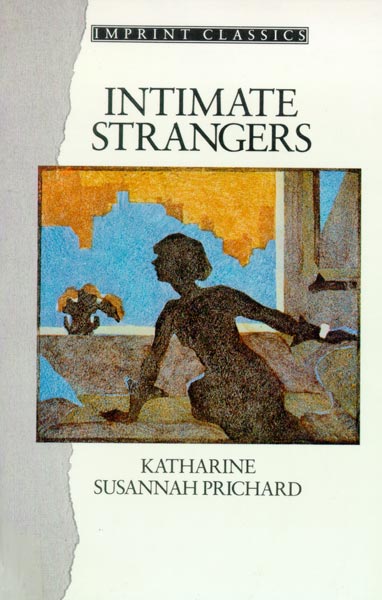
When Katharine Susannah Prichard set off from Perth for London and then a tour of the Soviet Union in May 1933, she left the manuscript of Intimate Strangers behind. It is the story of the troubled marriage of Elodie and Greg Blackwood, set in Perth during the Depression. The manuscript she left behind finished with the suicide of Greg after he has gambled their house away, and presumably before Elodie even has a chance to tell him she’s leaving him for the adventurous Jerome Hartog. While Prichard was somewhere in Sibera, war-damaged Hugo Throssell shot himself, having piled up huge debts from a failed ‘dude ranch’ venture at their home. She later expressed niggling doubt to her son, Ric, that perhaps part of his state of mind had been caused by reading the ending of the novel. Before publication in 1937, she altered the ending to set up a reconciliation between Greg and Elodie. The novel and the suicide will always be associated, and the issue has resurfaced often in the years since, including when the novel was turned into an ABC mini-series in 1981 and a magazine ran a sensationalised headline. In the introduction to the 1990 edition, Ric acknowledged parallels between Greg and Elodie and Katharine and Hugo, but emphasised the differences and the creative alchemy that amalgamates and transforms people and events beyond simple equivalencies; ‘the unknowable truth remains unknown.’

Intimate Strangers is a portrait of marriage as a concept and institution more than a portrait of a particular marriage. Elodie and Greg’s problems in their marriage of fifteen years are set against the troubled relationships of those around them, especially virginal tomboy, Dirk, who holds a line of suitors in her sway, not wanting to marry any of them, but eventually yielding to one for money. On the beaches of Calatta and then back in the suburbs of Perth, Elodie contemplates running away with Jerome as Greg continues his dalliances and fails as a provider. Over and over, the novel circles around the questions of finding sexual and personal fulfillment in marriage and out of it, with sexual attraction pulling people away from commitment. There is no clear message; the appeal and the problems of adultery are both presented. The resolution has Elodie and Greg recommit themselves to each other at the same time as they applaud Dirk’s escape from her marriage. In the moral world of the novel, Dirk’s escape is permissible because the marriage’s oppression mirrored that of the capitalist oppression of workers; as part of that, her husband Ted was violent, leaving her bruised. Greg is not as bad as Ted, but by today’s standards at least, he rapes Elodie in Chapter 6.

Intimate Strangers is distinct among Prichard’s novels. Most of her novels are researched, taking place among a particular occupation group – opal miners, timber workers, circus workers, station workers. Intimate Strangers is closer to the middle-class, urban world Prichard moved in. The urban setting is unusual for her, although as Throssell points out in the introduction, two of her lesser-known works, Windlestraws (1916) and Subtle Flame (1967) are also set in cities. Her other novels are also much more plotted; more than any other her other works, Intimate Strangers occurs within the characters’ consciousness, their inner conversations and impressions. However, just in case you were in doubt that you were really reading Prichard, in chapter 19 Dirk and Elodie turn up to a rally of unemployed workers in Fremantle to hear Tony speak, and the speeches of a number of the unemployed are reported. The tumult of the Great Depression is not foregrounded, but intrudes most here and when Greg loses his job in the downturn.

The novel is drenched in seawater and sand, lovingly evoking Perth beaches in the amalgam place of Calatta, part Rockingham, part Cottesloe. The characters begin on holiday there for the first half of the book, and return a couple of times, including for the final resolution. All the characters live to swim or sunbake or walk along the beach or fish. It is a valuable picture of Western Australian beach culture in the 1930s, sitting alongside J. M. Harcourt’s descriptions in Upsurge! (1934).

The novel enjoyed a brief renaissance in July 1981 with the broadcast of the two part mini-series adaptation. A review for the mini-series by Cul Cullen in The Women’s Weekly is one of the most hyperbolic hatchet jobs I’ve come across, describing it as ‘the silliest thing to flicker, unwatched, across our screens’; ‘aimless, stitled and utterly without relevance to a contemporary audience.’ Surely it couldn’t have been that bad; but the only way to know today is to watch the only copy I can see listed in the world at the National Archives. (In his introduction, Ric Throssell writes that it was also The Women’s Weekly which published the article at this time blaming the novel for his father’s suicide. However, The Women’s Weekly is now fully digitized for that year, and there is no trace of the article. It may have been a different magazine.)

While avoiding simplistic autobiographical readings of Intimate Strangers, it is an anguished book from an anguished period in Prichard’s life. The characters’ ponderings on how to find happiness and satisfaction in life and particularly marriage are themes which resonate today as well, even if the novel reads as a product of its age. It is not the Prichard novel I’d recommend readers start with, but it is a significant work in her corpus, demonstrating her versatility, and shedding light on its context.
Amalgam Places: The Puzzle of ‘Calatta’ in Prichard’s Intimate Strangers

16 Tuesday Sep 2014

Posted by Nathan Hobby in Katharine Susannah Prichard, Katharine Susannah Prichard's writings

≈ 3 Comments

Tags

Intimate Strangers, Perth beaches, place, setting, Tim Winton, Western Australia

If a writer sets a novel in a world without any familiar reference points, it might be described as surreal, or placed in the fantasy or alternative reality genre – Paul Auster’s In The Country of Last Things comes to mind. Other times, familiar places are given new names and also possibly amalgamated, while within that reality other larger places remain the same (Australia is still Australia). In Tim Winton’s work, is Angelus simply Albany renamed? One could go mad trying to tie down the suburb of Cloudstreet; it’s West Leederville, but it’s also Subiaco, and other western suburbs. And this is surely the point: renaming a familiar place loosens the constraints on the novelist. The novelist can construct their own place like building Lego, taking bits which go together. The railway line can be closer to the river. In the same way that time is manipulated, memories from different stages brought together, place can be manipulated.

So if I’m aware of this, why does my mind keep trying to crack the ‘code’ of Calatta, the beach setting in Katharine Susannah Prichard’s Intimate Strangers (1937)? Perhaps it’s because of Ric Throssell’s warning in the introduction:

The setting for the story was the familiar seaside scene of the Western Australian beaches. Anyone could tell that. ‘Calatta’ was Rockingham, or Cottesloe, or was it Point Peron? Or the Basin at Rottnest, perhaps? In Prichard’s lovingly evocative language the places and people seemed real. And yet, as in all works of fiction, reality and imagination are woven together in Intimate Strangers in new lives, new people, new events that exist only in the mind of their creator and the words in which their existence is evoked.

Throssell uses Calatta as a good example of how direct parallels can’t be drawn between fiction and life, a point which becomes important, biographically, when it comes to reading the novel as a portrait of Prichard’s marriage. Yet like the kid in class who ignores the point and goes off on their own tangent, I can’t help trying to put Calatta on the map as I read. In Chapter Four, the surf clubs compete, with Calatta going up against North Cottesloe, Cottesloe, City Beach and South Beach; later, it’s mentioned that Calatta’s ‘a few miles’ from Fremantle. It has holiday shacks, and a limestone main-street; cliffs; a view of an island. Just like Throssell warned, Calatta’s an amalgam and the point is to enter fully the novel’s world which is like my world, but also not like it – especially separated by eighty years.

In thinking through the function of ‘amalgam places’ for this post, I have a new appreciation of them. But James Joyce claimed Dublin could be rebuilt from his descriptions of it in Ulysses, and I’m quite fond of writers being very specific in evoking a place, using real names – if it’s done well. (I confused one reader in my current novel-in-progress is by writing about an alternative Perth where a ten story library sits on Heirisson Island, but still calling it ‘Perth’, and indeed calling everything by its real name. This objection is connected to all of this.) What do you think? Do you have a preference for fictionalised, amalgam places or not?

Review of a Forgotten Novel: Thomas Henry Prichard’s Retaliation

12 Friday Sep 2014

Posted by Nathan Hobby in book review, Katharine Susannah Prichard, Katharine Susannah Prichard's associates and connections

≈ Leave a comment

Tags

afterlife, death, romance, Thomas Henry Prichard, Victorian era

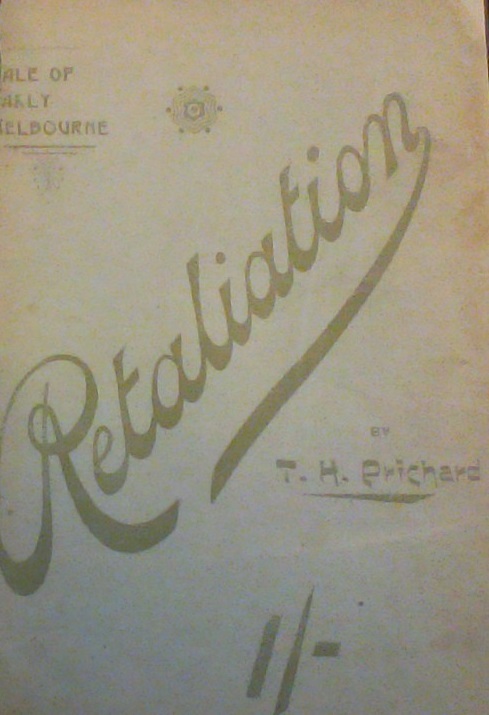
Retaliation-cover
‘Should he continue in the wide field of literature he will assuredly become one of our first writers of romance,’ wrote Launceston’s Daily Telegraph, reviewing journalist Thomas Prichard’s novel, Retaliation: An Early Tale of Melbourne (1891). It was not to be. This is the only novel Prichard was to publish before his death by suicide in 1907; in addition to his journalism, the rest of his oeuvre is filled out with two known short stories in The Bulletin and two serial Christmas stories in newspapers, as well as poems and some works of non-fiction. Retaliation was published in a cheap paperback edition with a green cover and sold for a shilling. Trove, the combined catalogue of libraries across Australia, lists six copies held in Australia; there may be several more in libraries not listed, and a few in private hands, but essentially, Prichard’s novel and his literary career have been forgotten. Retaliation is a popular fiction of its day, and while competent and representative, is not especially memorable. It does, however, read as a fascinating document of its time, especially in relation to the work of Prichard’s famous daughter, Katharine Susannah. Continue reading →

Haxby’s Circus: a review

27 Sunday Jul 2014

Posted by Nathan Hobby in book review, Katharine Susannah Prichard, Katharine Susannah Prichard's writings

≈ 5 Comments

Tags

Haxby's Circus

haxby

Spoiler Alert

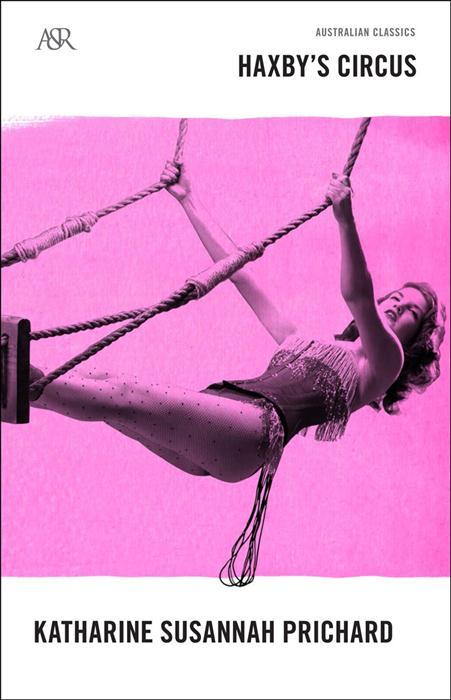
Katharine Susannah Prichard’s seventh novel, Haxby’s Circus: The Lightest, Brightest Little Show on Earth (1930), is a portrait of a circus family across a couple of decades and the transformation of the central character, Gina Haxby, from an agile, innocent acrobat to a world-weary and overweight middle-aged clown.

The circus wanders around Australia, right up and down the eastern states, into the small inland towns as well as the cities, and even across to Perth and then Geraldton. The narrative itself wanders as well, and any particular direction it has taken is often veered away from or even completely doubled back on. This is no weakness, but comes to be part of the novel’s charm. An example: in the first half of the novel, the antagonist is Dan Haxby himself, the patriarchal head of the family and circus. He seems too hard and too cruel, driving his wife and children to extremes. Gina breaks her back in a fall, and resolves to save her mother and her younger siblings from Dan. When she succeeds in escaping with her pregnant mother, they live in hiding to bring up the child, Maxine (Max), whose life will not be ruined by the circus. Yet years later, Dan comes to the same town and the family are reunited, the circus reformed and Gina’s resolve wavers. Over the rest of the novel, Gina’s relationship with her father softens, and he becomes slightly more reasonable; Max becomes an acrobat and it seems Gina’s fears and determination may even have been unwarranted. In this subtlety of character, it rings true with life for me. (Interestingly, the transformation from tyrant to a somewhat gentler man is the opposite of Hugh in Coonardoo, the novel KSP was writing in the same period.)

John Hay astutely calls the novel ‘episodically tragic’, but judges it the lesser work next to Coonardoo, and notes that it received little critical acclaim. Coonardoo is a more concentrated tragedy, with a smaller cast of characters and the profundity of tackling race relations in a more progressive way than contemporaries. Yet Haxby has the most powerful scenes I’ve yet encountered in KSP’s work, scenes of beauty, darkness and insight. The most profound is in the final chapter as Jack confronts Gina, asking why she is ‘running amuck’, hitting the drink and sleeping around. Gina responds ‘I want to know if there’s anything in this business of living, I think.’ She goes on to remember what Billy had said years earlier:

‘Billy was right after all. He said to me once: “Life’s a three volume novel, Gina. The first’s the book of ideals and illusions ; the second’s the book of realities and noble resolutions; the third’s the book of the senses and breakdown of the will.” I think he was right, Jack. It’s the third book I’m up to now.’ (312)

This cannot be KSP’s own philosophy; she lived her whole life in the book of ideals, perhaps with some noble resolutions from the second volume. Jack’s response is more in line with how KSP lived her life; it echoes a similar line in the autobiographical Wild Oats of Han: ‘I’d like to crock up and run off the rails. It’d be a relief somehow; but I won’t let life beat me that way. I’ve got to stand up to it, somehow.’ (314) Out of this existential scene, Gina finds the will to live meaningfully again; but, perversely, it’s by transforming herself into a clown, restoring the circus by humiliating herself.

KSP wears her politics more lightly in this novel. There are no Communist characters who turn up to challenge the system. Interestingly, when Gina inherits a fortune and finances the expansion of of the circus, she tells Dan ‘it must make a profit’. Yet all the family now have a share in the circus, and it’s this communal ownership which gives a taste of KSP’s politics. The other taste comes in the fact that again in this novel she successfully depicts a community, something few other novelists have done as well. There is a sense of the dignity of all the characters, and the goal Gina is striving for is not her own personal freedom or benefit, but the benefit of all in her circus community.

Haxby is in print in the Angus and Robertson Classics series, available both in print and as an ebook. I was fortunate enough to find a 1932 edition in the Florin Books series by Jonathan Cape at Robert Muir Books in Nedlands; Florin Books are, the ad says ‘the right size for all times and the right price for these times’ – at two shillings, that is. I liked my copy so much I didn’t write in it, and thus I have no annotations.

Coonardoo: preliminary thoughts on its place in Prichard’s work and life

07 Saturday Jun 2014

Posted by Nathan Hobby in book review, Katharine Susannah Prichard, Katharine Susannah Prichard's writings

≈ 2 Comments

Tags

Aboriginals, Coonardoo

coonardoo

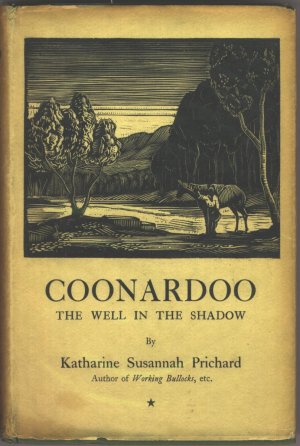
Coonardoo (1929) is the novel Katharine Susannah Prichard is best remembered for, a tragedy of the thwarted love between a station owner, Hugh, and an Aboriginal woman, Coonardoo, set in the Pilbara of Western Australia. It was ahead of its time in its depiction of race relations in Australia, and surely confronted Australians with some of the ugliness of their racism at its time; inevitably, by today’s standards, some aspects of the book itself seem somewhat racist, with talk of evolution of races and the ‘primitive’ charm of Aboriginality.

In this novel, Prichard’s narrative voice has shifted significantly from that of Working Bullocks, Black Opal and The Pioneers, all of which are more similar to each other than to this novel. To me, those earlier three novels all have a nineteenth century sensibility and tone, while Coonardoo is decidedly modern. The precedent in Prichard’s own work is The Wild Oats of Han, which appeared the year before Coonardoo, despite being written right back in 1907. Unlike the others, Han is a personal and autobiographical work, and my favourite of her novels so far. But like Coonardoo, its tone is less sentimental and the voice feels more direct; the narrator is further back, without the same sense of presence and control.

One way in which Coonardoo connects to Bullocks, Opal and Pioneers is that each presents a community with at least the capacity to be a kind of paradise, under threat by forces of fate and characters who do not understand the paradise. The paradise could be an opal town where everyone is their own boss, threatened by capitalists, or a timber community threatened by the greed of the sawmill. In Coonardoo, the ‘paradise’ is Wytaliba Station, with its harmonious relationships between the whites and blacks, as set up by Hugh’s mother, Mrs Bessie. The characters who ‘understand’ the paradise love the harsh isolation of the station life and treat the Aborigines with respect; Hugh’s wife, Mollie, does neither. A cardinal rule of the paradise is for the white men not to take the ‘gins’ as a harem, as Sam Geary on the neighboring station has done; it’s partly borne out of rejecting exploitation but also partly out of anti-miscegenation. The community is threatened and ultimately destroyed by both the forces of nature – drought – and Hugh’s inability to cope with this cardinal rule. Before she died, his mother set up an impossible dynamic in entrusting Coonardoo (the character) with the duty to look after Hugh, while also requiring that Hugh not take her as his partner. And so it is that this paradise is doomed, while the previous three hold out against the forces of fate and evil and carry on, albeit transformed, and the hope resting in the next generation. (Of course, we might see a note of hope in Hugh’s daughter, Phyllis, carrying on the station life, albeit on the neighbouring station.)

The novel developed as a genre of the self, the individual; one of Prichard’s achievements is the rare feat of depicting communities convincingly in novels. She is always interested in many different characters, switching rather democratically between viewpoints, and representing the web of interrelations in a community. Most importantly of all, she strives to capture the essence of a community, its ethos and spirit, the values which hold it together.

Like most of Prichard’s novels, Coonardoo resists a biographical reading. She researched the novel in the 1920s, spending time on a station in the North-West, just as she researched opal mining, the timber industry and the circus for other novels. Some biographical questions still presented themselves to me as I read. What significance are we to give her naming the protagonist ‘Hugh’, when her own husband’s name was ‘Hugo’ (admittedly, everyone called him ‘Jim’)? Both are paragons of Australianness; and perhaps like the character Hugh, Hugo/Jim was troubled by demons he didn’t articulate. It would be interesting to discover if Prichard saw herself reflected in Phyllis, who arrives at the station in a ‘borrowed’ car in chapter 23, escaping an affair gone wrong in Perth, and sets out challenging the gender stereotypes of the station, starting with the wearing of trousers. It would not surprise me if these chapters echoed most closely Prichard’s own time on the station. Like Prichard, Phyllis seems determined not to marry, only to find herself charmed by a suitor; the wooing of Phyllis feels a little like Prichard’s description of her own experience in Child of the Hurricane. And finally, speaking of the ‘child of the hurricane’, Prichard’s designation for herself, born in the middle of a Fijian cyclone – Coonardoo and Hugh’s child is referred to as the ‘son of the whirlwind’. Perhaps Prichard enjoyed the resonance between her own origin story and the Aboriginal understanding of whirlwinds giving a child its spirit; or perhaps her own personal mythology even developed in response to this.

Passion and timber: a review of KSP’s Working Bullocks

06 Tuesday May 2014

Posted by Nathan Hobby in book review, Katharine Susannah Prichard, Katharine Susannah Prichard's writings

≈ 3 Comments

Tags

1920s, Australian literature, Communism, Working Bullocks

Working Bullocks (1926) was Katharine Susannah Prichard’s fourth published novel, and her first set in Western Australia, where she’d been living since 1919. Set in the karri forests of the south-west, it uses the fictional towns of Karri Creek and Marritown as stand-ins for places around Pemberton as she tells of romance, struggle and strike in the lives of timber workers.

It take some time to establish itself. The first third is concerned with detailed descriptions of the work of the bullock teams carting logs, and of the protagonist, Red, catching a wild brumby. Prichard is determined to achieve verismilitude (as she did with her observations of opal miners in her previous novel, Black Opal), but perhaps it comes at the expense of readability. Of course, the same passages which bogged me down would have probably been met with delight by contemporaneous readers looking for an experience of the bush.

We know from the start that her hero, Red, is a fascinating character, and he begins to hit his stride about Chapter XI. He is a tormented loner, a man of principles fighting against setbacks; his brothers thought him dead in the war and sold off his fine team of bullocks to the butchers (7). (Strangely, Prichard never returns to Red’s time in the war, a glaring omission in her characterisation.) After his best friend, Chris, dies in a timber accident, Red goes bush for a year, only to return to civilisation when he captures the finest brumby, Boss. He loses Tessa, the girl he had been seeing, but falls passionately for Chris’s sister, the far more suitable and down-to-earth Deb. Deb’s mother challenges him to regain a bullock team to prove he has the means to keep a wife. Having earlier referenced Jacob from Genesis, who worked seven years to earn his wife (48), it seemed to me that the novel had settled into a natural plotline: the trials of Red as he overcomes the odds to rebuild his bullock team. Yet what follows instead is a series of sharp twists in the plot.

There is to be a race between Red’s brumby Boss, and the horse of Tessa’s successful suitor, Leslie Gaze. Yet Tessa comes to him as the race is starting and says he must let Leslie win, because only then will he marry her, and if he does not marry her, she will ‘die’, bringing down both Leslie and Red with her. Red is pushed to his  moral limits, facing a dilemma without a solution, but its terms are not clear enough, at least to this reader; could it be the censor, or at least Prichard’s concern for the censor? It seems Tessa is pregnant and will claim Red to be the father if he will not co-operate. Red throws the race, admits guilt, and walks away from his hope of marrying Deb, having covered himself in shame. He hits the bottle and turns into a harsh leader for the rest of the bullock team.

Soon after this, in chapter XXI, Mark Smith enters the narrative, in an interesting but somewhat unintegrated subplot. He works as Red’s offsider and becomes the closest he has to a friend. But most significantly, he is a communist, an agitator and he channels the workers’ anger at conditions into a strike after Deb’s other brother, Billy, is killed in the sawmill. Prichard paints the picture of a strike well, and it’s fascinating to watch Deb’s mother become a conscientious comrade to the cause during the strike. Yet the subplot is not anticipated; the workers’ conditions have not been foreshadowed as a problem, and the connection to the central plot is not well made.

The strike dies down and Red leaves town after he and Deb fall half in love. The rest of the novel settles into a romantic musical chairs, as Deb and Red must find their way back to each other through the obstacles of Niel the log chopper and the freshly widowed Tessa, back to snare Deb. (In one of the more innovative chapters, XXXI, Deb and Tessa are sharing a room and the narrative point of view switches back and forth between them.)

The sections of the novel told through Deb’s point of view are a highlight of the novel, and none more so than those describing her mystical communion with trees; ‘she had always gone to the trees when she was in trouble’ (273):

The trees were like people she knew who suddenly had become beautiful beyond anything earthly. Their stand and poise, long arms outflung, bodies tall and straight, crooked or gnomish, living flesh with the glamour of ivory, sloughing their bark, dark shapes wrapped in fibre. Deb swung to them in a fury of worship and admiration. The invocation, passion and lamentation of the trees swayed her. (275)

Deb and Red embody a simplicity and purity of life, two characters connected to their environment, work and appetites.

We should be grateful for Working Bullocks. It captures everyday working life in the Western Australian timber industry ninety years ago, yet balances that with a passionate, romantic sensibility. It was the novel which made her reputation on publication, and is usually regarded as one of her seminal works, yet while five or six of her other novels are in print today, I do not think Working Bullocks has been reprinted since 1991.

KSP’s autobiography, Child of the Hurricane: a polite rebel in dinner party mode

27 Sunday Apr 2014

Posted by Nathan Hobby in book review, Katharine Susannah Prichard, Katharine Susannah Prichard's writings

≈ 4 Comments

Tags

Alfred Deakin, Child of the Hurricane, suicide

Katharine Susannah Prichard takes the name of her autobiography from the circumstances of her birth, born in the fury of a hurricane in Fiji in 1883. The epithet echoes through this account of her early life to a moderate extent, as an image of her rejection of the ‘normal’ way to live, disavowing religion at a young age, marrying late, and finally embracing communism. Yet KSP comes across in this book not as a furious rebel, but an intelligent, singular woman, determined to rather politely live life her own way. It was published in 1964, but only traces her life until 1932.

Her childhood took her from Fiji to Tasmania to Melbourne, following the unstable fortunes of her father, Thomas Henry Prichard, a journalist. She becomes a journalist herself, determined to be married to her career, and sets off for London in 1907 and then again during the war. Along the way, her political and artistic development is lightly suggested.

The book offers moments of insight into her life, but she shows us what she wants us to know and no more.  It is not confessional nor particularly emotional. Instead, chapters are commonly structured around an encounter with a particular interesting person. Even in this period of her life, she is acquainted with many people of note, including Aleister Crowley, Alfred Deakin, and feminist Charlotte Perkins Gilman. Sometimes it reads a little too much like a structured sequence of dinner party anecdotes, but anecdotes from the most interesting of dinner party guests.

For me, one of the most interesting sections of the book is the description of a family reunion in 1902 of many of the eighty-five descendants of Grandfather and Grandmother Prichard on the fiftieth anniversary of their landing in Australia. All the original Prichard brothers and sisters were still alive at this point. It is an elegaic picture of what is already a distant memory for her, describing it in the 1960s.  She reflects that it’s now hundred years after their landing, and the descendants are too numerous to count. She writes:

I seem to be the only rebel among them. What would he say to me, I wonder, that grandfather whose name will live on the books I have written, and who made his bold venture into the unknown? Would he understand that  I am seeking to find as he did, a new and good life, though not only for the members of my own family, but for the families of mankind?

Curiously, Child of the Hurricane gives little insight into Katharine’s writing. She doesn’t write much about her motivations for writing, nor the process. She does describe, briefly, locking herself in her room for months to write her first novel, The Pioneers, and later gives some detail of a research trip for her novel Black Opal. (This research trip is given the quality of anecdote by its structure – she reports how the dray driver wouldn’t talk to her as he drove her out to the remote town; it’s only at the end of the story that she discovers he assumed she was a ‘city who’er’ and was trying to retain his respectability.) I wonder whether my expectations of her writing about writing reflect more recent expectations of writers’ autobiographies; perhaps we are more curious about the occupation of writing these days.

She writes briefly but compellingly of her great attraction for ‘Jim’, the war hero Hugo Throssell who was to become her husband. Yet their marriage and the whole years of her life 1918 to 1932 are given just one short chapter of eight pages, and much of this is taken up with stories about the horses they owned. We know from her son’s biography how hard it was to even write that Jim took his own life, and no doubt she could not bear to reveal any more than she did.  The book’s real focus is her early life, from 1883 to 1918 with the chapter on her marriage more a postscript.

Suicide haunted Katharine’s life; she herself seems a resilient and mentally healthy person, but even in the course of the book, she must narrate the suicide of her father and her husband. There are also deaths by suicide of two of her acquaintances. She admired Rachel, Countess of Dudley greatly, interviewing her as a young journalist; perhaps she knows more than the standard accounts of Rachel’s accidental death by drowning, because she wonders what ‘crisis in her own life caused her to walk out into the lake’ (137). Katharine also writes approvingly of Charlotte Perkins Gilman’s decision to end her life when faced with incurable cancer (191); a case of euthanasia.

I’m grateful that we have this account of her life from Katharine. It doesn’t live up to her own literary potential, but it is an important record of her fascinating life and times, albeit a partial one.

KSP’s Black Opal: a saint and a singer in a utopia under threat

13 Thursday Mar 2014

Posted by Nathan Hobby in book review, Katharine Susannah Prichard, Katharine Susannah Prichard's writings

≈ 1 Comment

Tags

1921, Australian literature, autodidact, Black Opal, coming of age, Communism, Miles Franklin, sex

1934-slnsw

Katharine Susannah Prichard’s third published novel, Black Opal (1921), is set in the opal mining settlement of Fallen Star Ridge. It has two significant plot strands: the Ridge’s pure, beautiful Sophie coming into womanhood and torn between three men; and the attempt of an American to buy out the individual miners and commercialise operations.

Perhaps the truer title would be Fallen Star Ridge, as the novel is focused on the opal mining community itself as an ideal. Between the publication of her first novel, The Pioneers, and this one, KSP had committed to communism, and the influence is evident. In chapter VIII of part I, the narrative stops and KSP paints a picture of the workers’ utopia the settlement represents.

Ridge miners find happiness in the sense of being free men. They are satisfied in their own minds that it is not good for a man to work all day at any mechanical toil; to use himself, or allow anyone else to use him, like a working bullock. A man must have to time to think, leisure to enjoy being alive, they say.  (64-5)

To a man, Ridge miners have decided against allowing any wealthy man, or body of wealthy men forming themselves into a company, to buy up the mines, put the men on a weekly wage, and work them, as the opal blocks at Chalk Cliffs had been worked. (65)

The utopia is threatened first by missing opals (who stole from their brother?) and then an attempt by the American, John Armitage, to buy up the mines. As a kind of utopia, it is rendered convincingly, a plausible depiction of how people might have led a  co-operative existence a century ago in rural Australia.

Central to the utopia is Michael, a saintly autodidact who looks after the needy in the community and quietly dispenses wisdom. I can’t help wondering if KSP imagined a similar role for herself, if she was to ever find herself living within a workers’ community; she must have often wondered how to reconcile her bookishness with her commitment to the working class. The workers of the Ridge are not the anti-intellectuals one might assume:

Ridge folk were proud of Michael’s books, and strangers who saw his miscellaneous collection – mostly of cheap editions, old school books, and shilling, sixpenny, and penny publications of literary masterpieces, poetry, and works on industrial and religious subjects – did not wonder that it impressed Ridge folk; or that Michael’s knowledge of the world and affairs was so extensive. He had tracts, leaflets, and small books on almost every subject under the sun. (9)

At the beginning of the novel, Michael makes a promise to Sophie’s dying mother that he will make sure she does not leave the safety of the Ridge for the evils of the world beyond it. Trying to keep this promise is nearly his undoing; it is to no avail – Sophie leaves, which is nearly her undoing.

Spoilers Ahead Continue reading →

KSP’s The Wild Oats of Han

16 Sunday Feb 2014

Posted by Nathan Hobby in book review, Katharine Susannah Prichard, Katharine Susannah Prichard's writings

≈ 3 Comments

Tags

Australian literature, childhood, children's books, Wild Oats of Hans

20140216_181840

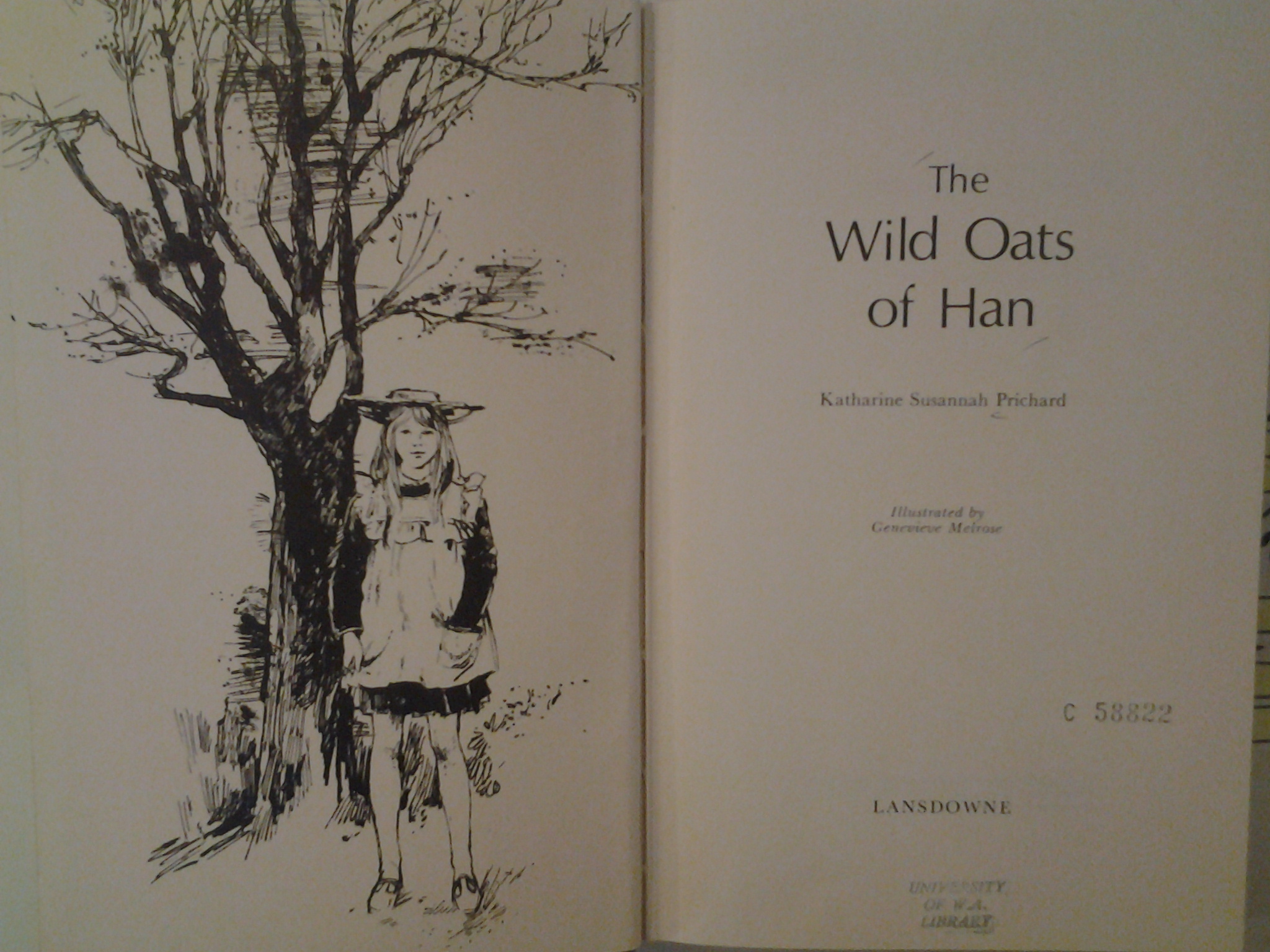
I’m trying to read the fiction of Katharine Susannah Prichard at least roughly in order, but of course that’s never as straightforward as it sounds. The Wild Oats of Han wasn’t published until 1928, but it was actually written in 1908, meaning that perhaps I should have it read it first; I’m reading it second.

Its genre is complicated, too. It’s presented as a children’s novel, but (my 1968 edition at least) is introduced with a note from KSP saying it ‘is truly, really story’, an idiosyncratic way to say it really happened. It is perhaps a memoir of childhood written in the form of fiction. Regardless, it is beautiful.

In this book, KSP’s prose is lyrical and captures the mind of a child incredibly well. Han is a dreamy, rebellious girl, a fascinating character, a girl who ‘scarcely knew the world of the real from the world of the unreal: both were blended in the crystal of her mind.’ (16) A mentor figure, Sam the woodcutter, tells her that ‘wild oats is a crop most people sow when they live like children’. (56) (The meaning has surely narrowed over the years.) Han determinedly sows her oats, skipping school to glory in the beauty of the bush; enchanted by the circus; battling her nemesis, Miss Whittler; in love with the family and friends around her. It is episodic, each short chapter almost self-contained, with only a loose progression of the overall narrative. Things change in the last few chapters, as the circumstances of her parents (absent characters for most of the novel) impede on her idyllic life, and she must go ‘down into the great mysterious world they had talked so much of, to take her part in the joy and the labour and the sorrow of it.’ (160)

Jack Beasley comments that the novel ‘is more a story about children for adults, than for children themselves’ (A Gallop of Fire, 31), and I agree with him. Its achievement lies in its evocation of the enchanted world of a child’s mind, which is not necessarily something a child can appreciate – only adults in retrospect; it reminds me in this respect of Randolph Stow’s Merry Go Round in the Sea. Early in Wild Oats, Han comes across a cave which amazes her:

Han went to school the next day. But the smell of the hills was in her nose: it was like a taste in her mouth. Memory of the cave haunted her. She had a mind-picture of the great underground room, so vast and deep that, leaning over the edge, she could not see how far it went, only the bones glimmering on the floor in the darkness. (31)

A children’s novel would require that there really be a human skeleton to discover at the bottom of the cave, or at least that some great adventure occur there. Yet Wild Oats evokes the gap between our childhood expectations of adventure gained from stories, and the reality that adventure is more a state of mind.

Sheila Chisholm

10 Monday Feb 2014

Posted by Nathan Hobby in Katharine Susannah Prichard, links

≈ Leave a comment

The fascinating Strange Flowers blog reviews the new biography Sheila by Robert Wainwright (Allen and Unwin, 2014). She was an Australian who became a high society figure between the wars in Britain, after marrying a lord who was recovering from war wounds in a hospital bed next to her brother. The parallels to Katharine Susannah Prichard are interesting – another Australian of a similar age (and the same year of death) who met a husband in the hospitals of the Great War. Despite the glitz around Sheila, perhaps KSP’s life was more interesting; another review complains:

Overall, I found the book rather superficial, a list of fabulous social events and prominent people. I was interested, but wanted more depth, but I suspect there just weren’t enough sources available.

Beyond, in this case, a potential lack of depth in the subject herself, lack of sources is surely the thing which defeats or at least hinders many biographies.

← Older posts
Newer posts →

Enter your email address to follow this blog and receive notifications of new posts by email.

Join 287 other subscribers

Nathan on Twitter

My Tweets

Categories

  • academic (9)
  • archives and sources (10)
  • autobiographical (62)
  • biographers (10)
  • biographical method (28)
  • biographical quests (18)
  • biographies (21)
    • political biography (2)
  • biographies of living subjects (2)
  • biographies of writers, artists & musicians (12)
  • biographies of writers, artists and musicians (20)
  • biography as a literary form (9)
  • biography in fiction (2)
  • biography in the news (2)
  • books (236)
    • authors (19)
    • book review (173)
    • reading (23)
  • Covid (2)
  • creative nonfiction (11)
  • daily life (2)
  • Daily Prompt (2)
  • death (21)
  • digital humanities (3)
  • family history (1)
  • fiction (8)
  • film and television biographies (5)
  • film review (48)
  • found objects (3)
  • historical biographies (1)
  • history (20)
  • In the steps of KSP (4)
  • John Curtin (13)
  • Katharine Susannah Prichard (114)
    • Glimpses of KSP (7)
    • My KSP biography (31)
      • deleted scenes (1)
  • Katharine Susannah Prichard's associates and connections (16)
  • Katharine Susannah Prichard's writings (34)
  • libraries (5)
  • life (20)
  • link (23)
  • links (41)
  • lists (28)
  • local history and heritage (1)
  • media (4)
  • memes and urban myths (1)
  • memoirs (10)
  • meta (2)
  • music (18)
  • news (9)
  • news and events (43)
  • obituary (1)
  • Old writing found on a floppy disk (1)
  • poetry (5)
  • politics and current affairs (26)
    • climate change (1)
  • prologues and introductions (2)
  • psychological aspects of biography (3)
  • quotes (22)
  • R.I.P. (10)
  • reading report (3)
  • religion (1)
  • religious biography (1)
  • research (5)
  • role of the biographer within the biography (2)
  • Series: A-Z of Katharine Susannah Prichard (26)
  • Series: Corona Diary (1)
  • Series: Saturday 10am (14)
  • Series: Short Stories (2016) (6)
  • Series: The Tourist (2013) (6)
  • Series: Thursday 3pm feature posts (2009) (35)
  • structure of biographies (3)
  • technology and the digital world (2)
  • television (4)
  • the nature of biography (4)
  • this blog (10)
  • Uncategorized (33)
  • Western Australia (26)
  • writing (41)

Archives

Recent Comments

amphisbaenathoroughly79c20f19aa's avataramphisbaenathoroughl… on John Curtin’s vision…
Nathan Hobby's avatarNathan Hobby on John Curtin’s vision…
karenlee thompson's avatarkarenlee thompson on John Curtin’s vision…
Nathan Hobby's avatarNathan Hobby on John Curtin’s vision…

Bookmarks

  • Adventures in Biography
  • ANZ LitLovers LitBlog
  • Bernice Barry
  • It only goes up to your knees
  • Jane Bryony Rawson
  • Jenn Plays Recorder
  • Katharine Susannah Prichard Writers' Centre
  • Laura Sewell Matter: Essayist and Biographer
  • Mutually said: Poets Vegan Anarchist Pacifist
  • Resident Judge
  • Speaking Thylacine
  • The Australian Legend
  • Timothy Parkin Poetry
  • Treefall Writing – Melinda Tognini
  • Whispering Gums
  • Wrapped up in books: the home of Guy Salvidge

Top Posts

  • The Joy of Knowledge Encyclopedia
  • The forgotten and the remembered: brief notes on the history of the Hodder & Stoughton £1000 Novel Competition
  • Paul Auster's Moon Palace : an overview
  • Book review - John Fowles : Daniel Martin
  • Book review: Strong Motion - Jonathan Franzen

Blog Stats

  • 234,922 hits

Tag Cloud

9/11 19th century 33 1920s 1921 1930s 1950s 1970s 1971 1981 2000s 2004 2011 2015 2017 20000 Days on Earth A.S. Byatt Aboriginals activism Adam Begley Adrian Mole adultery afterlife Agatha Christie Alan Hollinghurst Alberto Manguel Alfred Deakin Amazing Grace Americana Amy Grant An American Romance Andre Tchaikowsky Andrew McGahan angela myers anne fadiman Anne Rice Arabian Nights archives art arts funding A Serious Man Ash Wednesday ASIO atheism Atonement Australia Australian film Australian literature Australian Short Story Festival autism autobiography autodidact Barbara Vine beach Belle Costa da Greene Bell Jar best best-of Bible Big Issue Bill Callahan biographical ethics biographical quest genre biographies birthday birthdays Black Opal Bleak House Blinky Bill blogging blogs Blue Blades Bodega's Bunch bog Booker book launch booksale Borges Brenda Niall Brian Matthews Brian McLaren Britney Spears Burial Rites Burke and Wills buskers C.S. Lewis C.S. Lewis canon capitalism Carol Shields Carson McCullers Catcher in the Rye Catholicism celebrities Charles Dickens Charlie Kaufman childhood Child of the Hurricane children's books Choir of Gravediggers Christianity Christian writing Christina Stead Christmas Christopher Beha Cinque Terra Claire Tomalin classics cliches climate change Coen brothers coincidence Collie Collyer coming of age Communism concert Condensed Books consumerism Coonardoo Cormac McCarthy Corrections cosy fiction Dara Horn David Copperfield David Ireland David Marr David Suchet death Death of a president definition demolition Dennis LeHane dentist diaries divorce doctorow Doctor Who documentaries donald shriver Don DeLillo Don DeLillo Donna Mazza Donna Tartt Don Watson Dostovesky doubt drama dreams of revolution Drusilla Modjeska E.M. Forster ebooks editing Eichmann Eisenstein Elizabeth Kostova email empathy ensmallification existentialism faith Falling Man fame families fantasy fiction film and television folk football Frank Barscombe Fremantle Press G.K. Chesterton Gabrielle Carey Gallipoli genealogical fiction Genesis Geoff Nicholson George W. Bush Gerald Glaskin Gilead Golden Miles Goldfields Trilogy Graham Greene grandad great novels Greenmount Guinness World Records Guy Salvidge Hannah Arendt Hannah Kent Hans Koning Hans Koningsberger Harper Lee Haxby's Circus Hazel Rowley He-Man headers heaven Heidegger hell Henrietta Lacks Henry Morton Stanley Herman Hesse heroes Hey Dad! historical fiction history Holden Caulfield holidays Homer & Langley Home Song Stories House of Cards House of Zealots house of zealots Hugo Throssell humour Ian McEwan In between the sheets Indonesia Infamous Inside Llewyn Davis interstellar interview Intimate Strangers Invisible Ireland ISBNs Ishiguro itunes J.D. Salinger J.M. Coetzee J.S. Battye Janet Malcolm Jennifer Egan JFK JFK assassination Joanna Rakoff Joel Schumacher John Burbidge John Fowles John Howard John Kinsella John Updike John Updike Jonathan Franzen journal writing JSB Judgment Day Julia Baird Julian Barnes Kafka Kalgoorlie Kate Grenville Katherine Mansfield Kevin Brockmeier King's Park KSP Writers' Centre language last ride Laurie Steed Left Behind Leonard Cohen Leo Tolstoy Libra Library of Babel Library of Babel Lila Lily and Madeleine links Lionel Shriver lionel shriver lists literary fiction literature Lleyton Hewitt lost book Louisa Louisa Lawson Louis Esson louis nowra love letter Lubbock Lytton Strachey Madelaine Dickie Man Booker man in the dark Margaret Atwood Margaret River Press Marilynne Robinson mark sandman meaning of life Melbourne Mel Hall meme memorialisation memory MH17 Michael Faber Mike Riddell Miles Franklin mining boom missionaries moleskine Moon Palace morphine Mother Teresa movies Music of Chance My Brilliant Career names Napoleon Narnia narrative Narrow Road to the Deep North Narziss and Goldmund Natalie Portman Nathaniel Hobbie national anthem Nick Cave Nina Bawden non-fiction nonfiction noughties novelists novels obituaries obscurity On Chesil Beach Parade's End Paris Hilton Passion of the Christ past patriotism Paul Auster Paul de Man Perth Perth Writers Festival Peter Ackroyd Peter Cowan Writers Centre phd Philip K. Dick Philip Seymour Hoffman pierpontmorgan poetry slam politics popular fiction popular science Possession postapocalyptic postmodernism Pride prophetic imagination publications Pulp Purity Queen Victoria Rabbit Angstrom radio Radio National Randolph Stow rating: 5/10 rating: 6/10 rating: 7/10 rating: 8/10 rating: 9/10 rating: 10/10 ratings reading fiction autobiographically reading report Rebecca Skloot recap red wine reincarnation juvenile fiction rejection review - music reviewing rewriting Richard Flanagan Richard Ford Rick Moody Roaring Nineties Robert Banks Robert Hughes Robert Silverberg Robert Wadlow Robinson Crusoe Rolf Harris romance Rome ruins Russell Crowe Ruth Rendell Sarah Murgatroyd scalpers science fiction Science of Sleep secondhand books Secret River sermon illustration sex short stories Silent Woman Simone Lazaroo Simpsons Siri Hustvedt slavery Smashing Pumpkins social interactions social justice some people i hate sources South Australia souvenirs speculation speech speeches sport status anxiety Stephen Lawhead Stranger's Child subtitles Subtle Flame Sue Townsend suicide Surprised By Hope Suzanne Falkiner Sylvia Plath Synecdoche TAG Hungerford Award tapes teabags Ted Hughes The Children Act The Cure The Fur The Imitation Game theology The Pioneers The Revolutionary Thomas Disch Thomas Hardy Thomas Henry Prichard Thomas Mann thriller time Tim La Haye Tim Winton Tolstoy Tom Wright top 10 Towering Inferno Tracy Ryan Trove Truman Capote tshirts TS Spivet Twelve Years a Slave underrated writers Underworld unwritten biographies urban myth USA vampires Venice Victoria Cross Victoriana Victorian era Victorianism Victoria Park video Voltron w Wake in Fright Walkabout Walter M. Miller war War and Peace war on terror Water Diviner Wellington St Bus Station Westerly Western Australia West Wing What Happened to Sophie Wilder? Whitlams wikipedia Wild Oats of Hans William Wilberforce Winston Churchill Witches of Eastwick Working Bullocks workshop World War One writers writing Writing NSW youth Zadie Smith Zeitgeist Zelig

Enter your email address to follow this blog and receive notifications of new posts by email.

Join 287 other subscribers

Pages

  • About
  • My novel: The Fur
  • The Red Witch: A Biography of Katharine Susannah Prichard

Categories

  • academic (9)
  • archives and sources (10)
  • autobiographical (62)
  • biographers (10)
  • biographical method (28)
  • biographical quests (18)
  • biographies (21)
    • political biography (2)
  • biographies of living subjects (2)
  • biographies of writers, artists & musicians (12)
  • biographies of writers, artists and musicians (20)
  • biography as a literary form (9)
  • biography in fiction (2)
  • biography in the news (2)
  • books (236)
    • authors (19)
    • book review (173)
    • reading (23)
  • Covid (2)
  • creative nonfiction (11)
  • daily life (2)
  • Daily Prompt (2)
  • death (21)
  • digital humanities (3)
  • family history (1)
  • fiction (8)
  • film and television biographies (5)
  • film review (48)
  • found objects (3)
  • historical biographies (1)
  • history (20)
  • In the steps of KSP (4)
  • John Curtin (13)
  • Katharine Susannah Prichard (114)
    • Glimpses of KSP (7)
    • My KSP biography (31)
      • deleted scenes (1)
  • Katharine Susannah Prichard's associates and connections (16)
  • Katharine Susannah Prichard's writings (34)
  • libraries (5)
  • life (20)
  • link (23)
  • links (41)
  • lists (28)
  • local history and heritage (1)
  • media (4)
  • memes and urban myths (1)
  • memoirs (10)
  • meta (2)
  • music (18)
  • news (9)
  • news and events (43)
  • obituary (1)
  • Old writing found on a floppy disk (1)
  • poetry (5)
  • politics and current affairs (26)
    • climate change (1)
  • prologues and introductions (2)
  • psychological aspects of biography (3)
  • quotes (22)
  • R.I.P. (10)
  • reading report (3)
  • religion (1)
  • religious biography (1)
  • research (5)
  • role of the biographer within the biography (2)
  • Series: A-Z of Katharine Susannah Prichard (26)
  • Series: Corona Diary (1)
  • Series: Saturday 10am (14)
  • Series: Short Stories (2016) (6)
  • Series: The Tourist (2013) (6)
  • Series: Thursday 3pm feature posts (2009) (35)
  • structure of biographies (3)
  • technology and the digital world (2)
  • television (4)
  • the nature of biography (4)
  • this blog (10)
  • Uncategorized (33)
  • Western Australia (26)
  • writing (41)

Archives

Recent Comments

amphisbaenathoroughly79c20f19aa's avataramphisbaenathoroughl… on John Curtin’s vision…
Nathan Hobby's avatarNathan Hobby on John Curtin’s vision…
karenlee thompson's avatarkarenlee thompson on John Curtin’s vision…
Nathan Hobby's avatarNathan Hobby on John Curtin’s vision…

Bookmarks

  • Adventures in Biography
  • ANZ LitLovers LitBlog
  • Bernice Barry
  • It only goes up to your knees
  • Jane Bryony Rawson
  • Jenn Plays Recorder
  • Katharine Susannah Prichard Writers' Centre
  • Laura Sewell Matter: Essayist and Biographer
  • Mutually said: Poets Vegan Anarchist Pacifist
  • Resident Judge
  • Speaking Thylacine
  • The Australian Legend
  • Timothy Parkin Poetry
  • Treefall Writing – Melinda Tognini
  • Whispering Gums
  • Wrapped up in books: the home of Guy Salvidge

Top Posts

  • The Joy of Knowledge Encyclopedia
  • The forgotten and the remembered: brief notes on the history of the Hodder & Stoughton £1000 Novel Competition
  • Paul Auster's Moon Palace : an overview
  • Book review - John Fowles : Daniel Martin
  • Book review: Strong Motion - Jonathan Franzen

Blog Stats

  • 234,922 hits

Tag Cloud

9/11 19th century 33 1920s 1921 1930s 1950s 1970s 1971 1981 2000s 2004 2011 2015 2017 20000 Days on Earth A.S. Byatt Aboriginals activism Adam Begley Adrian Mole adultery afterlife Agatha Christie Alan Hollinghurst Alberto Manguel Alfred Deakin Amazing Grace Americana Amy Grant An American Romance Andre Tchaikowsky Andrew McGahan angela myers anne fadiman Anne Rice Arabian Nights archives art arts funding A Serious Man Ash Wednesday ASIO atheism Atonement Australia Australian film Australian literature Australian Short Story Festival autism autobiography autodidact Barbara Vine beach Belle Costa da Greene Bell Jar best best-of Bible Big Issue Bill Callahan biographical ethics biographical quest genre biographies birthday birthdays Black Opal Bleak House Blinky Bill blogging blogs Blue Blades Bodega's Bunch bog Booker book launch booksale Borges Brenda Niall Brian Matthews Brian McLaren Britney Spears Burial Rites Burke and Wills buskers C.S. Lewis C.S. Lewis canon capitalism Carol Shields Carson McCullers Catcher in the Rye Catholicism celebrities Charles Dickens Charlie Kaufman childhood Child of the Hurricane children's books Choir of Gravediggers Christianity Christian writing Christina Stead Christmas Christopher Beha Cinque Terra Claire Tomalin classics cliches climate change Coen brothers coincidence Collie Collyer coming of age Communism concert Condensed Books consumerism Coonardoo Cormac McCarthy Corrections cosy fiction Dara Horn David Copperfield David Ireland David Marr David Suchet death Death of a president definition demolition Dennis LeHane dentist diaries divorce doctorow Doctor Who documentaries donald shriver Don DeLillo Don DeLillo Donna Mazza Donna Tartt Don Watson Dostovesky doubt drama dreams of revolution Drusilla Modjeska E.M. Forster ebooks editing Eichmann Eisenstein Elizabeth Kostova email empathy ensmallification existentialism faith Falling Man fame families fantasy fiction film and television folk football Frank Barscombe Fremantle Press G.K. Chesterton Gabrielle Carey Gallipoli genealogical fiction Genesis Geoff Nicholson George W. Bush Gerald Glaskin Gilead Golden Miles Goldfields Trilogy Graham Greene grandad great novels Greenmount Guinness World Records Guy Salvidge Hannah Arendt Hannah Kent Hans Koning Hans Koningsberger Harper Lee Haxby's Circus Hazel Rowley He-Man headers heaven Heidegger hell Henrietta Lacks Henry Morton Stanley Herman Hesse heroes Hey Dad! historical fiction history Holden Caulfield holidays Homer & Langley Home Song Stories House of Cards House of Zealots house of zealots Hugo Throssell humour Ian McEwan In between the sheets Indonesia Infamous Inside Llewyn Davis interstellar interview Intimate Strangers Invisible Ireland ISBNs Ishiguro itunes J.D. Salinger J.M. Coetzee J.S. Battye Janet Malcolm Jennifer Egan JFK JFK assassination Joanna Rakoff Joel Schumacher John Burbidge John Fowles John Howard John Kinsella John Updike John Updike Jonathan Franzen journal writing JSB Judgment Day Julia Baird Julian Barnes Kafka Kalgoorlie Kate Grenville Katherine Mansfield Kevin Brockmeier King's Park KSP Writers' Centre language last ride Laurie Steed Left Behind Leonard Cohen Leo Tolstoy Libra Library of Babel Library of Babel Lila Lily and Madeleine links Lionel Shriver lionel shriver lists literary fiction literature Lleyton Hewitt lost book Louisa Louisa Lawson Louis Esson louis nowra love letter Lubbock Lytton Strachey Madelaine Dickie Man Booker man in the dark Margaret Atwood Margaret River Press Marilynne Robinson mark sandman meaning of life Melbourne Mel Hall meme memorialisation memory MH17 Michael Faber Mike Riddell Miles Franklin mining boom missionaries moleskine Moon Palace morphine Mother Teresa movies Music of Chance My Brilliant Career names Napoleon Narnia narrative Narrow Road to the Deep North Narziss and Goldmund Natalie Portman Nathaniel Hobbie national anthem Nick Cave Nina Bawden non-fiction nonfiction noughties novelists novels obituaries obscurity On Chesil Beach Parade's End Paris Hilton Passion of the Christ past patriotism Paul Auster Paul de Man Perth Perth Writers Festival Peter Ackroyd Peter Cowan Writers Centre phd Philip K. Dick Philip Seymour Hoffman pierpontmorgan poetry slam politics popular fiction popular science Possession postapocalyptic postmodernism Pride prophetic imagination publications Pulp Purity Queen Victoria Rabbit Angstrom radio Radio National Randolph Stow rating: 5/10 rating: 6/10 rating: 7/10 rating: 8/10 rating: 9/10 rating: 10/10 ratings reading fiction autobiographically reading report Rebecca Skloot recap red wine reincarnation juvenile fiction rejection review - music reviewing rewriting Richard Flanagan Richard Ford Rick Moody Roaring Nineties Robert Banks Robert Hughes Robert Silverberg Robert Wadlow Robinson Crusoe Rolf Harris romance Rome ruins Russell Crowe Ruth Rendell Sarah Murgatroyd scalpers science fiction Science of Sleep secondhand books Secret River sermon illustration sex short stories Silent Woman Simone Lazaroo Simpsons Siri Hustvedt slavery Smashing Pumpkins social interactions social justice some people i hate sources South Australia souvenirs speculation speech speeches sport status anxiety Stephen Lawhead Stranger's Child subtitles Subtle Flame Sue Townsend suicide Surprised By Hope Suzanne Falkiner Sylvia Plath Synecdoche TAG Hungerford Award tapes teabags Ted Hughes The Children Act The Cure The Fur The Imitation Game theology The Pioneers The Revolutionary Thomas Disch Thomas Hardy Thomas Henry Prichard Thomas Mann thriller time Tim La Haye Tim Winton Tolstoy Tom Wright top 10 Towering Inferno Tracy Ryan Trove Truman Capote tshirts TS Spivet Twelve Years a Slave underrated writers Underworld unwritten biographies urban myth USA vampires Venice Victoria Cross Victoriana Victorian era Victorianism Victoria Park video Voltron w Wake in Fright Walkabout Walter M. Miller war War and Peace war on terror Water Diviner Wellington St Bus Station Westerly Western Australia West Wing What Happened to Sophie Wilder? Whitlams wikipedia Wild Oats of Hans William Wilberforce Winston Churchill Witches of Eastwick Working Bullocks workshop World War One writers writing Writing NSW youth Zadie Smith Zeitgeist Zelig

Blog at WordPress.com.

  • Subscribe Subscribed
    • Nathan Hobby, a biographer in Perth
    • Join 287 other subscribers
    • Already have a WordPress.com account? Log in now.
    • Nathan Hobby, a biographer in Perth
    • Subscribe Subscribed
    • Sign up
    • Log in
    • Report this content
    • View site in Reader
    • Manage subscriptions
    • Collapse this bar
 

Loading Comments...