
Prime Minister John Curtin died 80 years ago on 5 July 1945 in an upstairs bedroom at the Lodge. He’d been taken up to the bedroom by stretcher on 22 May after leaving a small private hospital in Canberra. He never came back down those stairs. He died in his sleep at 4am with a nurse named Marjorie Sirl by his side. His wife Elsie was in an adjoining room, unable to sleep.
Or was she? The newspaper accounts of the time seem to have all used the same press release (I haven’t been able to find it in the archives though) which stated Elsie was also by his side when he died. But Elsie wrote a short memoir of Curtin as a series of articles published in Perth’s Daily News in 1950 and she states that the nurse came to her room to tell her he was dead. I trust her own account, five years after the event, over the reporting at the time which would not have come directly from her or Sirl. It’s a small detail but it dramatically changes the picture of Curtin’s last moment.
I’ve been writing my account of Curtin’s last months and death in my biography. Not because I’ve nearly finished – far from it – but I was working on an exhibition on this theme at work and so it seemed a good time to immerse myself in this period at home in my research.
Elsie’s account of Curtin’s last months was the first to appear in 1950, the ninth in her series of articles; it is plain spoken, poignant but phlegmatic:
Late on July 4 I had a cup of tea with “Dad”. “You’d better get some sleep,” he said. The nurse brought him a sedative. ‘Just wait a minute,’ he said. He was quiet for a moment, then, “I’m ready now.” I kissed him goodnight and went off to my room. Three or four hours later, when the sister in charge, Sister Sirl, came to my room, I knew before she spoke that it was all over.
Lloyd Ross began working on a biography of Curtin immediately after his death and interviewed many of the people who knew him best. But the biography ran into trouble and was much delayed. Ross eventually published his own series of newspaper articles in 1958 before finally publishing a pruned but still unwieldy, unpolished full-length biography in 1977. His article on Curtin’s death reads better than the book version. In the book, Ross had a bad habit of quoting great slabs of text, sometimes whole pages, including in the death chapter. The newspaper article has a superb source in quotes from one of Curtin’s closest friends in his last years, grazier ‘F-‘ – Fred Southwell. If only we had transcripts of the interviews Ross did. Southwell’s testimony shows the importance of other witnesses, suggesting Curtin kept up a brave face for Elsie:
F— called on him. Mrs Curtin was in the room and he talked about the pleasures of roaming around F—’s paddocks. When Mrs Curtin left the room, he said, “I’m not worth two bob.” She returned and he pretended to be cheerful. (Sun Herald 17 August 1958 pp35, 74, John Curtin Prime Ministerial Library, JCPML00415/9)
David Day’s John Curtin: A Life (1999) does a good job combining the different strands of Curtin’s final months into a narrative – the war situation, the politics, and the personal. However, I think he has the chronology wrong. A crucial source is Rev Hector Harrison’s 1973 interview. Curtin requested that Harrison conduct his funeral service and Harrison had at least two visits to Curtin in his last days. In one conversation – supposedly in hospital – Harrison consoles him with the idea that he will be remembered in history books for centuries but Curtin responds, wrenchingly, ‘I’ve had a family and I’ve hardly seen them grow up. Been away nearly all the time, especially in the formative years of life.’ Harrison remembers it was not long before Curtin died and it was the day Australian troops were reported to have landed at Balikpapan – which would have made it 1 or 2 July. Day places it earlier in the chapter and redates it to early May, assuming Harrison was actually remembering the landing on Tarakan Island. Presumably, Day redates Harrison’s memory because Curtin was out of hospital by 1 July. But it’s far more likely Harrison was mixing up the location of the conversation – Harrison, Frederick McLaughlin and Elsie’s accounts all agree that Curtin hadn’t begun talking about dying until well into June. Again, a detail which changes the picture of his last months. Less crucially but still erroneously, Day dates the final photograph of Curtin in the garden of the Lodge to the day he returned there from the hospital on 22 May (p. 570), confusing Curtin’s final look around the garden in Elsie’s account with the taking of a photograph there. The photograph itself is annotated 27 April, before he went to hospital.
John Edwards’ John Curtin’s War (2017-2018) combines a personal narrative of Curtin’s prime-ministership with a military/administrative history of Australia in the Second World War. It’s an uneasy combination at times but I think his account of Curtin’s death is the most accomplished – he has a good eye for the telling detail and the prose is appropriately unadorned, direct.
I wrote my own first draft of Curtin’s death without going back to Ross, Day or Edwards, in the hope that I would come out with something quite different. But there’s only a limited number of sources and I discovered Edwards had foregrounded the same quote from Rev Hector Harrison that I was drawn to. No-one can expect complete novelty in these matters. What’s more, I have one major source no-one else has drawn on which adds a new perspective. As my biography develops, I will revisit my death scene with a clearer sense of the themes I want to highlight, the aspects of Curtin my portrait will emphasise.
*
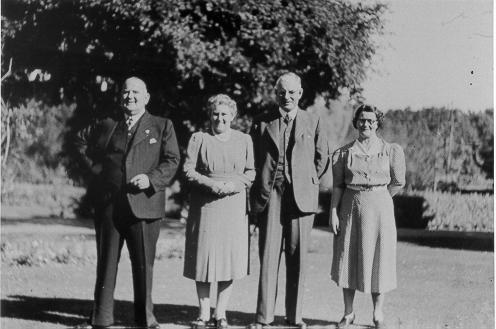
As I alluded to, there’s a photograph of Curtin and his wife, Elsie, taken in the grounds of the Lodge on 27 April 1945 which was published in newspapers after his death as the final photograph of Curtin. It was only three days before he was admitted to hospital; his daughter writes in a letter that Curtin arranged the photo shoot in honour of their anniversary on 21 April. Equally interesting and lesser known is the photograph above (John Curtin Prime Ministerial Library, JCPML00450/6), taken at the same time, with Ray Tracey, Curtin’s chauffeur, and Jessie Pincombe, the Lodge’s housekeeper. There was a reason Curtin wanted a photo with them – this was his household. Tracey probably spent more time with Curtin than anyone in his prime-ministership, playing billiards with him and discussing sport and racing. Tracey drove Elsie over to Adelaide for the ALP Women’s Conference earlier in 1945. Jessie Pincombe is recorded in the newspapers as comforting Elsie immediately after Curtin’s death on 5 July. This other final photograph gives a fuller sense of those last months of Curtin’s life.
 Nathan Hobby, a biographer in Perth
This is beautifully insightful – yes, into Curtin’s death and personality, but even more so into the vagaries of biography writing. The inaccurate recollections, the contradictions, the endless decisions about narrative. Thank you SO much for sharing.
LikeLike
Thank you Michelle, I’m so glad you think so!
LikeLiked by 1 person
Thank you – an excellent insight.
LikeLiked by 1 person
A nice piece of sleuthing Nathan – small details can reveal much, not least about historians and biographers! A related issue as I’m sure you know was how justified was Serle In his ADB entry in regarding Curtin’s death as a war casualty. Again as you’ll know, Michael McKernan agreed. There was even debate about him saying this caught in the relevant ADB file (see https://press.anu.edu.au/publications/prime-ministers-australian-national-university P 105)
Michael
LikeLiked by 1 person
Thank you Michael! I’ll have to check out the ADB file. Everyone wanted to honour Curtin as a war casualty, but 60 seems a very typical age to die of heart disease for that generation, regardless of their stress levels. His father-in-law was about the same age when he died of heart disease in his retirement.
LikeLike
Such an interesting piece of work, Nathan. Gosh, you’re good at this stuff!!!!
Denise
LikeLike