
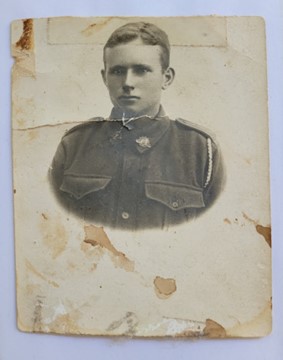
When I was fifteen, my grandmother sent me a photo of her father, Bert Sewell, in military uniform during the Great War. He was twenty but he looks younger. She was offering it to me because she thought I resembled him. Her attention was unpredictable and her true thoughts and feelings inscrutable; I felt honoured to have been chosen like this out of six grandsons. I placed the photo in the concertina folder I had for important documents, which also put it out of sight and out of mind for many years. I don’t remember my grandmother ever talking about him again. But when she died we found a correction she’d made in biro to Bert’s entry in a family history book.
Bert died on 9 December 1967 in Perth’s Hollywood Repatriation Hospital. Ten days later, his wife, Iris, died too. Their entry in the family history book claims, ‘An unfortunate accident followed by prolonged litigation brought about their hastened deaths’ (Sewell 167). My grandmother scribbled those lines out and wrote that Bert died of bladder cancer and Iris died ‘following a third stroke’. What my grandmother wrote is technically closer to the truth. But just before he died, Bert shot a man in the thigh and spent nine days in the Meekathara lockup. Although it wasn’t actually an accident and the litigation wasn’t prolonged, its proximity connects it to his death and Iris’s death. My dad was thirteen at the time; he was told about their deaths but not about the shooting.
My dad went in search of Bert’s trail in 2014. In Geraldton, he tracked down a man named Alan who had been Bert’s boss on Beringarra Station in the 1960s. When my dad interviewed him, Alan remembered Bert quite well—probably the only person left alive who did. ‘He’d been in the First World War’, Alan said, ‘but he never talked about it much—only the joking side of it. But he admitted he had shot a lot of Germans during the war. You know, he spent the time in the trenches and I think that was probably why he was such a tough old bugger.’
Bert was wounded in France, a gunshot wound to his knee; his brother was killed. His parents went bankrupt while he was at the front and the farm was sold. After the war, he married Iris and they had five children over the next decade, with my grandmother the first. They were farming but it didn’t work out and in the Depression they too went bankrupt. Before that, he had a traffic accident, hitting a boy who ran onto the road. The boy died a few months later after an operation to repair his skull. Iris and Bert eventually bought a dairy on the outskirts of the city; Iris ran the dairy and Bert went off on long stints working in the outback. For six weeks around Christmas time, he would come back to the city to stay. For some reason, he didn’t sleep inside but in an outside cabin. He would lie on his camp-bed smoking and reading Westerns. He could roll a cigarette with one hand.
In 1967, Bert was being treated for bladder tumours at Hollywood Repatriation Hospital in between stints working at Beringarra Station. Beringarra is 850 kilometres north-east of Perth. There were 14,000 sheep on the station and Bert was working as a fencing contractor. He lived a hard life, shooting pigeons for food and his boss Alan remembers he would ‘open a tin of meat and eat half of it at night and leave it on the cab of the motor-car overnight and have the rest of the meat for breakfast’. He got on well with Alan’s wife and ‘when he came into the homestead he wouldn’t eat with the blokes, he’d come up and eat with us, so he became very much part of the family’. It’s a memory which sits uneasily with something my dad says at one point in the interview: ‘I never spent more than a few minutes with my grandad’.
On the weekend of 2 and 3 September 1967, Alan and many of the others left the station for the three hour drive to the Landor Races, the annual race meeting of the East Gascoyne Race Club held in the red dirt over two days. There were two women, three children and two men left on the station. Alan remembers, ‘I had a lady cook there and she got her daughter to come up from Morawa’; the cook’s name was Mrs Paddon ‘a very, very old lady even then’. One of the men was Bert; the other man, who Bert ended up shooting, was a fifty-year-old yardman named Mervyn Stockman, or as Alan calls him, ‘this bloody useless yardman—he had a record that long on him’.
Stockman was from South Australia and over the years had found himself in regular trouble. In 1937 he was wanted for the maintenance payments for a baby born in Adelaide before being tried at Mount Gambier for indecent language. He appeared before courts several times for drunkenness. In July 1951, he began shouting, ‘Heil Hitler!’ to passers-by on George Street in the middle of Sydney while drunk; he pleaded guilty to having behaved offensively and was fined three pounds (Evening Advocate). ‘Medium build, fresh complexion, light-brown hair, blue eyes, ordinary nose and mouth, round chin, two brown moles small of back, two brown marks inside left upperarm’ recorded the police gazette in the absence of a photo (South Australian Police Gazette).
On the Saturday night while most of the Beringarra workers were at the races, Stockman, in the words of Alan, ‘picked up a bottle of metho, got blind bloody drunk on the metho and started intimidating these women’. He had his rifle out. Bert packed everyone else into his Ford Prefect ute and drove them five miles out to a shearing shed, a safe distance from Stockman. They slept in the shearing shed that night and the next day thought it would be safe to return. Back at the homestead, there was a confrontation and Bert shot Stockman in the thigh.
Either Mrs Paddon or her daughter ‘got on the pedal-set calling for help’ to a neighbouring station manager, John. According to Alan, ‘John went over and stabilised the situation and then the police came out. But we—the policeman and I from Landor—we were sent back down there, armed with all the rifles we could get.’ There was no need for further violence—Stockman was admitted to Meekathara Hospital where he remained for five nights.
Detectives came to investigate the situation. They charged Bert with unlawful wounding and Stockman with two counts of pointing a firearm. Both men appeared in the Meekathara Police Court and were remanded in custody, Bert until a date to be determined and Stockman until 20 October.
The local police were sympathetic to Bert’s case, so they probably made his stay in the lockup as comfortable as they could. But for my grandmother, wife of an Anglican minister and someone to whom appearances meant a lot, it must have been a terrible source of shame to think of her aging father in a police cell.
Bert’s case was held on Tuesday 19 September, the day he was meant to be back at the hospital for another appointment. According to Alan, ‘the prosecutors and the defendants and I and Bert were all in the pub on the booze in the morning before the court case.’ The barred windows of the police holding cell on one side of Main Street look across to the Commercial Hotel on the other side. They walked from the pub over to the courthouse. ‘It was a foregone conclusion what was going to happen to Bert,’ says Alan, ‘but it had to go through the due process’. According to the newspaper, Bert was discharged ‘when it was held that insufficient evidence had been produced to sustain an unlawful wounding charge against him’ (The West Australian). He was free to return to Perth for his delayed medical treatment.
***
WHEN BERT’S repatriation file arrived by email from the National Archives, I was startled to find, near the beginning, a letter in my grandmother’s familiar handwriting. But it was actually written by her sister, Daphne, who—sharing genetics and probably the same teachers—came out with the same hand. This in itself is a minor haunting. To me, Daphne has only ever been a cluster of tragedies in the family tree: a photo in a family album of her toddler son hours before he drowned in sheep dip, her premature death in 1970, her husband Tom who lost his legs. And now I find a letter of hers preserved by bureaucracy.
She was writing in March 1968, more than three months after Bert’s death. ‘Dear Sir/Madam’ the letter began as she finally committed to paper the questions that had been haunting her for months:
What was the operation, did the Doctor find cancer present,
Was the bladder removed completely or only the growth.
Was there a growth in the bowel?
What was the result of the post mortem
Did someone pick up his belongings from the hospital.
I would be very greatful [sic] if you could send me the information. (Repatriation Department 3)
She knew so little about Bert’s death. There is no reply recorded in the file, a silence that seems so sad if it means Daphne was never given any resolution; was she ineligible to know because she was not the next-of-kin or was a reply sent and not saved? Her letter changes my perception. It isn’t necessarily a case of my grandmother and her generation obscuring Bert’s death. Perhaps they were all baffled like Daphne.
Bert’s delayed cystoscopy finally took place on 9 October. It found two tumours in his bladder requiring surgery, but ‘Patient is being discharged at his own request for three weeks, when he will be re-admitted’ (Repatriation Department 52). He probably returned to Meekathara to testify at Stockman’s trial; the trial doesn’t seem to have been reported in any of the newspapers and its outcome is a mystery to me.
In the operation on 6 December, Bert’s whole bladder was removed. After the operation, he developed septicaemia and was ‘dangerously ill’. He died on 9 December at 5:45pm, not directly from the stress of the shooting or the bladder cancer itself, but an operation gone wrong. It wasn’t an easy death; ‘the mouth contains regurgitated gastric content’, the autopsy found. Iris was not present and was notified by ‘verbal message’—a telephone call to her house? Or was she elsewhere in the hospital, just getting some food or rest, missing the moment of death?
The hospital recorded the ‘valuables’ Bert had left behind at the hospital—there was nothing personal, just a $12 cheque, 28 cents in coins, as well as a 3 pence piece, only recently decommissioned with the switch to decimal currency. Procedures were followed and a ridiculous cheque was made out to Iris for 28 cents, but she was dead by the time it came.
Bert’s funeral service was conducted by W.H. Mead Funeral Directors on 12 December 1967. I look up the address of the funeral home and discover it’s opposite my son’s school. It’s a caryard now, but most days as I park my car overlooking the address, I think of my forebears gathering in that caryard to farewell Bert. I imagine it as a beautiful Federation building, appropriate to commemorating the dead, which only serves to stoke my anger that the caryard knocked it down. But then I find photos of the funeral home from 1972. It was a low, drab 1960s building which could serve quite well as a dentist, set back from the street with a neat lawn.
I don’t know if Iris was at Bert’s funeral or if she was too sick to attend. She died of a stroke a week later. ‘Passed away peacefully at the Armadale-Kelmscott Hospital,’ according to the notice my grandmother placed. There weren’t many notices. The neighbours banded together to offer ‘sympathy to a good neighbour’ when Bert died and ‘sympathy to a very nice neighbour’ when Iris died. I thought there might be some ripple in the papers because of the Beringarra incident but there wasn’t. I thought the Beverley Times, the chronicle of their homelands in the Wheatbelt, might pay tribute to them as it had to their parents and grandparents, but perhaps they had been away too long.
In a final ignominy, a memo entitled ‘Examination of brain after fixation in formalin’ reveals that on 11 January 1968, Dr J. Ward in the mortuary found no abnormality and discarded Bert’s brain. The options were limited. It would have been unreasonable to delay the funeral to wait for the formalin to fix. It would also have been unreasonable to dig up the coffin and reunite his remains. Yet it’s in this organ discarded in the mortuary of the Repatriation Hospital that we think of our self residing and our most complex functions occurring. I imagine a great tub of medical waste, a collection of small tragedies, placed into the incinerator unceremoniously and a plume of smoke rising out of the tall narrow chimney. You might even be able to see it from the adjacent Karrakatta Cemetery.
***
I TAKE the train to the cemetery on a warm November day. A map at the entry shows the sprawling sections, divided by denomination. Bert and Iris’s grave is in the north-eastern corner and I set off along the road. I pass a graveside service, the appropriately sombre words of a young minister carrying over to me. The renewed sections are covered in lush grass, their graves bold and shiny. There are some older gravestones preserved in the garden beds at the side, in a huddle of the dispossessed. They are a representative sample of the best-looking ones, only a small percentage of the many which have been removed. I wonder if I could save my great-grandparents’ gravestones before ‘renewal’ and place them in my garden? I pass another section which seems to have escaped renewal, full of aging stone monuments appropriate to death, and carrying the dignity of more than a century. But my great-grandparents’ section is not old enough to be picturesque. It is tired and not ornate, sandy between the graves. Lacking the majestic gum trees that shade many of the sections, these mid-century graves are in full sun.
Each grave has an iron marker displaying its number and looking like they are made to last far longer than the lease the cemetery offers. Bert and Iris’s grave has a small, angled stone with its words reduced to dots, the original metal having fallen out. It’s not the kind of headstone which survives renewal and I find it harder to imagine preserving it in my own garden. The grave itself is brutally plain, a rectangle of bare concrete with blue metal chips running through it. There are two small holes at the head of the grave to hold flowers, one retaining its built-in vase and one forlornly empty.
In Kevin Brockmeier’s The Brief History of the Dead, there is an afterlife in which you live only as long as someone on Earth still remembers you. When the last person who remembers you dies themselves, you disappear. It makes literal the secular afterlife. We tell the departed that they will never be forgotten, but we’re either mistaken or we’re lying.
***
I’VE BEEN working on this essay for a year and the present I’m writing from keeps changing, undermining my attempt to create a stable reality with which to remember those long dead. The day Bert’s repatriation record arrives in June, I find out my other (maternal) grandmother is in hospital. I don’t drive straight down to see her that night; instead I read through the scans of records about an ancestor I never knew. I keep thinking she still has many months to go but she dies three weeks later. Preparing her eulogy, I listen back over an oral history interview I conducted with her before she was sick. It covers only her early life and I reassure future listeners that it is just the first in a series. But it was to be the only one. In October, my best friend is visiting town. He’s a doctor and I tell him I don’t want to be morbid but can I ask him about the autopsy report and Bert’s death? He doesn’t mind answering my questions. Over dinner, he mentions that his depression is back. In February, he kills himself. It makes the attention I give to the dead seem obscene; I should be keeping vigil with the living.
I move house, my son changes schools and I stop my daily reflection on the demolished funeral home. I keep googling Alan wondering if I should get in touch to see if he will answer some follow up questions. In May he dies. ‘The Captain has left after a long and rewarding innings,’ reads one of the notices. I don’t feel regretful; he recalled everything about Bert he could tell us. I’m left only with the miracle that my dad found him at all and recorded his unlikely memories of an unfamous man dead so many years.
The essay has been expanding. I try to tell of all Bert’s misfortunes, his whole life, as much as can be recovered. But that is more than an essay and finally I pare his biography back, he becomes his final misfortunes.
Works cited
Brockmeier, Kevin. The Brief History of the Dead. Pantheon Books, 2006.
Evening Advocate, 20 July 1951, 7.
Repatriation Department. Sewell, Hubert Harry [sic]. National Archives of Australia, PP869/1, M8787.
Sewell, Barbara. The House of Northbourne Parkers: pioneers of Western Australia, 1830-1983. Barbara Sewell, 1983.
South Australian Police Gazette, 19 January 1938, 26.
The West Australian, 19 September 1967, 16.
 Nathan Hobby, a biographer in Perth
I really love this piece, Nathan. Mournful, nostalgic, sad, but also captivating. I’d love to know more. Anything else to come?
Denise
LikeLiked by 1 person
Thanks Denise! That’s probably it on Bert. I cut out the earlier misfortunes- he accidentally hit a child with his car in about 1925 and the child died a few months later. And he went bankrupt in the depression!
LikeLike
Great essay Nathan. I love that country east of Meeka, so empty and so much attached to it – Turee Creek of course, and the station in Neveille Shute’s Beyond The Black Stump (roughly contemporaneous with your G Grandfather), to name two
LikeLiked by 1 person
Thanks Bill! I wish I knew that country better.
LikeLike
Very sombre and beautifully written Nathan. I never knew my grandparents and only know snippets of their lives, unfortunately each generation has it’s tough times and these are the instances that are often more remembered. I think I have dwelt too much on the hardness of my paternal grandparents lives because it’s what I know (including an unhappy marriage and incarceration in a concentration camp). These days I try to think of the happiness they probably had at times. This change in my thinking came about when a young physio I was seeing came to the conclusion that I have had a hard life. It brought me up short because it’s not how I have viewed my 61 years on this earth. It’s just a life that has had some unusual challenges that have left their marks 😊
Still need to get a copy of KSP to sit down with and read x
LikeLike
Thank you! A good change of thinking, it’s possible to see the happiness and small joys in every life.
LikeLike
A magnificent piece.
So well written and informative.
Thank you
LikeLike