Jonathan Franzen’s Purity – a capsule review

Tags

,

purity

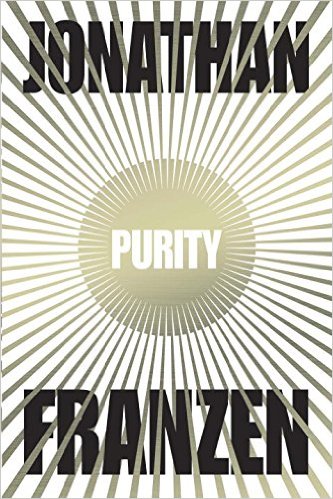
Jonathan Franzen’s Purity, published at the beginning of this month, is an engrossing and ambitious novel about idealism and marriage. In its long chapters from different viewpoint characters, it throws many balls into the air – fatherless Pip, real name Purity, a young woman in California with a crippling university debt and a needy, hermit-like mother; Andreas Wolf, a fictional, supposedly-purer Julian Assange, driven by lust and a dark secret from 1989 in East Berlin; and Tom Aberant, the founder of an online newspaper championing independent journalism, who still hasn’t got over his ex-wife. (It’s a curious choice that Franzen doesn’t give Pip’s mother, Penelope, a viewpoint chapter, and probably a weakness of the novel.) The different threads increasingly intertwine until the novel finally resolves with an unexpectedly cosy ending. Franzen has so many strengths. Complex characters with behaviours and thoughts that illuminate people we know and perhaps ourselves. Compelling drama as his characters are torn between conflicting desires and pushed to the edge. A seriousness of theme and purpose combined with moments of hilarity. All of these are on display in this novel, and yet inevitably, I have to compare it to his novels The Corrections (2001) and Freedom (2009), both all-time favourites of mine, and my initial impression is that it is less profound than these – at least partly because of that cosy ending.
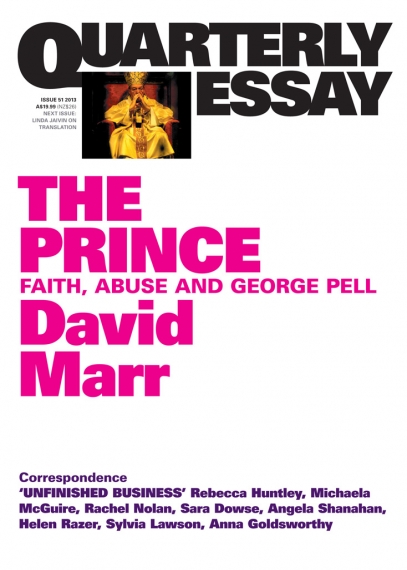
Notes on biographical method in The Prince: Faith, Abuse and George Pell by David Marr

Tags

,

prince-marr

I’ve finished listening to the audio version of David Marr’s The Prince: Faith, Abuse and George Pell during night-feeds of my nine-week old son, a slightly surreal and disturbing companion at 2:30am each morning. It’s the original Quarterly Essay edition of 2013; the print version of this edition is 124 pages, while the expanded 2014 edition is 210 pages. Continue reading

Mr Brandis, the writers of Australia await your response!

Tags

,

In the midst of the many disturbing social, environmental and economic policies of the incumbent federal coalition government, its treatment of writers has not been prominent in the national consciousness. But Mr Brandis, the arts minister, has taken away millions from the Australia Council for the Arts to administer himself. This includes all the funding for writers, and writers of Australia have now been living in uncertainty for a considerable time while the new arrangement has not been announced. Kate Forsyth has written a “A small and very polite rant about the importance of writers to the world” directed at Mr Brandis. It concludes with some innovative additional ways forward for funding writers better, including letting writers write on the dole, and exempting writing income from tax. Two ideas well-worth considering.

Wake in Fright

Tags

,

wake-in-fright

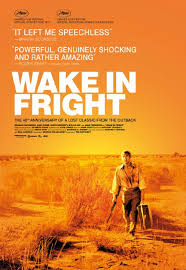
I’ve finally watched the great Australian film, Wake In Fright (1970). It’s the story of a school-teacher’s descent into a hell of drinking, gambling, and violence when he gets stuck at an outback town called the Yabba on his way back to Sydney. The brutality of the characters’ dissipation is matched by the beauty of the film-making, each scene, each shot so well-composed to capture the landscape, the drama, the horror. Watching it in stops and starts over a week as I fed my newborn son, I was acutely aware of its achievements at a micro-level.

It’s such an ambitious film. It successfully attempts to depict the dark side of the Australian psyche. Aboriginals hover at the edge of several shots, never speaking. The orgy of gambling stops only for a surreal moment’s silence to remember the fallen Anzacs. The only crime is to refuse a beer with a bloke.

It’s unthinkable that this film was out of circulation for years, considered lost until the discovery of a print in a discard bin and its splendid restoration for its 2009 re-release.

Why and how I write: a blog chain

Tags

Writer and priest, Ted Witham, has asked me to carry on a chain-blog. Ted’s post can be found here, giving interesting insight into his writing process. I think a walk along the beach first thing is a splendid idea, though would be a bit hard for me. I’m also looking forward to his feature article on Dorothea Angus.

What am I working on at the moment?

As readers of this blog know, I’m working on a biography of the early life of Katharine Susannah Prichard. I have a new title this week, taken from chapter two: “The Memory of a Storm: The Making of Katharine Susannah Prichard, 1883-1919”. It’s a phrase from her book The Wild Oats of Han, but it also refers nicely back to her autobiography, Child of the Hurricane, the foundation for my book. Continue reading

Some notes on Who’s Been Sleeping In My House?

Tags

,

whos-been-sleeping

With Who’s Been Sleeping In My House? showing on ABC and Who Do You Think You Are? on SBS, biographical quest television is having its moment, and I’m so glad. Each week on My House, presenter Adam Ford researches the past of an Australian house. This season has gone from a former hotel in country Victoria, to a flat in Sydney, to Adelaide, to north Queensland, and most recently to Mt Lawley, an inner-city suburb in Perth.

Continue reading

An Unsentimental Bloke wins the National Biography Award

Tags

,

unsentimentalbloke

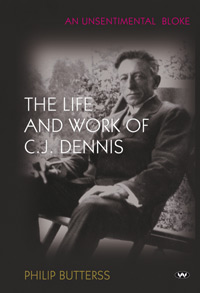
Congratulations to Philip Butterss, whose biography of CJ Dennis, An Unsentimental Bloke, won the National Biography Award of Australia on Monday. A battered old copy of CJ Dennis’s Sentimental Bloke sat on my family’s shelf when I was a child, and my unsuccessful efforts to read it immunised me against him, perhaps rather unfairly. Continue reading

Finding “critical utility” for literary biography: a summary and initial response to Philip Holden

Tags

This post, I warn you, is a response to an academic journal article. If you find it boring or incomprehensible, please do come again another time – you’re likely to encounter something of broader appeal.

Philip Holden’s “Literary Biography as a Critical Form” Biography 37.4 (Fall 2014) is a lifeline thrown out to literary biography, the “Cinderella” of literary studies. Holden takes as his point of departure Michael Benton’s monograph Literary Biography: An Introduction (2009). In my reading of Benton’s work (which I found an excellent account of the state of the genre and challenges and issues within it for the biographer and reader), he is content to retain literary biography’s estrangement – or at least distinctiveness – from literary theory and literary criticism and proceed with giving an account of the genre on its own terms. Holden, in contrast, wants to achieve a rapprochement. Continue reading

Dump Pickings

Tags

,

Over on her blog in another amusing and insightful post, Laura Sewell Matter’s biographical quest takes her to the rubbish dump, the one named after the wife of her subject. What a meta-moment! As she says: “The research process has been largely about sifting through dusty old stuff in search of what remains useful. There are items that stink and items whose original use I cannot decipher, amidst all the metaphorical tuna cans and banana peels** (remnants of daily life), and a few real treasures that make it all worth the effort.”