Letter to the future

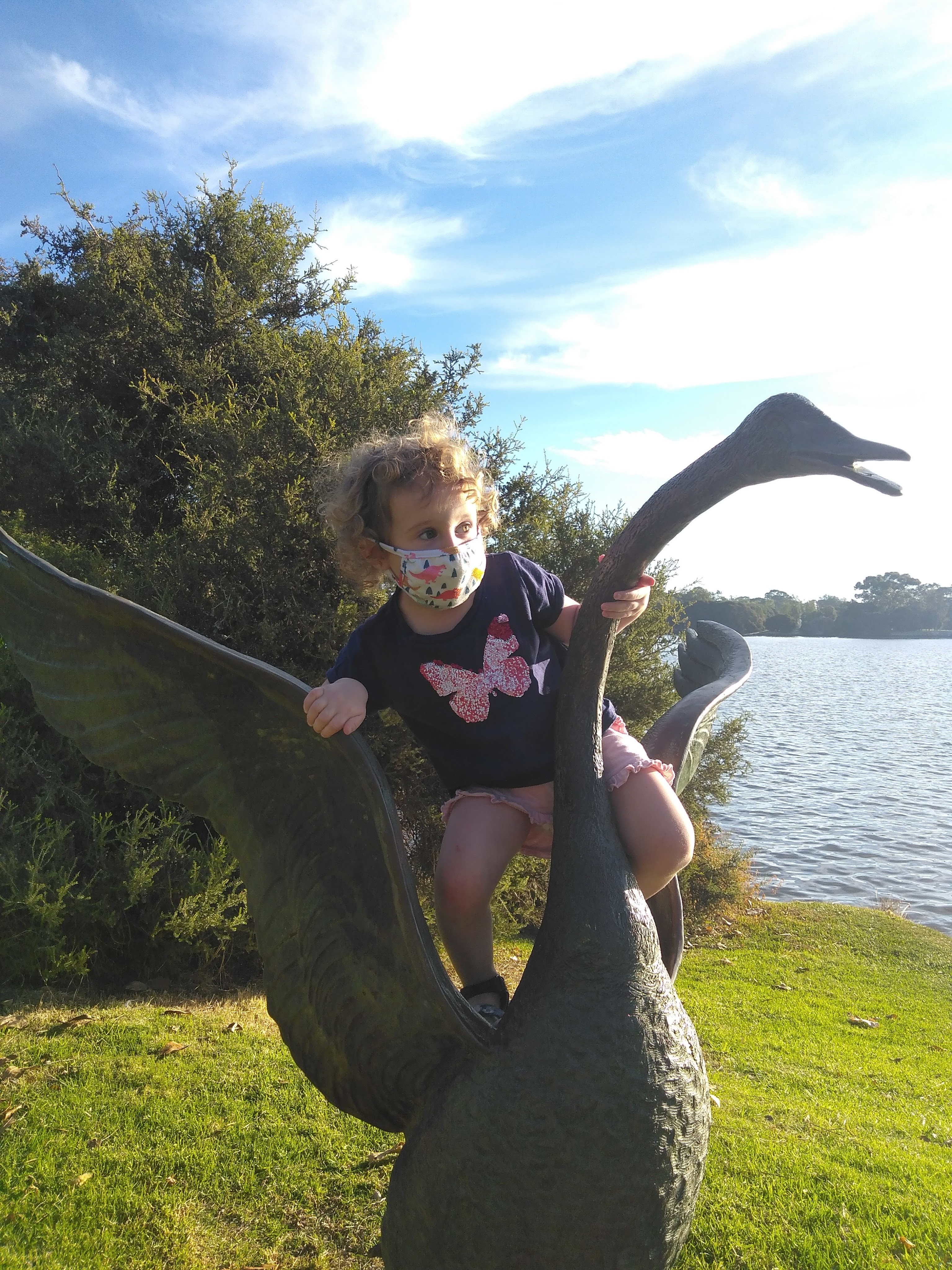
Little girl in a mask climbing on a statue of a swan.

What do you even remember about the pandemic years? Are you aware of how much they’ve affected you? Do you still obsessively wash your hands, Sarah? This last year, if we can’t find you, there’s a fair chance you’ve slipped into the bathroom to stand on the step-stool and bathe your hands in liquid soap with the water running, sometimes until the soap dispenser is empty. It’s not likely you’ll remember the ‘before’; you were eighteen-months old in March, that weekend the prime-minister said the lockdown was coming but he was heading to the footy one last time. And Thomas, maybe your memories will start with with this time, the ‘before’ fading out until it seems all your first six years or more were lived in the shadow of coronavirus. I hope not, I hope all the different seasons remain distinct in your memories. I keep asking you about your past to try to keep alive as many of them as I can.

Continue reading

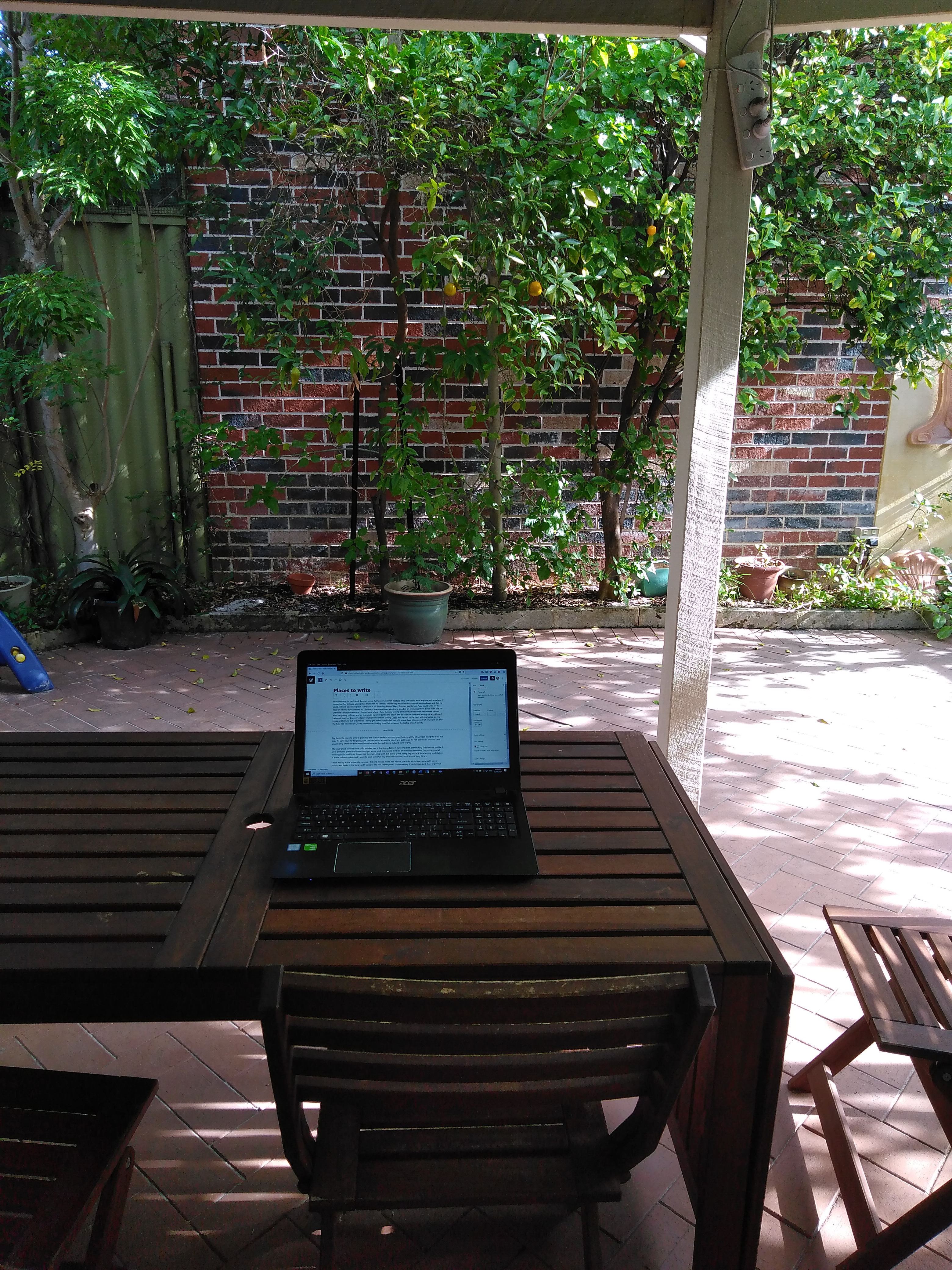
Edge of the bath and back seat of the car: the places you’ll write

In an obituary for her friend, Sumner Locke, Katharine Susannah Prichard said, ‘She could write anyhow and anywhere. I remember her telling a young man that when he came to her wailing about his uncongenial surroundings, and that he could not find a suitable place to work in at his boarding house “Man,” Sumner said to him, “you could write on the edge of a bath, if you wanted to.”‘ I think of that sometimes as either a goad or an encouragement. I also think of Kate Grenville saying somewhere – I’m not sure where – how the only writing time she had was when her mother looked after her young children and so she would park her car by the beach and write in the backseat leaning on a kickboard balanced over her knees. I’m sure I’ve got the details slightly wrong but I’ve taken inspiration from her during Covid and parked by the river with my laptop on my knees until it runs out of batteries – I only get an hour and a half out of it these days. (Alas, once I left my lights on and another battery ran out too; on that occasion waiting for the RAC to arrive I had some extra thinking time, the laptop already dead.)

Continue reading

Katharine Susannah Prichard in the 1940s and 1950s

A contribution to Australian Women Writers Generation 3 Week, Part II, 17-23 Jan. 2021

Katharine Susannah Prichard spent the 1940s working on her Western Australian goldfields trilogy, which finally appeared as The Roaring Nineties (1946), Golden Miles (1948), and Winged Seeds (1950). It’s a saga that tells the story of the development of the goldfields through the fortunes of one family, and interwoven with folklore, historical events, and technical descriptions. It is Katharine’s attempt at writing faithful to her communist convictions, bearing the influence of reportage and socialist realism. Yet it’s also faithful to Katharine’s recurring literary interests in industries, regions, and group narratives. It is a decisive turn away from her experiment with modernist interiority in her novel of middle-class marriage, Intimate Strangers, drafted between 1929 and 1933 and published in 1937.

It was an ambitious project, and at the time the reviewers focused more on its failings than its successes. It’s true that Katharine’s politics and research are sometimes intrusive, but it is also a poignant and tragic saga that evokes very well an industry and a place and the changes over the years. Katharine reacted to the negative reviews by discounting Australian critics altogether and maintained the trilogy was the high point of her ouevre.

Katharine had been at the vanguard of Australian writing and she now found it hard to be striking out in her own direction, largely alone. She read Patrick White’s Tree of Man in 1957 and was excited by it, even though she disliked the focus on ‘moronic types’. Yet as Patrick White and Randolph Stow were proclaimed by some as Australia’s first great writers, Katharine felt she and her generation were being neglected. By 1964 she had turned decisively against White writing, ‘Lost in the fog of their own delusions, writers like Patrick White believe they are uncommitted to any social purpose, while, as a matter of fact, they serve the causes of obfuscation and the defeat of human dignity in its demand for truth and justice.’

After World War Two, Australia changed in ways that left Katharine alienated and sad. She had long wanted Australia to have cultural independence from the United Kingdom, but it didn’t go the way she hoped. Her hopes were for an Australia sympathetic to socialism and proud of its progressive history and its love of the bush. Instead, she witnessed with horror the pivot toward the USA, the rise of consumerism, the long Menzies government, and increased urbanisation. In my forthcoming biography of Katharine, I look at the 1950s in her life as a time of frustration, with false literary starts, an autobiography which wouldn’t write itself, and her feeling of stronger identification with the Soviet Union and its people than an Australia which had changed in one direction as much as she had changed in another.

Honouring KSP: 2 short videos on Katharine’s life & a tour of her house

Tags

, ,

This week, Writing NSW’s Honouring Katharine Susannah Prichard online event continues! I made this short video about her early years, from her purported birth in a hurricane to her political conversion and literary breakthrough.
And this one is about Katharine’s prime from 1919 to 1933, the period she exhausted herself in a flurry of political activity and returned to literature to write her three greatest novels before the biggest tragedy of her life hit her.
This video is a tour of Katharine’s home in Greenmount, now the headquarters of KSP Writers’ Cenre, with chairperson Elizabeth Lewis.

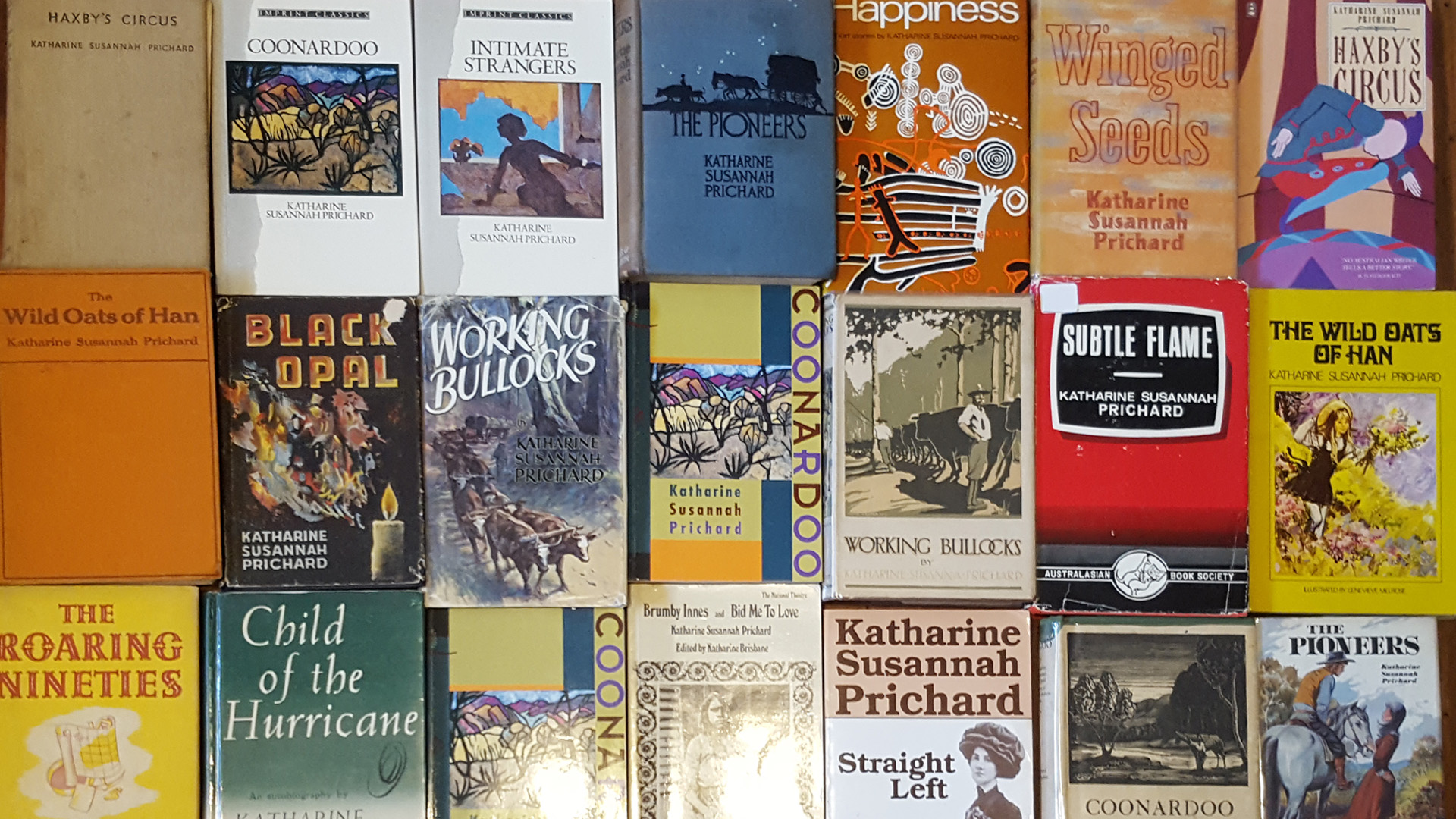
Honouring Katharine Susannah Prichard: a reading list for the joys of KSP

Tags

Writing NSW is honouring Katharine Susannah Prichard this month, the seventh writer in their annual celebration of our Australian literary heritage. Why read Prichard in the year 2020, fifty-one years after her death? I want to answer that by focusing on the joys her work can bring us today. This reading list accompanies the first video I made with Writing NSW for the celebration, which will be streaming on their site from 9 November 2020.

Continue reading

Katharine Susannah Prichard commemorative anthology

Tags

Today is the 51st anniversary of Katharine Prichard’s death. As part of the commemoration of the fiftieth anniversary last year, the KSP Writers’ Centre published an anthology called Kaleidoscope, collecting creative non-fiction, fiction, and poetry about Katharine, her husband Hugo Throssell, and their house in the hills of Perth, now the home of the centre. The published pieces were the best entries in a competition; Shey Marque judged the poetry and I judged the non-fiction and fiction. The standard was high and the collection is a significant interpretation of Katharine and her legacy, as well as a good read. I wrote in the judge’s report, ‘        

Katharine was a complex person with many aspects to her life and a writer with a diverse oeuvre. This multi-voiced anthology captures some of that diversity and honours her political commitment to the collective. It moves across genres, across countries, across decades, beyond the span of her own long life into the fifty years since her death and even into the future.

It includes a moving fictionalisation of Hugo’s last moments through his eyes, the story of a mother giving birth in Fiji, where Katharine was born, and Denise Faithfull’s intriguing account of her literary pilgrimages in the footsteps of James Joyce and Katharine. I contributed a brief biography of Katharine’s life as an introduction. Katharine’s granddaughter, Karen Throssell, launched the book and her wonderful speech can be read here.

It’s a hard book to get hold of, but worth the effort. The first print run sold out on the launch day, but I believe there has been a second print run. To buy a copy, you can contact Wild Weeds Press at the KSP Writers’ Centre – wwp-admin@wildweedspress.com. Not sure of the price, but $20 or $30 plus postage, I think.

The physicality of books

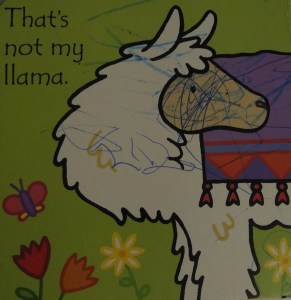
I try to teach my kids to be careful with books but it doesn’t work with two-year-old Sarah. She has a very physical relationship with books. The ones she loves best she bends their covers until they break (Favourite Fairy Tales), tears out the lift-the-flaps (Hop Little Bunnies), scribbles on the faces of the characters (That’s Not My Llama). ‘She’s getting the paperbacks!’ her brother called out urgently once.

Continue reading

On reading Moon of Desire

Tags

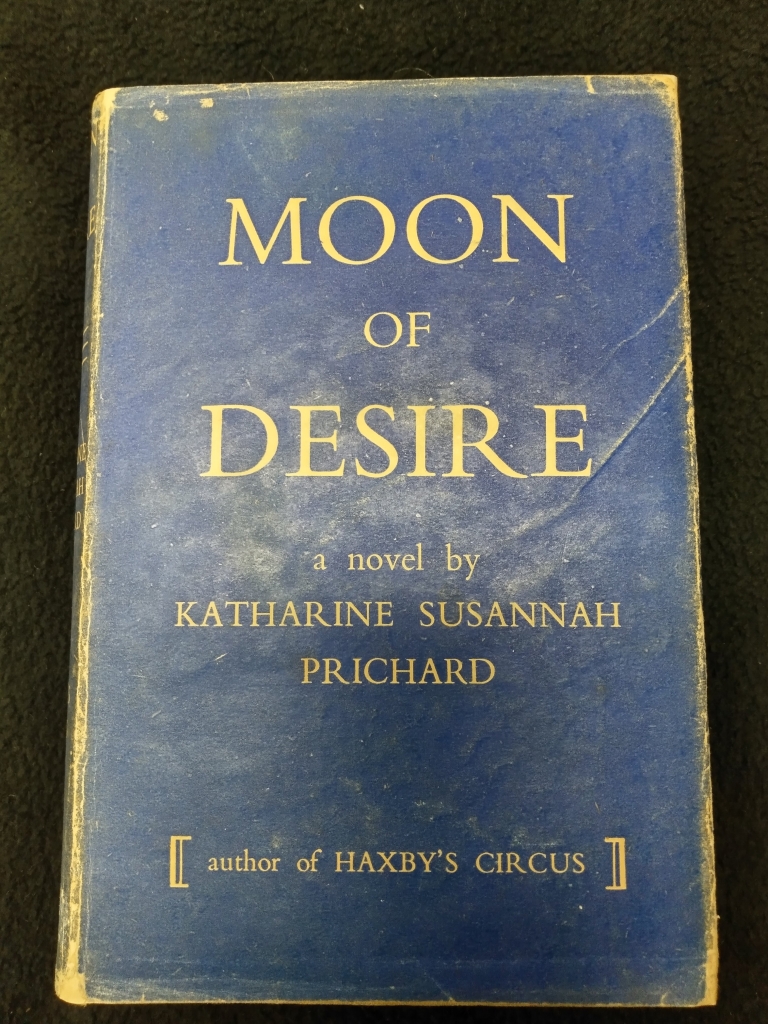
Dust jacketed copy of Katharine Prichard's Moon of Desire (1941)

The first thing I did when I started writing a biography of Katharine Susannah Prichard was to read all of her novels, roughly in order. I even found a rare copy of her rarest novel, Windlestraws (1916) at just the right time. But I didn’t find a copy of her second rarest novel, Moon of Desire (1941) – at least not at a price I wanted to pay – and so it languished unread, as I marched on with other more pressing things. She rated it lowly herself, explicitly writing an action-filled romance when she was short of money in the hope of it selling well and being optioned as a Hollywood film.

Continue reading

Some news

img_20200423_161108

Here I am in the Officeworks carpark on Thursday signing a contract with Melbourne University Publishing for my biography of Katharine Susannah Prichard.

I have to submit it by 1 September (gulp – this has become a bit harder since isolation, now there are children with us all the time). The publisher has let me go to 150,000 words (about 500 pages) – twice as long as my PhD, which only covered the first part of Katharine’s life. I have two chapters to finish off, then an immense amount of editing to do. (Alas I’m at 159,000 words right now, so it shall include more cutting!) It’ll be published in the first half of 2021. Really hoping I can have a book launch by then. A national tour would be nice, children permitting.

It’s been a long road, six years working on this, and sixteen years in the literary wilderness since my first book, so it means a lot to finally be coming back. Thanks to everyone who’s accompanied me along the way.

I miss blogging. Once I’m done, I’d love to get back to it. At the moment, time has become rather scarce. I miss you all!