• About
  • The Red Witch: A Biography of Katharine Susannah Prichard
  • My novel: The Fur

Nathan Hobby, a biographer in Perth

~ The lives of John Curtin & Katharine Susannah Prichard, the art of biography, and other things

Nathan Hobby, a biographer in Perth

Category Archives: books

A street called wall

24 Friday Oct 2008

Posted by Nathan Hobby in authors, link

≈ 2 Comments

Tags

poetry slam

My wife Nicole has entered the ABC National Poetry Slam Competition. It’s an excellent political poem called ‘A street called wall’. You can view it online here: http://contribute.abc.net.au/kickapps/_A-street-called-wall/video/372060/32422.html .

I like the interweaving of so many texts in the poem – nursery rhymes, Lewis Carroll, the Beatles, Don McLean, advertisements. For me it captures the milieu of the moment. And I’m in admiration of her rhyme and rhythm.

But I’m biased; judge for yourself.

Gen Y literary blog, Angela Myers

21 Tuesday Oct 2008

Posted by Nathan Hobby in books, link, writing

≈ 4 Comments

Tags

angela myers

A new blog I’m following is Literary Minded, Angela Myers’ excellent blog of all things literary from an Australian perspective at http://blogs.crikey.com.au/literaryminded/. I’m overwhelmed by her energy and prolificy, and feel appropriately old and tired. She’s keeping up with everything!

She describes herself as a Gen Y writer and I realise I’m not sure I can call myself this. Not that it wouldn’t be good to be the voice of a generation (until Gen Z comes along and you’re yesterday’s news). But that I feel a perpetual outsider status to be necessary to my sense of self. I guess I’m disloyal to my generation. There’s a lot I don’t like about it.  (But I don’t think it’s as bad or as monolothic as commercial media makes out, either.) Maybe I need to find more of a sense of generation as part of my identity.

(Part of the problem is that I’m on the cusp of Gen Y and Gen X and so I don’t belong in either. )

Forgive them for they do not know what literary fiction is

21 Tuesday Oct 2008

Posted by Nathan Hobby in life, reading, writing

≈ 3 Comments

Tags

literary fiction

A common question people ask when I tell them I write novels is, ‘What genre?’. Okay, so maybe they don’t use the word genre, but that’s often the gist of the second question. (Sometimes people ask what a novel is, but not every time, or even half the time. But way too many times.)

I usually tell them ‘literary fiction’, but I’m beginning to think that hardly anyone knows what I mean. ‘Like fantasy?’ someone said today.

I don’t mind calling literary fiction a genre. When I was a science fiction nut at sixteen and seventeen, I remember reading an impassioned article in Aurealis, perhaps by Van Ikin, about how literary fiction is just as generic as science fiction. The literary stories he analysed had a number of common features – a journey, introspection, the suggestion of illicit sex and some other things I can’t remember. Maybe not true of everything published as ‘literary fiction’, but the argument has validity.

What I can’t do is explain easily to people what literary fiction is without sounding elitist.

‘It’s a type of fiction which pushes boundaries… it could be about anything… but it explores the experience and meaning of life… often… sometimes… it’s read by highbrow people with English degrees… or just people with better taste… oh dear, I didn’t actually mean that…’

Because let’s face it, us literary fiction readers do look down on the rest of you. At least a little. Sorry.

Anyway, I feel this gulf between me and people who have no clue what literary fiction is. I guess it’s the problem everyone faces who has gone deeper into their field. I mean, I’m not going to appreciate the finer points of distinction between different types of motorbike racing or knitting, am I?

Sleeplessness in a house of mourning: Paul Auster’s Man in the dark

25 Thursday Sep 2008

Posted by Nathan Hobby in book review

≈ Leave a comment

Tags

man in the dark, Paul Auster

Paul Auster, Man in the dark, Faber : 2008. RRP: $29.95

After finishing my favourite author’s latest novel, I’m not sure what I think of it. It’s a slim novel of insomnia as seventy-two year old August Brill reports two of his strategies of dealing with his failure to fall asleep. Brill is living in a house of three generations of mourning, having recently lost his wife, while his daughter Miriam has been abandoned by her husband and the boyfriend of his grand-daughter, Katya has been killed in Iraq.

Brill’s first strategy is to tell the story of Owen Brick, a man summoned from our world to fight a war in an alternate world where the north-eastern states do not accept George W. Bush’s victory in the 2000 election. There was no 9/11 in this world and there is no war in Iraq, but there is instead a second civil war. The nightmarish war-torn America is perhaps a self-parodying indictment against Brill (and Auster) and all the other progressives who are certain that everything would have turned out better if only Bush hadn’t been president.

The story arc of Owen Brick is an engrossing one. Piece by piece he comes to understand more of the alternate world as he tries to escape his mission to assassinate the author of the war : August Brill. These sections are reminiscent of Auster’s lyrical post-apocalypse, In the country of last things. But in an unsatisfying move, Brill extinguishes the story quite suddenly, before Brick has a chance to reach Brill’s own home and confront him.

It’s this sense of a half-finished narrative within the novel that leads me to think Man in the dark is most comparable with Auster’s 2004 novel Oracle night, where a similar thing happens. Both seem deliberately unsatisfying.

Brill’s second strategy is to tell Katya (who can’t sleep either) the story of his marriage. It is a fascinating story, with obtuse parallels to Owen Brick’s story. Brill can now bring the wisdom of seventy-two years to analyse the way he lived as a younger man and the painful mistakes he made:

I’ve thought about this for years, and the only half-reasonable explanation I’ve ever come up with is that there’s something wrong with me, a flaw in the mechanism, a damaged part gumming up the works. I’m not talking about moral weakness. I’m talking about my mind, my mental makeup. I’m somewhat better now, I think, the problem seemed to diminish as I grew older, but back then, at thirty-five, thirty-eight, forty, I walked around with a feeling that my life had never truly belonged to me, that I had never truly inhabited myself, that I had never been real. And because I wasn’t real, I didn’t understand the effect I had on others, the damage I could cause, the hurt I could inflict on the people who loved me. (153)

Brill’s story manages to put Katya to sleep, leaving him to reflect in the last few pages of the novel on the horror of Katya’s boyfriend’s death. Perhaps it’s the shocking horror of the details of this that are actually the animating force behind the rest of the novel and its much slower horrors.

The novel finishes with Brill telling Miriam that the poet she is writing about, Rose Hawthorne, had one (and only one) good line: As the weird world rolls on.

If it sounds like it doesn’t all hang together, that’s because it doesn’t. In this novel Auster presents life as a bundle of narratives, some true, some imagined, some complete, some incomplete and all of them held together by the rather fragile and diverse unity of a person’s mind. Beyond this, I don’t get it. But neither could I put it down.

7/10

Sweet: the novel all Baptists should read

21 Sunday Sep 2008

Posted by Nathan Hobby in book review

≈ 1 Comment

Tracy Ryan, Sweet, Fremantle Press: 2008.

Tracy Ryan’s third novel, Sweet, is the story of three women caught in the thrall of a manipulative pastor of a conservative Baptist church in the outer-suburbs of Perth circa 1986. The Reverend William King is a complex figure, genuinely caring but always controlling.

Cody is seventeen and has just lost her brother in a car accident. In her grief the church offers her a degree of purpose and meaning. Yet she seems to fall into Christianity, rather than converting through conviction. Soon, William is pressuring her to give her testimony in front of the church, the story of her conversion from the darkness of ‘Romanism’. But this story he is trying to impose on her doesn’t ring true; her nominally Roman Catholic background is neutral in her memory.

Kylie is a young mother whose husband Mick is frequently away shearing. Her Baptist neighbours take an interest in her and babysit her children; soon she finds herself sucked into the church. Mick is unimpressed by her heavy involvement and she is torn between the church and him.

Carol has been a Christian much longer and her story is about the disintegration of her externally perfect Baptist family. As problems with her daughter and husband arise, she begins to realise that life isn’t as simple as her faith has taught her.

Capturing the milieu

As someone born into this context of conservative Baptists in the 1980s, I can say that the novel has captured the milieu very well. The church services centre on the sermon where the pastor might rail against Catholics or make an altar call. There are missionary slide nights, and prayer meetings, and discussions about theology or ethics which always sound like the blind leading the blind, pooled ignorance as someone pulls out one Bible verse and another a different one.

Early in the novel, there is a cringe-inducing wedding scene, with the ‘Christians all huddling away from the drinks table with the cardboard wine casks’ (61). Good hearted Carol marches a scandalised church lady across the divide to give the bride a hug amongst the drinkers.

The women attend a group called ‘More Than Rubies’, a reference to the book of Proverbs where a good wife is said to be more precious than rubies. Amongst the women, the stifling of erroneous thinking and behaviour is achieved through gossip disguised as Christly concern and pressure, both subtle and overt.

The novel captures the cliches and language of Baptists too – Cody reflects on them never saying ‘bad luck’ or ‘good luck’, because nothing happens by chance. Kylie is censured for calling a baby an ‘old soul’ – because reincarnation is not true. We read about MKs and PKs – missionaries’ kids and pastors’ kids – the backbone of Baptist churches and always enjoying an unspoken respectability that converts do not have.

As the system begins to unravel for Cody, William asks her:

‘There’s not some kind of problem is there? I mean, in your walk with God.’
Walk with God. William was falling back on all the cliches, countering her worldly jargon with his own. Cody hated that. She preferred it when he talked to her like an ordinary person, without the verbiage. All the church women were full of it, as if they drew from the same phrase book: ‘I have to ask you this because the Lord laid it on my heart…’ ‘The Lord told me that…’ (293-294)

Depicting ‘faith’

Working as I do at what used to be the Baptist Theological College, the parts I liked reading the most were those set there as Cody is pushed by William into studying. As Cody grows in confidence, she challenges the blithe assumptions of some of the other students. She comes to this important insight into Baptists and their claim to read the Bible free of tradition:

Because they couldn’t see how their own traditions ‘gave’ them their way of reading Scripture. They thought they were so pure and free of ritual and tradition, but if you came in from the outside, it looked like nothing but. (262)

The novel’s depiction of ‘faith’ is a confronting one for evangelicals. The three women are a part of the church more out of loneliness than a strong conviction of the truth of the beliefs they take on board. ‘Faith’ in the novel is more a function of conformity to the system. The women want to be loved and accepted. They want the attention of the pastor and the approval of the other people in the system. There are a lot of people within evangelical churches for whom this will ring true.

For evangelicals, then, the novel offers a chance to see their faith explained in psychological and social terms. Of course, evangelicals will conclude that true faith is a response to the living God; but it is important to consider how the system gets in the way of God.

Sweet is a compelling novel. It kept me reading and thinking. The prose is smooth and unintrusive yet filled with flashes of beauty. The structure effectively balances and interweaves the stories of the three women connected by William King. It is at once an engrossing drama of broad interest and yet also an important portrait of the evangelical world, a world rarely depicted in literature.

Strange memories of 1978

14 Sunday Sep 2008

Posted by Nathan Hobby in history, media, reading

≈ 2 Comments

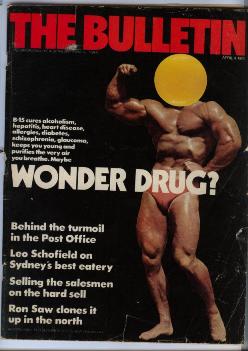
I just spent a delightful hour looking through a copy of The Bulletin dated 4 July 1978. More than any book or film can, it gave me a snapshot of the world three years before I was born. I find the familiarity and unfamiliarity of the bearded, big haired strangely coloured photographs and articles and advertisements fascinating.

Cassettes are a running theme. Siemens offers a free cassette explaining the benefits of their PABX telephone system – ‘Get your secretary to mail the coupon now’. Send off for the Len Evans Home Wine Tasting Pack and you receive a FREE How-To Wine Guide Cassette. At a sales conference Zig Ziglar (whose signed book I weeded from a library once) proclaims that if you don’t feed your mind with a cassette player, you’re losing $25 000 a year. (I think of The Assassination of Richard Nixon, set in the same decade, the main character obsessively listening to positive thinking cassettes.)

At the same conference, an aging Norman Vincent Peale, author of The Power of Positive Thinking spoke. He’s dead now, of course. ‘There’s no problems in cemeteries,’ he told the conference. ‘Problems are a sign of life.’

There are ads for Asbestos Cement Pipelines at Port Waratah – ‘helping keep coal dust firmly in its place’. Dunhill on the inside cover – ‘Internationally acknowledged to be the finest cigarette in the world’. Craven Mild on the back cover, a golfer swinging – ‘mild as can be… yet they satisfy’.

There’s an article on the demise of the Democratic Labor Party, a strange footnote to the Cold War years, their existence finally sputtering out with Nixon’s detente with the Soviets and the rise of an exciting new party, the Democrats. I say a footnote, and yet they kept Labor out of power for a couple of decades, terrified as they were of the Communist menace. And now no Democrats either.

An article about Alan Bond selling his share in the Yanchep Sun City project to Japanese investors. I didn’t even know this story from my own city, of Bond (that ubiquitous presence in the news bulletins of my childhood in the late eighties) buying up hectares of land and creating the Yanchep suburb sixty kilometres north of Perth. Back then, WA feared being taken over by the Japanese (if not the Communists); both fears have passed away now, only to be replaced.

The gossip page is instructive, the names now a little faded – the release of ‘aging film star’ Joan Collins’ embarrassingly naked memories; a revisiting of Frank Sinatra’s visit to Australia a few years’ previously when he got on the wrong side of union boss Bob Hawke; actor Hayley Mills’ divorce (was she in Parent Trap or something? I think my mum used to talk about her) and also that of Sylvester Stallone, the one celebrity on the page who has kept his place. In another thirty years?

And then there’s an interview by distinguished British novelist V.S. Pritchett of his colleague Graham Greene, both of them reflecting on life in their seventies. I get so sad about people getting old and dying. Greene was just publishing his twentieth novel, one of his best to my eyes, The Human Factor. He published at least one more novel before dying thirteen years later in 1991. Pritchett was to live on another nineteen years, to the glorious age of ninety-seven, well into the period of my own consciousness. But I was an ignorant sixteen year old. I don’t remember him dying. He didn’t publish any books in those nearly two decades, though.

And as of this year, of course, The Bulletin, that given fact of Australian media, is no longer published.

Book review: The post-birthday world / Lionel Shriver (2007)

12 Saturday Jul 2008

Posted by Nathan Hobby in book review

≈ 2 Comments

Tags

lionel shriver

Irina McGovern, expatriate American illustrator in London, is tempted to kiss Ramsey Acton, a passionate snooker player. The narrative splits in two, one strand following a life in which she does kiss him, and one following her as she stays with her long term ‘safe’ partner, Lawrence Trainer.

At 515 pages, it’s a long novel, and despite covering almost a decade from the mid-nineties, it doesn’t feel epic in a way that would justify that length. Instead, at times, the narrative seems to lack direction as we follow the minutaie of Irina’s life in its two manifestations. Perhaps a brave enough editor could have convinced Shriver to pare and focus it.

Yet it’s a novel which in detail contains so much brilliant insight into the fabric of everyday life and relationships. Shriver is wise, thoughtful and interesting. She describes so well what it’s like to stay at a hotel, cook dinner, go shopping, attend an award ceremony.

As you might expect, Irina’s two lives contain (sometimes unexpected) parallels (and contrasts). So, for example, in one chapter she will rail against the routine of everyday life, while in the other she will reflect on how great they are. In one chapter, Ramsey will buy her mother a car; in its parallel, Lawrence buys Irina a car. It’s a device which is interesting yet sometimes contrived. My biggest disappoinment – SPOILER ALERT – is that the final chapter has her two lives converging at Ramsey’s funeral; in both she ends up back with Lawrence, even though in one she left him and in the other he ends up leaving her.

My  favourite part of the book are the two children’s books which Irina creates in her two parallel lives, each book reflecting an aspect of the novel we are reading. In one, a young boy becomes a snooker player and always wonders what he could have been if he stayed at school. In the other, a boy gives up a blossoming friendship to be loyal to his best friend, only to have his best friend leave him for the third boy. The intertextuality and dramatic irony are delightful, as well as the vividness with which Shriver creates these cryptobooks.

7.5/10

R.I.P. Thomas Disch 1940-2008

11 Friday Jul 2008

Posted by Nathan Hobby in authors, R.I.P.

≈ 1 Comment

Tags

Thomas Disch

Last Friday I felt compelled to look up Thomas Disch, my third favourite science fiction writer. I found a link to his livejournal account. He’d written on it just two days earlier, 2 July 2008. I thought up what I could say to him about how great his work is. I couldn’t think of what to write; he’s a bitter, cynical man and I didn’t want to be cut down for liking him.

Then yesterday he shows up on the Wikipedia’s recent deaths list. He’d killed himself that same day I found his blog. I feel pretty sad about that. The worst way to die.

There’s now 111 comments on his last entry, with people telling him how good he was, or how they miss him. But of course he’s not there to read it. I thought of adding to it, but instead I’ve written this. I can’t claim to be as much as a fan of some of them, but I really liked his work.

People seem immortal when they have a blog. They can’t be blogging, and so immediately visible, and then die. It just can’t happen.

334 is the best novel of his I’ve read. I can’t remember too much, but for the bleak wittiness of it, and the droll way he wrote horrific things. I liked the interconnections between the novellas that make it up too. And I liked the irony of the spaceship on the front, when none of it’s set in space. Poor pulp writers.

I read Camp Concentration and The Genocides earlier this decade and liked them as well. It’s only the Puppies of Terra I didn’t like.

His more recent horror books are the best horror books I’ve ever read (I haven’t read many, I must say) – The M.D. and the Businessman.

A penchant for dissatisfaction and Lionel Shriver’s brilliance

01 Tuesday Jul 2008

Posted by Nathan Hobby in authors, book review, life, link, writing

≈ Leave a comment

Tags

donald shriver, lionel shriver, reading report

I will need to elaborate on Lionel Shriver’s brilliance at some time. She’s about the most quotable writer I’ve ever read. After being very impressed by We need to talk about Kevin, Post-birthday world has lines on almost every page that I feel like writing down. She has this acute insight into the details of life, and it’s this which can truly set a writer apart.

Not just the details either – an ability to observe and describe emotional states. To see what we all experience but don’t realise.

A couple of weeks ago she wrote an excellent column about her father for the Guardian where she talks of their mutual penchant for dissatisfaction – ‘great when you’re young; at 80, it’s self-destructive’. How true. How disturbing. (Maybe it’s half my problem. I need to get over the dissatisfaction that drove me through my teens and early twenties. Because IT DOESN’T WORK when you hit late twenties.)

I wonder how her father feels about her writing so candidly about him while he’s still alive. Ten years ago I would have written with this openness. Maybe even five years ago. But I’ve become much more guarded the last few years.

I don’t think she’s candid out of naivety, like I was. I genuinely thought that if I was open and honest to the world, they’d repay me with my kindness. Then I met some formidable people who taught me otherwise.

I’m fascinated by Lionel Shriver’s father because he’s a theology scholar. One of these few places where my polarity of interests – theology and literature – meet, besides in me.

The Joy of Knowledge Encyclopedia

19 Thursday Jun 2008

Posted by Nathan Hobby in books, life

≈ 19 Comments

Tags

wikipedia

I had a strange impulse to browse the Hamlyn Illustrated Encyclopedia tonight. A one volume three column encyclopedia with black and white pictures at the top of the page. This edition was published in 1986, with the previous title being the Joy of Knowledge Encyclopedia (what a wonderful and comforting title). It’s my wife’s, not mine, but I know if I’d grown up with it I would have a strong attachment to it, offering as it does the whole world in one book.

I love Wikipedia, because it has lengthy articles on Spiderman 2099 and daily updates on recent deaths. But I remembered one thing it doesn’t have – the pleasure of browsing. On the way to check the entry on ‘Anabaptists’, my eye was caught by a photo of ‘Agnew, Spiro’ and I learnt some brief facts about this man I only really knew about from Mad Magazine. (So much of what I know about American politics and popular culture has come from Mad Magazine!). The ‘Anabaptists’ article was laughable – according to this, they were a Middle Age movement (about two hundred years out!) preoccupied only with believers’ baptism by immersion, and contributing nothing beyond being the ancestors of modern day Baptists, a very contestable suggestion indeed.

Then on the way to ‘Wycliffe, John’ I saw, for the first time in living memory, a picture of a ‘Wolverine’ and I was dragged pleasurably into a field outside theology / literature / history.

Long live the browsable encyclopedia!

← Older posts
Newer posts →

Enter your email address to follow this blog and receive notifications of new posts by email.

Join 287 other subscribers

Nathan on Twitter

My Tweets

Categories

  • academic (9)
  • archives and sources (10)
  • autobiographical (62)
  • biographers (10)
  • biographical method (28)
  • biographical quests (18)
  • biographies (21)
    • political biography (2)
  • biographies of living subjects (2)
  • biographies of writers, artists & musicians (12)
  • biographies of writers, artists and musicians (20)
  • biography as a literary form (9)
  • biography in fiction (2)
  • biography in the news (2)
  • books (236)
    • authors (19)
    • book review (173)
    • reading (23)
  • Covid (2)
  • creative nonfiction (11)
  • daily life (2)
  • Daily Prompt (2)
  • death (21)
  • digital humanities (3)
  • family history (1)
  • fiction (8)
  • film and television biographies (5)
  • film review (48)
  • found objects (3)
  • historical biographies (1)
  • history (20)
  • In the steps of KSP (4)
  • John Curtin (13)
  • Katharine Susannah Prichard (114)
    • Glimpses of KSP (7)
    • My KSP biography (31)
      • deleted scenes (1)
  • Katharine Susannah Prichard's associates and connections (17)
  • Katharine Susannah Prichard's writings (34)
  • libraries (5)
  • life (20)
  • link (23)
  • links (41)
  • lists (28)
  • local history and heritage (1)
  • media (4)
  • memes and urban myths (1)
  • memoirs (10)
  • meta (2)
  • music (18)
  • news (9)
  • news and events (44)
  • obituary (1)
  • Old writing found on a floppy disk (1)
  • poetry (5)
  • politics and current affairs (26)
    • climate change (1)
  • prologues and introductions (2)
  • psychological aspects of biography (3)
  • quotes (22)
  • R.I.P. (10)
  • reading report (3)
  • religion (1)
  • religious biography (1)
  • research (5)
  • role of the biographer within the biography (2)
  • Series: A-Z of Katharine Susannah Prichard (26)
  • Series: Corona Diary (1)
  • Series: Saturday 10am (14)
  • Series: Short Stories (2016) (6)
  • Series: The Tourist (2013) (6)
  • Series: Thursday 3pm feature posts (2009) (35)
  • structure of biographies (3)
  • technology and the digital world (2)
  • television (4)
  • the nature of biography (4)
  • this blog (10)
  • Uncategorized (33)
  • Western Australia (26)
  • writing (41)

Archives

Recent Comments

Nathan Hobby's avatarNathan Hobby on New publication: my Hugo Thros…
Lisa Hill's avatarLisa Hill on New publication: my Hugo Thros…
Nathan Hobby's avatarNathan Hobby on New publication: my Hugo Thros…
amphisbaenathoroughly79c20f19aa's avataramphisbaenathoroughl… on New publication: my Hugo Thros…

Bookmarks

  • Adventures in Biography
  • ANZ LitLovers LitBlog
  • Bernice Barry
  • It only goes up to your knees
  • Jane Bryony Rawson
  • Jenn Plays Recorder
  • Katharine Susannah Prichard Writers' Centre
  • Laura Sewell Matter: Essayist and Biographer
  • Mutually said: Poets Vegan Anarchist Pacifist
  • Resident Judge
  • Speaking Thylacine
  • The Australian Legend
  • Timothy Parkin Poetry
  • Treefall Writing – Melinda Tognini
  • Whispering Gums
  • Wrapped up in books: the home of Guy Salvidge

Top Posts

  • Paul Auster's Moon Palace : an overview
  • The Joy of Knowledge Encyclopedia
  • Some news
  • The 28th, 29th, and 30th prime ministers: a memoir
  • Elizabeth Macarthur: A Life at the Edge of the World by Michelle Scott Tucker

Blog Stats

  • 241,152 hits

Tag Cloud

9/11 19th century 33 1920s 1921 1930s 1950s 1970s 1971 1981 2000s 2004 2011 2015 2017 20000 Days on Earth A.S. Byatt Aboriginals activism Adam Begley Adrian Mole adultery afterlife Agatha Christie Alan Hollinghurst Alberto Manguel Alfred Deakin Amazing Grace Americana Amy Grant An American Romance Andre Tchaikowsky Andrew McGahan angela myers anne fadiman Anne Rice Arabian Nights archives art arts funding A Serious Man Ash Wednesday ASIO atheism Atonement Australia Australian film Australian literature Australian Short Story Festival autism autobiography autodidact Barbara Vine beach Belle Costa da Greene Bell Jar best best-of Bible Big Issue Bill Callahan biographical ethics biographical quest genre biographies birthday birthdays Black Opal Bleak House Blinky Bill blogging blogs Blue Blades Bodega's Bunch bog Booker book launch booksale Borges Brenda Niall Brian Matthews Brian McLaren Britney Spears Burial Rites Burke and Wills buskers C.S. Lewis C.S. Lewis canon capitalism Carol Shields Carson McCullers Catcher in the Rye Catholicism celebrities Charles Dickens Charlie Kaufman childhood Child of the Hurricane children's books Choir of Gravediggers Christianity Christian writing Christina Stead Christmas Christopher Beha Cinque Terra Claire Tomalin classics cliches climate change Coen brothers coincidence Collie Collyer coming of age Communism concert Condensed Books consumerism Coonardoo Cormac McCarthy Corrections cosy fiction Dara Horn David Copperfield David Ireland David Marr David Suchet death Death of a president definition demolition Dennis LeHane dentist diaries divorce doctorow Doctor Who documentaries donald shriver Don DeLillo Don DeLillo Donna Mazza Donna Tartt Don Watson Dostovesky doubt drama dreams of revolution Drusilla Modjeska E.M. Forster ebooks editing Eichmann Eisenstein Elizabeth Kostova email empathy ensmallification existentialism faith Falling Man fame families fantasy fiction film and television folk football Frank Barscombe Fremantle Press G.K. Chesterton Gabrielle Carey Gallipoli genealogical fiction Genesis Geoff Nicholson George W. Bush Gerald Glaskin Gilead Golden Miles Goldfields Trilogy Graham Greene grandad great novels Greenmount Guinness World Records Guy Salvidge Hannah Arendt Hannah Kent Hans Koning Hans Koningsberger Harper Lee Haxby's Circus Hazel Rowley He-Man headers heaven Heidegger hell Henrietta Lacks Henry Morton Stanley Herman Hesse heroes Hey Dad! historical fiction history Holden Caulfield holidays Homer & Langley Home Song Stories House of Cards House of Zealots house of zealots Hugo Throssell humour Ian McEwan In between the sheets Indonesia Infamous Inside Llewyn Davis interstellar interview Intimate Strangers Invisible Ireland ISBNs Ishiguro itunes J.D. Salinger J.M. Coetzee J.S. Battye Janet Malcolm Jennifer Egan JFK JFK assassination Joanna Rakoff Joel Schumacher John Burbidge John Fowles John Howard John Kinsella John Updike John Updike Jonathan Franzen journal writing JSB Judgment Day Julia Baird Julian Barnes Kafka Kalgoorlie Kate Grenville Katherine Mansfield Kevin Brockmeier King's Park KSP Writers' Centre language last ride Laurie Steed Left Behind Leonard Cohen Leo Tolstoy Libra Library of Babel Library of Babel Lila Lily and Madeleine links Lionel Shriver lionel shriver lists literary fiction literature Lleyton Hewitt lost book Louisa Louisa Lawson Louis Esson louis nowra love letter Lubbock Lytton Strachey Madelaine Dickie Man Booker man in the dark Margaret Atwood Margaret River Press Marilynne Robinson mark sandman meaning of life Melbourne Mel Hall meme memorialisation memory MH17 Michael Faber Mike Riddell Miles Franklin mining boom missionaries moleskine Moon Palace morphine Mother Teresa movies Music of Chance My Brilliant Career names Napoleon Narnia narrative Narrow Road to the Deep North Narziss and Goldmund Natalie Portman Nathaniel Hobbie national anthem Nick Cave Nina Bawden non-fiction nonfiction noughties novelists novels obituaries obscurity On Chesil Beach Parade's End Paris Hilton Passion of the Christ past patriotism Paul Auster Paul de Man Perth Perth Writers Festival Peter Ackroyd Peter Cowan Writers Centre phd Philip K. Dick Philip Seymour Hoffman pierpontmorgan poetry slam politics popular fiction popular science Possession postapocalyptic postmodernism Pride prophetic imagination publications Pulp Purity Queen Victoria Rabbit Angstrom radio Radio National Randolph Stow rating: 5/10 rating: 6/10 rating: 7/10 rating: 8/10 rating: 9/10 rating: 10/10 ratings reading fiction autobiographically reading report Rebecca Skloot recap red wine reincarnation juvenile fiction rejection review - music reviewing rewriting Richard Flanagan Richard Ford Rick Moody Roaring Nineties Robert Banks Robert Hughes Robert Silverberg Robert Wadlow Robinson Crusoe Rolf Harris romance Rome ruins Russell Crowe Ruth Rendell Sarah Murgatroyd scalpers science fiction Science of Sleep secondhand books Secret River sermon illustration sex short stories Silent Woman Simone Lazaroo Simpsons Siri Hustvedt slavery Smashing Pumpkins social interactions social justice some people i hate sources South Australia souvenirs speculation speech speeches sport status anxiety Stephen Lawhead Stranger's Child subtitles Subtle Flame Sue Townsend suicide Surprised By Hope Suzanne Falkiner Sylvia Plath Synecdoche TAG Hungerford Award tapes teabags Ted Hughes The Children Act The Cure The Fur The Imitation Game theology The Pioneers The Revolutionary Thomas Disch Thomas Hardy Thomas Henry Prichard Thomas Mann thriller time Tim La Haye Tim Winton Tolstoy Tom Wright top 10 Towering Inferno Tracy Ryan Trove Truman Capote tshirts TS Spivet Twelve Years a Slave underrated writers Underworld unwritten biographies urban myth USA vampires Venice Victoria Cross Victoriana Victorian era Victorianism Victoria Park video Voltron w Wake in Fright Walkabout Walter M. Miller war War and Peace war on terror Water Diviner Wellington St Bus Station Westerly Western Australia West Wing What Happened to Sophie Wilder? Whitlams wikipedia Wild Oats of Hans William Wilberforce Winston Churchill Witches of Eastwick Working Bullocks workshop World War One writers writing Writing NSW youth Zadie Smith Zeitgeist Zelig

Enter your email address to follow this blog and receive notifications of new posts by email.

Join 287 other subscribers

Pages

  • About
  • My novel: The Fur
  • The Red Witch: A Biography of Katharine Susannah Prichard

Categories

  • academic (9)
  • archives and sources (10)
  • autobiographical (62)
  • biographers (10)
  • biographical method (28)
  • biographical quests (18)
  • biographies (21)
    • political biography (2)
  • biographies of living subjects (2)
  • biographies of writers, artists & musicians (12)
  • biographies of writers, artists and musicians (20)
  • biography as a literary form (9)
  • biography in fiction (2)
  • biography in the news (2)
  • books (236)
    • authors (19)
    • book review (173)
    • reading (23)
  • Covid (2)
  • creative nonfiction (11)
  • daily life (2)
  • Daily Prompt (2)
  • death (21)
  • digital humanities (3)
  • family history (1)
  • fiction (8)
  • film and television biographies (5)
  • film review (48)
  • found objects (3)
  • historical biographies (1)
  • history (20)
  • In the steps of KSP (4)
  • John Curtin (13)
  • Katharine Susannah Prichard (114)
    • Glimpses of KSP (7)
    • My KSP biography (31)
      • deleted scenes (1)
  • Katharine Susannah Prichard's associates and connections (17)
  • Katharine Susannah Prichard's writings (34)
  • libraries (5)
  • life (20)
  • link (23)
  • links (41)
  • lists (28)
  • local history and heritage (1)
  • media (4)
  • memes and urban myths (1)
  • memoirs (10)
  • meta (2)
  • music (18)
  • news (9)
  • news and events (44)
  • obituary (1)
  • Old writing found on a floppy disk (1)
  • poetry (5)
  • politics and current affairs (26)
    • climate change (1)
  • prologues and introductions (2)
  • psychological aspects of biography (3)
  • quotes (22)
  • R.I.P. (10)
  • reading report (3)
  • religion (1)
  • religious biography (1)
  • research (5)
  • role of the biographer within the biography (2)
  • Series: A-Z of Katharine Susannah Prichard (26)
  • Series: Corona Diary (1)
  • Series: Saturday 10am (14)
  • Series: Short Stories (2016) (6)
  • Series: The Tourist (2013) (6)
  • Series: Thursday 3pm feature posts (2009) (35)
  • structure of biographies (3)
  • technology and the digital world (2)
  • television (4)
  • the nature of biography (4)
  • this blog (10)
  • Uncategorized (33)
  • Western Australia (26)
  • writing (41)

Archives

Recent Comments

Nathan Hobby's avatarNathan Hobby on New publication: my Hugo Thros…
Lisa Hill's avatarLisa Hill on New publication: my Hugo Thros…
Nathan Hobby's avatarNathan Hobby on New publication: my Hugo Thros…
amphisbaenathoroughly79c20f19aa's avataramphisbaenathoroughl… on New publication: my Hugo Thros…

Bookmarks

  • Adventures in Biography
  • ANZ LitLovers LitBlog
  • Bernice Barry
  • It only goes up to your knees
  • Jane Bryony Rawson
  • Jenn Plays Recorder
  • Katharine Susannah Prichard Writers' Centre
  • Laura Sewell Matter: Essayist and Biographer
  • Mutually said: Poets Vegan Anarchist Pacifist
  • Resident Judge
  • Speaking Thylacine
  • The Australian Legend
  • Timothy Parkin Poetry
  • Treefall Writing – Melinda Tognini
  • Whispering Gums
  • Wrapped up in books: the home of Guy Salvidge

Top Posts

  • Paul Auster's Moon Palace : an overview
  • The Joy of Knowledge Encyclopedia
  • Some news
  • The 28th, 29th, and 30th prime ministers: a memoir
  • Elizabeth Macarthur: A Life at the Edge of the World by Michelle Scott Tucker

Blog Stats

  • 241,152 hits

Tag Cloud

9/11 19th century 33 1920s 1921 1930s 1950s 1970s 1971 1981 2000s 2004 2011 2015 2017 20000 Days on Earth A.S. Byatt Aboriginals activism Adam Begley Adrian Mole adultery afterlife Agatha Christie Alan Hollinghurst Alberto Manguel Alfred Deakin Amazing Grace Americana Amy Grant An American Romance Andre Tchaikowsky Andrew McGahan angela myers anne fadiman Anne Rice Arabian Nights archives art arts funding A Serious Man Ash Wednesday ASIO atheism Atonement Australia Australian film Australian literature Australian Short Story Festival autism autobiography autodidact Barbara Vine beach Belle Costa da Greene Bell Jar best best-of Bible Big Issue Bill Callahan biographical ethics biographical quest genre biographies birthday birthdays Black Opal Bleak House Blinky Bill blogging blogs Blue Blades Bodega's Bunch bog Booker book launch booksale Borges Brenda Niall Brian Matthews Brian McLaren Britney Spears Burial Rites Burke and Wills buskers C.S. Lewis C.S. Lewis canon capitalism Carol Shields Carson McCullers Catcher in the Rye Catholicism celebrities Charles Dickens Charlie Kaufman childhood Child of the Hurricane children's books Choir of Gravediggers Christianity Christian writing Christina Stead Christmas Christopher Beha Cinque Terra Claire Tomalin classics cliches climate change Coen brothers coincidence Collie Collyer coming of age Communism concert Condensed Books consumerism Coonardoo Cormac McCarthy Corrections cosy fiction Dara Horn David Copperfield David Ireland David Marr David Suchet death Death of a president definition demolition Dennis LeHane dentist diaries divorce doctorow Doctor Who documentaries donald shriver Don DeLillo Don DeLillo Donna Mazza Donna Tartt Don Watson Dostovesky doubt drama dreams of revolution Drusilla Modjeska E.M. Forster ebooks editing Eichmann Eisenstein Elizabeth Kostova email empathy ensmallification existentialism faith Falling Man fame families fantasy fiction film and television folk football Frank Barscombe Fremantle Press G.K. Chesterton Gabrielle Carey Gallipoli genealogical fiction Genesis Geoff Nicholson George W. Bush Gerald Glaskin Gilead Golden Miles Goldfields Trilogy Graham Greene grandad great novels Greenmount Guinness World Records Guy Salvidge Hannah Arendt Hannah Kent Hans Koning Hans Koningsberger Harper Lee Haxby's Circus Hazel Rowley He-Man headers heaven Heidegger hell Henrietta Lacks Henry Morton Stanley Herman Hesse heroes Hey Dad! historical fiction history Holden Caulfield holidays Homer & Langley Home Song Stories House of Cards House of Zealots house of zealots Hugo Throssell humour Ian McEwan In between the sheets Indonesia Infamous Inside Llewyn Davis interstellar interview Intimate Strangers Invisible Ireland ISBNs Ishiguro itunes J.D. Salinger J.M. Coetzee J.S. Battye Janet Malcolm Jennifer Egan JFK JFK assassination Joanna Rakoff Joel Schumacher John Burbidge John Fowles John Howard John Kinsella John Updike John Updike Jonathan Franzen journal writing JSB Judgment Day Julia Baird Julian Barnes Kafka Kalgoorlie Kate Grenville Katherine Mansfield Kevin Brockmeier King's Park KSP Writers' Centre language last ride Laurie Steed Left Behind Leonard Cohen Leo Tolstoy Libra Library of Babel Library of Babel Lila Lily and Madeleine links Lionel Shriver lionel shriver lists literary fiction literature Lleyton Hewitt lost book Louisa Louisa Lawson Louis Esson louis nowra love letter Lubbock Lytton Strachey Madelaine Dickie Man Booker man in the dark Margaret Atwood Margaret River Press Marilynne Robinson mark sandman meaning of life Melbourne Mel Hall meme memorialisation memory MH17 Michael Faber Mike Riddell Miles Franklin mining boom missionaries moleskine Moon Palace morphine Mother Teresa movies Music of Chance My Brilliant Career names Napoleon Narnia narrative Narrow Road to the Deep North Narziss and Goldmund Natalie Portman Nathaniel Hobbie national anthem Nick Cave Nina Bawden non-fiction nonfiction noughties novelists novels obituaries obscurity On Chesil Beach Parade's End Paris Hilton Passion of the Christ past patriotism Paul Auster Paul de Man Perth Perth Writers Festival Peter Ackroyd Peter Cowan Writers Centre phd Philip K. Dick Philip Seymour Hoffman pierpontmorgan poetry slam politics popular fiction popular science Possession postapocalyptic postmodernism Pride prophetic imagination publications Pulp Purity Queen Victoria Rabbit Angstrom radio Radio National Randolph Stow rating: 5/10 rating: 6/10 rating: 7/10 rating: 8/10 rating: 9/10 rating: 10/10 ratings reading fiction autobiographically reading report Rebecca Skloot recap red wine reincarnation juvenile fiction rejection review - music reviewing rewriting Richard Flanagan Richard Ford Rick Moody Roaring Nineties Robert Banks Robert Hughes Robert Silverberg Robert Wadlow Robinson Crusoe Rolf Harris romance Rome ruins Russell Crowe Ruth Rendell Sarah Murgatroyd scalpers science fiction Science of Sleep secondhand books Secret River sermon illustration sex short stories Silent Woman Simone Lazaroo Simpsons Siri Hustvedt slavery Smashing Pumpkins social interactions social justice some people i hate sources South Australia souvenirs speculation speech speeches sport status anxiety Stephen Lawhead Stranger's Child subtitles Subtle Flame Sue Townsend suicide Surprised By Hope Suzanne Falkiner Sylvia Plath Synecdoche TAG Hungerford Award tapes teabags Ted Hughes The Children Act The Cure The Fur The Imitation Game theology The Pioneers The Revolutionary Thomas Disch Thomas Hardy Thomas Henry Prichard Thomas Mann thriller time Tim La Haye Tim Winton Tolstoy Tom Wright top 10 Towering Inferno Tracy Ryan Trove Truman Capote tshirts TS Spivet Twelve Years a Slave underrated writers Underworld unwritten biographies urban myth USA vampires Venice Victoria Cross Victoriana Victorian era Victorianism Victoria Park video Voltron w Wake in Fright Walkabout Walter M. Miller war War and Peace war on terror Water Diviner Wellington St Bus Station Westerly Western Australia West Wing What Happened to Sophie Wilder? Whitlams wikipedia Wild Oats of Hans William Wilberforce Winston Churchill Witches of Eastwick Working Bullocks workshop World War One writers writing Writing NSW youth Zadie Smith Zeitgeist Zelig

Blog at WordPress.com.

  • Subscribe Subscribed
    • Nathan Hobby, a biographer in Perth
    • Join 287 other subscribers
    • Already have a WordPress.com account? Log in now.
    • Nathan Hobby, a biographer in Perth
    • Subscribe Subscribed
    • Sign up
    • Log in
    • Report this content
    • View site in Reader
    • Manage subscriptions
    • Collapse this bar

Loading Comments...