• About
  • The Red Witch: A Biography of Katharine Susannah Prichard
  • My novel: The Fur

Nathan Hobby, a biographer in Perth

~ The lives of Katharine Susannah Prichard and John Curtin, the art of biography, and other things

Nathan Hobby, a biographer in Perth

Category Archives: autobiographical

Lionel Shriver on holidays

05 Fri Feb 2010

Posted by Nathan Hobby in autobiographical

≈ Leave a comment

Tags

holidays, Lionel Shriver

i just returned from a great holiday, but even it wasn’t completely free of my ambivalence about holidays. I hate packing, I hate unpacking, I find it stressful choosing somewhere to stay, and I often wonder what I should be doing. (I don’t like having to answer what I did on a holiday, because I generally like to do not much at all. Not this frantic activity some require, see at least three sights a day.)

I liked discovering a kindred soul (besides my wife) in Lionel Shriver, who has outright hatred of the idea of a holiday. She writes excellently as always in her anti-holiday rant.

She has a new novel due out next month, which has already attracted some unfriendly reviews on goodreads.com. I wonder if it was people who had seen an advance copy, liars or confused readers. They didn’t sound like proper reviewers who I would bother sending an advance copy to.

[Thursday 3pm #36] By the orange trees

10 Thu Dec 2009

Posted by Nathan Hobby in autobiographical, books, Series: Thursday 3pm feature posts (2009)

≈ 2 Comments

Tags

anne fadiman

So I missed a week and no-one commented. That’s a relief, in one sense. Last Thursday I was camping in the bush, a long way from a computer.

It was a semi-cleared area near Jarrahdale, and I pitched my tent near a row of four old orange trees. Animals – kangaroos, is my guess – had stripped all the oranges on the lower branches, but there were plenty higher up, slightly sour with hard to peel skin. Further over was a tall oak tree. Near my tent were pieces of an old china plate and broken bottles.

I tried to picture the house which must have stood there. There should be monuments in places like this. To think people might have lived whole lives in that space, and no-one even knows today.  Our ancestors are strangers who leave some traces, a mystery to us.

While sitting under the shade of a gum tree on Thursday afternoon, I finished Anne Fadiman’s excellent collection of personal bibliographic essays, Ex-Libris: Confessions of a Common Reader.  These are the kind of essays I aspire to in this blog. She writes about the experience of ‘marrying’ her book collection with her husband’s and the challenges of agreeing on ways to arrange books. She explores the ins and outs of annotating – or not annotating – books. (I am a lead pencil annotater. I have sympathy with people who consider it desecration.)

[Thursday 3pm #24] The cartoons of my childhood: nostalgia and disappointment

10 Thu Sep 2009

Posted by Nathan Hobby in autobiographical, Series: Thursday 3pm feature posts (2009)

≈ 3 Comments

Tags

He-Man, Voltron

voltron

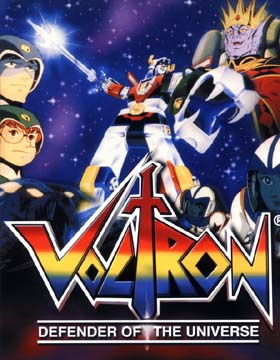
Have you ever tried going back to the cartoons of your childhood? I have, and it’s been a mix of nostalgia and disappointment. I can watch the same episodes again, but I can’t watch them with the same eyes.

I watched some episodes of He-Man and Voltron for the first time in twenty years this year. I was shocked how bad they were. They both offered incoherent, ludicrous story lines, combining visual elements likely to appeal to six year olds with no thought for consistency. He-Man features bare chested warriors with swords next to cyborgs all living in a castle and each episode fighting off a simplistic baddie called Skeletor who is a skeleton in a cloak. The castle is an important element: Voltron has it too, as five astronauts find hidden robot lions to save a princess from an evil alien king.

The backstory of Voltron is that the mighty Voltron robot was so powerful that a space-goddess (!) cast a spell on it, splitting it into five different coloured parts, which became robot lions as they fell to the ground, each one falling to an environment relevant to its colour – the green lion to the forest, the blue lion into the water, etc. It takes some keys buried in the king’s sarcophagus (and one stolen by ‘space-mice’) to reactivate the lions. But of course, the team learns that it has to join together into one big robot if it wants to win. It sounds remarkably well designed to sell toys. And it worked – we all wanted all the lions; my brother got the yellow one, and I the green one.

It’s no wonder children wrote terrible stories at school. The cartoons they watched were setting a terrible example. Although not all of them – I also rewatched a number of episodes from The Mysterious Cities of Gold, and it stood up much better. It used to be on at 5pm on ABC in the late 80s. It’s an epic story of lost orphans who are taken to South America to find the Mysterious Cities of Gold. It has a lot of moral ambiguity and complexity to some of its characters and it still managed to fill me with some sense of wonder.

I hate to think what will happen when I try to re-read the Famous Five. The only childhood book that has stayed with me into adulthood is John Christopher’s The Tripods Trilogy.

[Thursday 3pm #22] Sports culture is oppressive

27 Thu Aug 2009

Posted by Nathan Hobby in autobiographical, Series: Thursday 3pm feature posts (2009)

≈ 11 Comments

Tags

football, sport

Yesterday I felt oppressed by the dominance of sports culture in Australia. It was a meeting and we were making introductions and we had to say something interesting about ourselves. And most people’s ‘interesting thing’ was their sporting loyalty, some comment staking their loyalty and denigrating a different sports code or a rival team. What I hated the most was the raucous laughter which accompanied it. To me, it felt so unfunny and childish.

Usually I wouldn’t care much, but the mood I was in yesterday, it felt oppressive. It was made worse when someone explained to the visiting Englishman, ‘This is just Aussie humour’. And that made me think how sporting obsession is normalised and if you don’t fit it, you’re abnormal. Common ground is established by exploring one’s football loyalties. If you don’t care about the football… what sort of person are you?

Football team loyalty seems misguided to me. The players themselves swap teams. (Do they care who they’re playing for?)

Do I want everyone to start appreciating the arts more? What if you established initial common ground by giving your opinion on James Joyce or how moved you are or not by Beethoven?

Yes and no. As much as I feel oppressed by a raucous, crass, crude, unthinking, primitive culture of sport which elevates men (and only a few women) as national heroes for their ability to kick balls or swim fast, I wouldn’t actually like to be a part of the mainstream. I guess I relish my role as outsider and my shameful feelings of cultural superiority.

How about you?

[Thursday 3pm #18] American Habits

30 Thu Jul 2009

Posted by Nathan Hobby in autobiographical, lists, reading, Series: Thursday 3pm feature posts (2009)

≈ 1 Comment

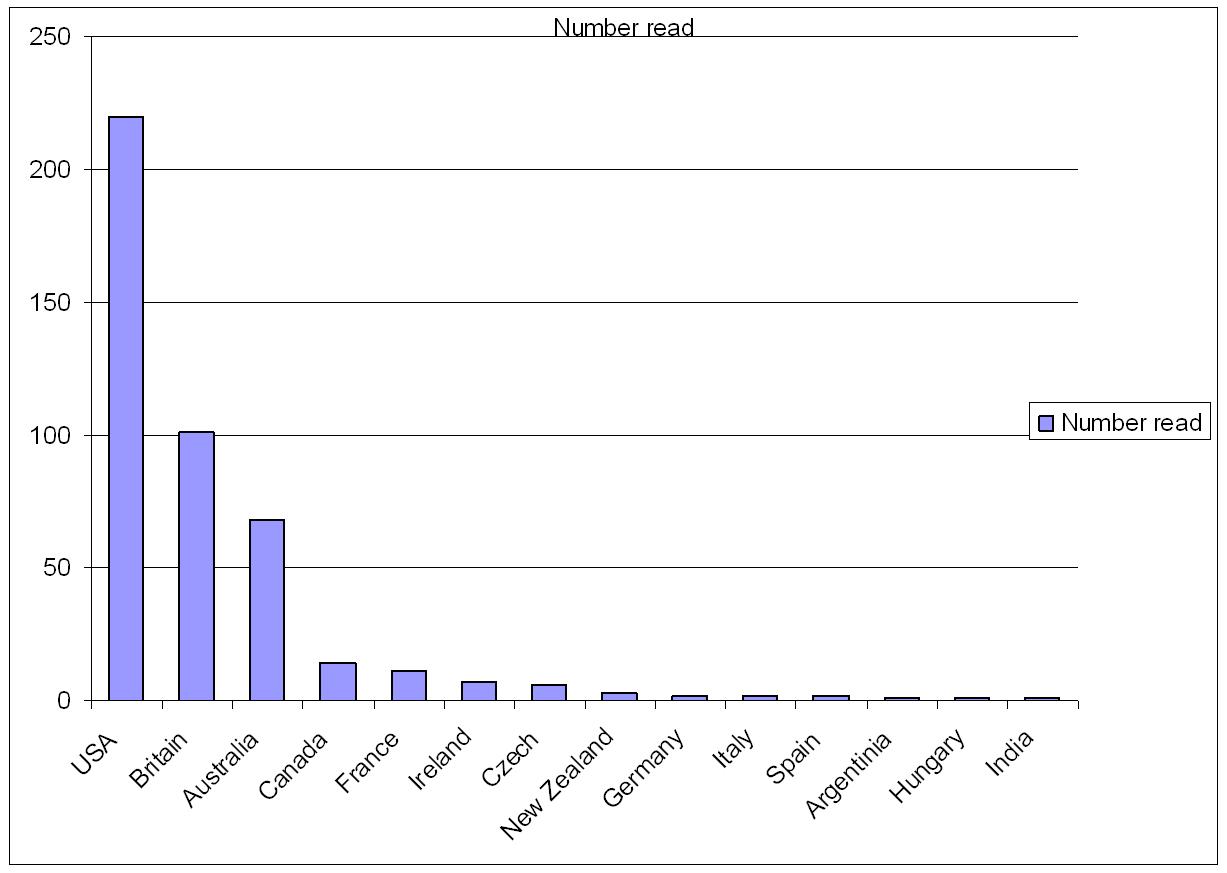
On Tuesday night, when I should have been doing something productive or relaxing, I created a graph showing how many novels (and other narratives) I had read by country since 1996. The results were predictably homogenous, but even more weighted toward the USA than I imagined.

Novelsbycountry

There you have it – 220 from the USA, 101 from Britain, 68 from Australia, 14 from Canada for the top four places. I don’t have records from 98-00; maybe I was much more cosmpolitan in those years. The figures are also skewed toward the USA because in 96 and 97 when I was a science fiction addict, just about everything I read came from there.

I was thinking of resolving to read more Australian, European, Asian and African texts to broaden my horizons. And maybe I will. But I’m not going to worry too much. There’s too many things in this world to feel guilty about.

But I am curious about why I’m so drawn to American fiction. I have an aversion to consumerism, patriotism, fundamentalism and unchecked capitalism, all those things America is famous for. But I am also fascinated by America, and even to prod and gawk at those things I hate. Many of my favourite authors are American – Auster, DeLillo, Franzen, Moody, McCullers, Updike. I’d like to visit the USA some day; I’ll just have a hard time convincing my wife. (I think I would like to travel by train across its heartland; keep meaning to read Don Watson’s account of this.)

I think its easier to read in tune with our own culture, rather than cross cultural boundaries; and interestingly I don’t feel like I have to cross much of a boundary to read American fiction – or British fiction, I suppose, but I’ve found less authors there whom I love.

Interestingly just about every European novel I have read has been brilliant. This is merely a reflection of how selective I’ve been, but there’s an untapped continent there. In fact, there’s at least four of them.

What are your reading habits like? Regale and shame me with the stories of how you spend your leisure time reading Afghani novels in the original or 13th century Chinese epics. Go on, show me up. 🙂

[Thursday 3pm #8] The Names

21 Thu May 2009

Posted by Nathan Hobby in autobiographical, Series: Thursday 3pm feature posts (2009)

≈ 7 Comments

Tags

childhood, coincidence, names, Nathaniel Hobbie

As a child, one of my prized books was a book of baby names and their meanings. Not because I was planning names for my own children, but because I found it fascinating to discover what people’s names ‘really meant’. I thought it gave me insight into their true character. It also gave me a certain type of power, coming to school and announcing to other children what their names meant.

My name is of Hebrew origin and means ‘Gift of God’; I tried to read as much as I could into that. I told James at school he had a very bad name, as his name means ‘Deceiver’. I wondered how anyone could call their child James, knowing this.

And then there was Matthew C., whose name was Greek for ‘Gift of God’. I always wanted to be his best friend, and I thought this linked us in some special way. I told him this theory, but he was not entirely convinced. When he moved to Iceland, he didn’t reply to the letter I sent him.

Perhaps I have disabused myself of some of the primitive notions I had about names as a child, but not entirely. Instinctually, I still feel that other ‘Nathans’ should (a) be friendly to me and (b) have some trait of Nathanness to them. Time has proven neither of these things to be true.

Just as important as the ‘meaning’ of names has been the antecedents for names. I have always loved the tension present in my given names – Nathan David – from the Old Testament figures with those names. Nathan is the brave prophet who rebuked the poet king for adultery and murder. David is my father’s name; that irony interests me too.

‘Nathan’ used to be a fairly rare given name, of which I was very proud. ‘Hobby’ is uncommon too, and it was strange when another family of Hobbys moved to our country town when I was eleven. We didn’t think they were related; years later we discovered they were second cousins, separated from our awareness by family secrets.

One of these Hobbys was called Joshua, and was about the same age as my brother Joshua. I didn’t know what to make of this idea – would it be like having a twin brother to have someone with the same name? Or did it make a person un-unique, did it compromise their specialness, their distinctiveness in the world? I leaned toward the latter interpretation, and thought it a terrible cruelty to be a Smith, or even worse a John Smith.

In the year below me at high school, there were two Laura Smiths. Different years were never known beyond vague rumours, and it took me a long time to work out they were talking about two different Laura Smiths. One of them I knew by sight; the other I didn’t. A year after I graduated, one of them died in a car accident. I wondered if it was the one I knew by sight, or the one I didn’t, and tried not to think of it as sadder if it was the one I knew by sight. I wondered what the surviving Laura felt, if it seemed a close call.

And then, finally, last year I met, in a manner of speaking, the only other Nathan Hobby I know of in the world. I found him on facebook. He’s younger than me and into football, from what I can gather about him. I thought there would have to be something essentially similar about us. But of course, there didn’t have to be. I still get a shock on my facebook feed when I read statements like ‘Nathan Hobby is no longer in a relationship’.

But then perhaps the more remarkable twin, an almost Borgesian one, is my literary twin, Nathaniel Hobbie. When I was working in a public library in 2004, his book arrived about the same time as my book came out. It was called ‘Priscilla and the Pink Planet’ and it’s about a little girl obsessed with pink. His career has been more successful than mine so far; he’s followed up with four other books about Priscilla.

It sounds like a Vonnegutian alter ego for me; I even started a novel called Lazarus the Pacifist Superhero with Nathaniel Hobbie as the main character. It makes it seem there must be some power to names and that out in the world are variations on each person.

Do you have a twin out there in the world?

[Thursday 3pm #6] All the houses you ever lived in

07 Thu May 2009

Posted by Nathan Hobby in autobiographical, Series: Thursday 3pm feature posts (2009)

≈ 6 Comments

After attending a party, we found ourselves near the house we lived in when we were first married. Both being so sentimental, we drove past it.

‘Wouldn’t you love,’ she said, ‘to buy all the houses you ever lived in? So you could have them forever.’

And I felt excited she said this, because it was one of those times when someone articulates something in my head that I thought unarticulatable or simply too unformed or silly to say.

Sometimes it’s an unbearable thought, all the houses I ever lived in still existing in their own ways, inhabited by someone else who now has more claim on them than me. But it’s less unbearable than the thought of the houses no longer existing, of their being chewed up by bulldozers and a different buildilng existing in the same space. On a long enough timescale, I suppose this is the fate of all the houses I ever lived in. If I could imagine a future for them or for the Earth one million, one billion years hence. But in human timescale, at least one of them will, in all likelihood, outlast me.

The two families that merged to form me – the Winnings and the Hobbys – are wanderers. My parents each lived in maybe ten houses over their childhood. Perhaps this made them want stability when they had their own children; and thus I lived at Lot 105 Railway Parade in Allanson for thirteen years.

In my dreams, this house is always home. I haven’t lived in it since 1996, but I keep returning to it. It sits at the top of a hill on three acres with a gravel driveway which seemed so very long as a child. The brown donkey shed, the rainwater tank, the trees which I knew so well. But usually it’s the inside of it I dream about. I wonder how I know that it’s this house when I wake up? Perhaps I see the orange kitchen. (A childhood friend, reading my novel The Fur remarked that she noticed the kitchen she remembered so well too.) But it’s more than colours or a physical geography, it’s a spiritual knowledge that it’s the same house.

I once started a writing project where I intended to decribe, exhaustively, each room of that house and the memories associated with them. I started with the laundry, of all places, and its first aid cabinet full of icecream containers of aging treatments, expired ointments.

Since that house, I have lived in fourteen houses, returning to the wandering roots of my family tree. Now I’m exiled from each one; I can only hope to drive past and see what it has become from the outside. And being so pathologically fearful of what people might think, hating to think of them saying, ‘What’s that car doing out there,’ I’m scared to stop.

My wife’s family is good at staying put; I visited the house her mum grew up in a few years ago, still in the family. I could feel all the memories and family history in that house, it was the pantina of so many decades.

I felt sad hearing this year that, just weeks after its sale, the new owners demolished it. Such disregard for the beauty of a house, the years of life poured into each one.

What about you? Do you long to own all the houses you ever lived in? Do you drive past when you find yourself in the area?

Newer posts →

Enter your email address to follow this blog and receive notifications of new posts by email.

Join 291 other subscribers.

Nathan on Twitter

My Tweets

Categories

  • academic (9)
  • archives and sources (10)
  • autobiographical (67)
  • biography (100)
    • biographers (10)
    • biographical method (27)
    • biographical quests (18)
    • biographies of living subjects (2)
    • biographies of writers, artists & musicians (12)
    • biographies of writers, artists and musicians (20)
    • biography as a literary form (9)
    • biography in fiction (2)
    • biography in the news (2)
    • film and television biographies (5)
    • historical biographies (1)
    • political biography (2)
    • prologues and introductions (2)
    • psychological aspects of biography (3)
    • religious biography (1)
    • role of the biographer within the biography (2)
    • structure of biographies (3)
    • the nature of biography (4)
  • books (237)
    • authors (19)
    • book review (173)
    • reading (23)
  • Covid (2)
  • creative nonfiction (11)
  • daily life (2)
  • Daily Prompt (2)
  • death (21)
  • digital humanities (3)
  • family history (1)
  • fiction (8)
  • film review (48)
  • found objects (3)
  • history (20)
  • John Curtin (8)
  • Katharine Susannah Prichard (144)
    • Glimpses of KSP (7)
    • In the steps of KSP (4)
    • Katharine Susannah Prichard's associates and connections (17)
    • Katharine Susannah Prichard's writings (34)
    • My KSP biography (31)
      • deleted scenes (1)
  • libraries (5)
  • life (21)
  • link (22)
  • links (41)
  • lists (28)
  • local history and heritage (1)
  • media (4)
  • memes and urban myths (1)
  • memoirs (10)
  • meta (2)
  • music (18)
  • news (9)
  • news and events (43)
  • obituary (1)
  • Old writing found on a floppy disk (2)
  • poetry (5)
  • politics and current affairs (26)
    • climate change (1)
  • quotes (22)
  • R.I.P. (10)
  • reading report (3)
  • religion (1)
  • research (5)
  • Series: A-Z of Katharine Susannah Prichard (26)
  • Series: Alphabet Memoir (3)
  • Series: Corona Diary (1)
  • Series: Saturday 10am (14)
  • Series: Short Stories (2016) (6)
  • Series: The Tourist (2013) (6)
  • Series: Thursday 3pm feature posts (2009) (35)
  • technology and the digital world (2)
  • television (4)
  • this blog (10)
  • Uncategorized (32)
  • Western Australia (26)
  • writing (42)

Archives

Recent Comments

Megha's avatarMegha on A is for Ambition
Nathan Hobby's avatarNathan Hobby on B is for Book Exchanges, Redux…
Sheryl's avatarSheryl on B is for Book Exchanges, Redux…
Nathan Hobby's avatarNathan Hobby on B is for Book Exchanges, Redux…

Bookmarks

  • Adventures in Biography
  • ANZ LitLovers LitBlog
  • Bernice Barry
  • It only goes up to your knees
  • Jane Bryony Rawson
  • Jenn Plays Recorder
  • Katharine Susannah Prichard Writers' Centre
  • Laura Sewell Matter: Essayist and Biographer
  • Mutually said: Poets Vegan Anarchist Pacifist
  • Resident Judge
  • Speaking Thylacine
  • The Australian Legend
  • Timothy Parkin Poetry
  • Treefall Writing – Melinda Tognini
  • Whispering Gums
  • Wrapped up in books: the home of Guy Salvidge

Top Posts

  • About
  • The forgotten and the remembered: brief notes on the history of the Hodder & Stoughton £1000 Novel Competition
  • How to vote: a plea
  • Atonement: the film compared to the book
  • Paul Auster's Moon Palace : an overview

Blog Stats

  • 257,470 hits

Tag Cloud

9/11 19th century 33 1920s 1921 1930s 1950s 1970s 1971 1981 2000s 2004 2011 2015 2017 20000 Days on Earth A.S. Byatt Aboriginals activism Adam Begley Adrian Mole adultery afterlife Agatha Christie Alan Hollinghurst Alberto Manguel Alfred Deakin Amazing Grace Americana Amy Grant An American Romance Andre Tchaikowsky Andrew McGahan angela myers anne fadiman Anne Rice Arabian Nights archives art arts funding A Serious Man Ash Wednesday ASIO atheism Atonement Australia Australian film Australian literature Australian Short Story Festival autism autobiography autodidact Barbara Vine beach Belle Costa da Greene Bell Jar best best-of Bible Big Issue Bill Callahan biographical ethics biographical quest genre biography birthday birthdays Black Opal Bleak House Blinky Bill blogging blogs Blue Blades Bodega's Bunch bog Booker book launch booksale Borges Brenda Niall Brian Matthews Brian McLaren Britney Spears Burial Rites Burke and Wills buskers C.S. Lewis C.S. Lewis canon capitalism Carol Shields Carson McCullers Catcher in the Rye Catholicism celebrities Charles Dickens Charlie Kaufman childhood Child of the Hurricane children's books Choir of Gravediggers Christianity Christian writing Christina Stead Christmas Christopher Beha Cinque Terra Claire Tomalin classics cliches climate change Coen brothers coincidence Collie Collyer coming of age Communism concert Condensed Books consumerism Coonardoo Cormac McCarthy Corrections cosy fiction Dara Horn David Copperfield David Ireland David Marr David Suchet death Death of a president definition demolition Dennis LeHane dentist diaries divorce doctorow Doctor Who documentaries donald shriver Don DeLillo Don DeLillo Donna Mazza Donna Tartt Don Watson Dostovesky doubt drama dreams of revolution Drusilla Modjeska E.M. Forster ebooks editing Eichmann Eisenstein Elizabeth Kostova email empathy ensmallification existentialism faith Falling Man fame families fantasy fiction film and television folk football Frank Barscombe Fremantle Press G.K. Chesterton Gabrielle Carey Gallipoli genealogical fiction Genesis Geoff Nicholson George W. Bush Gerald Glaskin Gilead Golden Miles Goldfields Trilogy Graham Greene grandad great novels Greenmount Guinness World Records Guy Salvidge Hannah Arendt Hannah Kent Hans Koning Hans Koningsberger Harper Lee Haxby's Circus Hazel Rowley He-Man headers heaven Heidegger hell Henrietta Lacks Henry Morton Stanley Herman Hesse heroes Hey Dad! historical fiction history Holden Caulfield holidays Homer & Langley Home Song Stories House of Cards House of Zealots house of zealots Hugo Throssell humour Ian McEwan In between the sheets Indonesia Infamous Inside Llewyn Davis interstellar interview Intimate Strangers Invisible Ireland ISBNs Ishiguro itunes J.D. Salinger J.M. Coetzee J.S. Battye Janet Malcolm Jennifer Egan JFK JFK assassination Joanna Rakoff Joel Schumacher John Burbidge John Fowles John Howard John Kinsella John Updike John Updike Jonathan Franzen journal writing JSB Judgment Day Julia Baird Julian Barnes Kafka Kalgoorlie Kate Grenville Katherine Mansfield Kevin Brockmeier King's Park KSP Writers' Centre language last ride Laurie Steed Left Behind Leonard Cohen Leo Tolstoy Libra Library of Babel Library of Babel Lila Lily and Madeleine links Lionel Shriver lionel shriver lists literary fiction literature Lleyton Hewitt lost book Louisa Louisa Lawson Louis Esson louis nowra love letter Lubbock Lytton Strachey Madelaine Dickie Man Booker man in the dark Margaret Atwood Margaret River Press Marilynne Robinson mark sandman meaning of life Melbourne Mel Hall meme memorialisation memory MH17 Michael Faber Mike Riddell Miles Franklin mining boom missionaries moleskine Moon Palace morphine Mother Teresa movies Music of Chance My Brilliant Career names Napoleon Narnia narrative Narrow Road to the Deep North Narziss and Goldmund Natalie Portman Nathaniel Hobbie national anthem Nick Cave Nina Bawden non-fiction nonfiction noughties novelists novels obituaries obscurity On Chesil Beach Parade's End Paris Hilton Passion of the Christ past patriotism Paul Auster Paul de Man Perth Perth Writers Festival Peter Ackroyd Peter Cowan Writers Centre phd Philip K. Dick Philip Seymour Hoffman pierpontmorgan poetry slam politics popular fiction popular science Possession postapocalyptic postmodernism Pride prophetic imagination publications Pulp Purity Queen Victoria Rabbit Angstrom radio Radio National Randolph Stow rating: 5/10 rating: 6/10 rating: 7/10 rating: 8/10 rating: 9/10 rating: 10/10 ratings reading fiction autobiographically reading report Rebecca Skloot recap red wine reincarnation juvenile fiction rejection review - music reviewing rewriting Richard Flanagan Richard Ford Rick Moody Roaring Nineties Robert Banks Robert Hughes Robert Silverberg Robert Wadlow Robinson Crusoe Rolf Harris romance Rome ruins Russell Crowe Ruth Rendell Sarah Murgatroyd scalpers science fiction Science of Sleep secondhand books Secret River sermon illustration sex short stories Silent Woman Simone Lazaroo Simpsons Siri Hustvedt slavery Smashing Pumpkins social interactions social justice some people i hate sources South Australia souvenirs speculation speech speeches sport status anxiety Stephen Lawhead Stranger's Child subtitles Subtle Flame success Sue Townsend suicide Surprised By Hope Suzanne Falkiner Sylvia Plath Synecdoche TAG Hungerford Award tapes teabags Ted Hughes The Children Act The Cure The Fur The Imitation Game theology The Pioneers The Revolutionary Thomas Disch Thomas Hardy Thomas Henry Prichard Thomas Mann thriller time Tim La Haye Tim Winton Tolstoy Tom Wright top 10 Towering Inferno Tracy Ryan Trove Truman Capote tshirts TS Spivet Twelve Years a Slave underrated writers Underworld unwritten biographies urban myth USA vampires Venice Victoria Cross Victoriana Victorian era Victorianism Victoria Park video Voltron w Wake in Fright Walkabout Walter M. Miller war War and Peace war on terror Water Diviner Wellington St Bus Station Westerly Western Australia West Wing What Happened to Sophie Wilder? Whitlams wikipedia Wild Oats of Hans William Wilberforce Witches of Eastwick Working Bullocks workshop World War One writers writing Writing NSW youth Zadie Smith Zeitgeist Zelig

Enter your email address to follow this blog and receive notifications of new posts by email.

Join 291 other subscribers.

Pages

  • About
  • My novel: The Fur
  • The Red Witch: A Biography of Katharine Susannah Prichard

Categories

  • academic (9)
  • archives and sources (10)
  • autobiographical (67)
  • biography (100)
    • biographers (10)
    • biographical method (27)
    • biographical quests (18)
    • biographies of living subjects (2)
    • biographies of writers, artists & musicians (12)
    • biographies of writers, artists and musicians (20)
    • biography as a literary form (9)
    • biography in fiction (2)
    • biography in the news (2)
    • film and television biographies (5)
    • historical biographies (1)
    • political biography (2)
    • prologues and introductions (2)
    • psychological aspects of biography (3)
    • religious biography (1)
    • role of the biographer within the biography (2)
    • structure of biographies (3)
    • the nature of biography (4)
  • books (237)
    • authors (19)
    • book review (173)
    • reading (23)
  • Covid (2)
  • creative nonfiction (11)
  • daily life (2)
  • Daily Prompt (2)
  • death (21)
  • digital humanities (3)
  • family history (1)
  • fiction (8)
  • film review (48)
  • found objects (3)
  • history (20)
  • John Curtin (8)
  • Katharine Susannah Prichard (144)
    • Glimpses of KSP (7)
    • In the steps of KSP (4)
    • Katharine Susannah Prichard's associates and connections (17)
    • Katharine Susannah Prichard's writings (34)
    • My KSP biography (31)
      • deleted scenes (1)
  • libraries (5)
  • life (21)
  • link (22)
  • links (41)
  • lists (28)
  • local history and heritage (1)
  • media (4)
  • memes and urban myths (1)
  • memoirs (10)
  • meta (2)
  • music (18)
  • news (9)
  • news and events (43)
  • obituary (1)
  • Old writing found on a floppy disk (2)
  • poetry (5)
  • politics and current affairs (26)
    • climate change (1)
  • quotes (22)
  • R.I.P. (10)
  • reading report (3)
  • religion (1)
  • research (5)
  • Series: A-Z of Katharine Susannah Prichard (26)
  • Series: Alphabet Memoir (3)
  • Series: Corona Diary (1)
  • Series: Saturday 10am (14)
  • Series: Short Stories (2016) (6)
  • Series: The Tourist (2013) (6)
  • Series: Thursday 3pm feature posts (2009) (35)
  • technology and the digital world (2)
  • television (4)
  • this blog (10)
  • Uncategorized (32)
  • Western Australia (26)
  • writing (42)

Archives

Recent Comments

Megha's avatarMegha on A is for Ambition
Nathan Hobby's avatarNathan Hobby on B is for Book Exchanges, Redux…
Sheryl's avatarSheryl on B is for Book Exchanges, Redux…
Nathan Hobby's avatarNathan Hobby on B is for Book Exchanges, Redux…

Bookmarks

  • Adventures in Biography
  • ANZ LitLovers LitBlog
  • Bernice Barry
  • It only goes up to your knees
  • Jane Bryony Rawson
  • Jenn Plays Recorder
  • Katharine Susannah Prichard Writers' Centre
  • Laura Sewell Matter: Essayist and Biographer
  • Mutually said: Poets Vegan Anarchist Pacifist
  • Resident Judge
  • Speaking Thylacine
  • The Australian Legend
  • Timothy Parkin Poetry
  • Treefall Writing – Melinda Tognini
  • Whispering Gums
  • Wrapped up in books: the home of Guy Salvidge

Top Posts

  • About
  • The forgotten and the remembered: brief notes on the history of the Hodder & Stoughton £1000 Novel Competition
  • How to vote: a plea
  • Atonement: the film compared to the book
  • Paul Auster's Moon Palace : an overview

Blog Stats

  • 257,470 hits

Tag Cloud

9/11 19th century 33 1920s 1921 1930s 1950s 1970s 1971 1981 2000s 2004 2011 2015 2017 20000 Days on Earth A.S. Byatt Aboriginals activism Adam Begley Adrian Mole adultery afterlife Agatha Christie Alan Hollinghurst Alberto Manguel Alfred Deakin Amazing Grace Americana Amy Grant An American Romance Andre Tchaikowsky Andrew McGahan angela myers anne fadiman Anne Rice Arabian Nights archives art arts funding A Serious Man Ash Wednesday ASIO atheism Atonement Australia Australian film Australian literature Australian Short Story Festival autism autobiography autodidact Barbara Vine beach Belle Costa da Greene Bell Jar best best-of Bible Big Issue Bill Callahan biographical ethics biographical quest genre biography birthday birthdays Black Opal Bleak House Blinky Bill blogging blogs Blue Blades Bodega's Bunch bog Booker book launch booksale Borges Brenda Niall Brian Matthews Brian McLaren Britney Spears Burial Rites Burke and Wills buskers C.S. Lewis C.S. Lewis canon capitalism Carol Shields Carson McCullers Catcher in the Rye Catholicism celebrities Charles Dickens Charlie Kaufman childhood Child of the Hurricane children's books Choir of Gravediggers Christianity Christian writing Christina Stead Christmas Christopher Beha Cinque Terra Claire Tomalin classics cliches climate change Coen brothers coincidence Collie Collyer coming of age Communism concert Condensed Books consumerism Coonardoo Cormac McCarthy Corrections cosy fiction Dara Horn David Copperfield David Ireland David Marr David Suchet death Death of a president definition demolition Dennis LeHane dentist diaries divorce doctorow Doctor Who documentaries donald shriver Don DeLillo Don DeLillo Donna Mazza Donna Tartt Don Watson Dostovesky doubt drama dreams of revolution Drusilla Modjeska E.M. Forster ebooks editing Eichmann Eisenstein Elizabeth Kostova email empathy ensmallification existentialism faith Falling Man fame families fantasy fiction film and television folk football Frank Barscombe Fremantle Press G.K. Chesterton Gabrielle Carey Gallipoli genealogical fiction Genesis Geoff Nicholson George W. Bush Gerald Glaskin Gilead Golden Miles Goldfields Trilogy Graham Greene grandad great novels Greenmount Guinness World Records Guy Salvidge Hannah Arendt Hannah Kent Hans Koning Hans Koningsberger Harper Lee Haxby's Circus Hazel Rowley He-Man headers heaven Heidegger hell Henrietta Lacks Henry Morton Stanley Herman Hesse heroes Hey Dad! historical fiction history Holden Caulfield holidays Homer & Langley Home Song Stories House of Cards House of Zealots house of zealots Hugo Throssell humour Ian McEwan In between the sheets Indonesia Infamous Inside Llewyn Davis interstellar interview Intimate Strangers Invisible Ireland ISBNs Ishiguro itunes J.D. Salinger J.M. Coetzee J.S. Battye Janet Malcolm Jennifer Egan JFK JFK assassination Joanna Rakoff Joel Schumacher John Burbidge John Fowles John Howard John Kinsella John Updike John Updike Jonathan Franzen journal writing JSB Judgment Day Julia Baird Julian Barnes Kafka Kalgoorlie Kate Grenville Katherine Mansfield Kevin Brockmeier King's Park KSP Writers' Centre language last ride Laurie Steed Left Behind Leonard Cohen Leo Tolstoy Libra Library of Babel Library of Babel Lila Lily and Madeleine links Lionel Shriver lionel shriver lists literary fiction literature Lleyton Hewitt lost book Louisa Louisa Lawson Louis Esson louis nowra love letter Lubbock Lytton Strachey Madelaine Dickie Man Booker man in the dark Margaret Atwood Margaret River Press Marilynne Robinson mark sandman meaning of life Melbourne Mel Hall meme memorialisation memory MH17 Michael Faber Mike Riddell Miles Franklin mining boom missionaries moleskine Moon Palace morphine Mother Teresa movies Music of Chance My Brilliant Career names Napoleon Narnia narrative Narrow Road to the Deep North Narziss and Goldmund Natalie Portman Nathaniel Hobbie national anthem Nick Cave Nina Bawden non-fiction nonfiction noughties novelists novels obituaries obscurity On Chesil Beach Parade's End Paris Hilton Passion of the Christ past patriotism Paul Auster Paul de Man Perth Perth Writers Festival Peter Ackroyd Peter Cowan Writers Centre phd Philip K. Dick Philip Seymour Hoffman pierpontmorgan poetry slam politics popular fiction popular science Possession postapocalyptic postmodernism Pride prophetic imagination publications Pulp Purity Queen Victoria Rabbit Angstrom radio Radio National Randolph Stow rating: 5/10 rating: 6/10 rating: 7/10 rating: 8/10 rating: 9/10 rating: 10/10 ratings reading fiction autobiographically reading report Rebecca Skloot recap red wine reincarnation juvenile fiction rejection review - music reviewing rewriting Richard Flanagan Richard Ford Rick Moody Roaring Nineties Robert Banks Robert Hughes Robert Silverberg Robert Wadlow Robinson Crusoe Rolf Harris romance Rome ruins Russell Crowe Ruth Rendell Sarah Murgatroyd scalpers science fiction Science of Sleep secondhand books Secret River sermon illustration sex short stories Silent Woman Simone Lazaroo Simpsons Siri Hustvedt slavery Smashing Pumpkins social interactions social justice some people i hate sources South Australia souvenirs speculation speech speeches sport status anxiety Stephen Lawhead Stranger's Child subtitles Subtle Flame success Sue Townsend suicide Surprised By Hope Suzanne Falkiner Sylvia Plath Synecdoche TAG Hungerford Award tapes teabags Ted Hughes The Children Act The Cure The Fur The Imitation Game theology The Pioneers The Revolutionary Thomas Disch Thomas Hardy Thomas Henry Prichard Thomas Mann thriller time Tim La Haye Tim Winton Tolstoy Tom Wright top 10 Towering Inferno Tracy Ryan Trove Truman Capote tshirts TS Spivet Twelve Years a Slave underrated writers Underworld unwritten biographies urban myth USA vampires Venice Victoria Cross Victoriana Victorian era Victorianism Victoria Park video Voltron w Wake in Fright Walkabout Walter M. Miller war War and Peace war on terror Water Diviner Wellington St Bus Station Westerly Western Australia West Wing What Happened to Sophie Wilder? Whitlams wikipedia Wild Oats of Hans William Wilberforce Witches of Eastwick Working Bullocks workshop World War One writers writing Writing NSW youth Zadie Smith Zeitgeist Zelig

Blog at WordPress.com.

  • Subscribe Subscribed
    • Nathan Hobby, a biographer in Perth
    • Join 295 other subscribers.
    • Already have a WordPress.com account? Log in now.
    • Nathan Hobby, a biographer in Perth
    • Subscribe Subscribed
    • Sign up
    • Log in
    • Report this content
    • View site in Reader
    • Manage subscriptions
    • Collapse this bar
Loading Comments...