
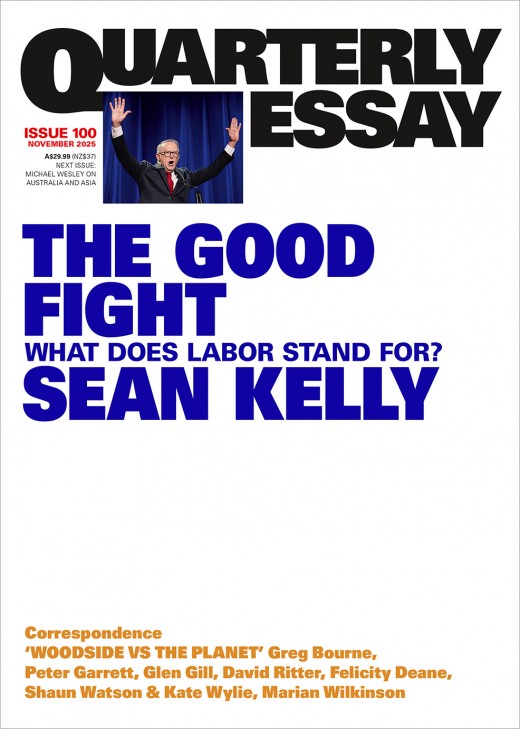
What a treasure Quarterly Essay is. Great Australian essayists engaging with politics and culture in style. The 100th quarterly essay is by Sean Kelly, who wrote my favourite book about Australian politics, The Game: A Portrait of Scott Morrison. In this new book, The Good Fight: What does Labor stand for? he is engaging with an ally, Anthony Albanese, and I can imagine the anguish as an insider turned freelance writer must say the hard things. As always, Kelly brings a literary sensibility, starting with Kafka and ending with Ferrante.
The Good Fight talks about the centre-left’s problem of what to believe in after the triumph of neoliberalism and the death of communism. It’s always struck me that social democracy never actually failed, we just got told it was unviable and we believed it. Neoliberalism’s most insidious and total victory was to have its tenets adopted by centre-left governments – Hawke-Keating, Blair, Clinton. Kelly’s exploration of the shifts involved for Labor in recent decades is convincing and he intertwines it with a philosophical analysis of what it even means to believe anything.
Kelly’s interpretation of Albanese and his beliefs and his strategy vary over time. He has his frustrations at Albanese’s timidity but he also puts forward a generous interpretation of a careful Perseus-like politician, with Medusa’s head in the bag. (It makes sense as you’re reading.) Kelly’s own doubts and autobiographical vulnerability make him a winsome narrator.
Working on a biography of John Curtin, a question in the corner of my mind is whether John Curtin is the same as Albanese – two left-wing Laborites who turned moderate once in power? There’s similarities but Curtin never faltered in belief, the major theme of this essay. What Curtin believed changed over time: his overriding belief became the primacy of winning the war well and nobly. His conflict with the left faction of his own party was over differing beliefs or at least differing priorities. For Curtin, the Labor platform of socialising the economy couldn’t interfere with the first priority of winning the war. But he wasn’t going slowly for the sake of holding onto power or out of timidity. It was out of conviction that it was what his role demanded of him and it was what he had stood for in the 1943 election. Albanese’s greater cause seems to be becoming ‘the natural party of government’ and his hatred of sitting on the opposition benches. Of course, the opportunity to unite a nation and show conviction is much greater in the midst of a world war, and comparisons to labor saints are never quite fair. But the similarities and differences between Albanese and Curtin are something I’d like to explore some more another time.
 Nathan Hobby, a biographer in Perth
“Becoming ‘the natural party of government’ and his hatred of sitting on the opposition benches” is a pretty shabby reason for wanting to win government and that comment shows how hollow Albanese has turned out to be. Curtin was a man of principle, Albanese isn’t.
My copy of this QE went straight to recycling, plastic cover and all. I can see what the Labor Party stands for without anybody telling me: they stand for caving in to interest groups in marginal electorates and in that respect they are no different to the Liberal Party version of rule by party polling data. I wish QE would write about bigger issues. Alan Kohler’s one about the complex reasons for the housing problem was the best of the most recent ones.
LikeLike
Yes, it’s not enough of a reason unless you have something to do! Sean Kelly is pushing quite hard for Labor to do more in this essay and I think he does it well. But I share your disappointment.
LikeLike
Hi Nathan, I haven’t read the latest Quarterly Essay — must do.
I liked your POV that ‘social democracy never actually failed, we just got told it was unviable’.
I was really interested in Lisa’s Hill’s comments. Agree!
We live in Grayndler, Albanese’s seat, but I’ve never voted for him (I became a ‘greenie’when the socialists lost the plot!) I met Albanese once at an election when I was handing out ‘How to Vote’ pamphlets – he can give a very nasty look!
Looking forward to your discussion in the bio. of the similarities & differences between Curtin & Albanese, Nathan. Sounds really interesting.
Denise
LikeLike
How interesting, Denise! The hatred between Labor and Greens can be quite intense, I wouldn’t want to have been on the receiving end of that look.
LikeLike