• About
  • The Red Witch: A Biography of Katharine Susannah Prichard
  • My novel: The Fur

Nathan Hobby, a biographer in Perth

~ The lives of John Curtin & Katharine Susannah Prichard, the art of biography, and other things

Nathan Hobby, a biographer in Perth

Tag Archives: death

How To Live 200 Years

26 Friday Aug 2011

Posted by Nathan Hobby in death, quotes

≈ 1 Comment

Tags

death

Hence, to sum up: The most rational modes of keeping physical decay or deterioration at bay, and thus retarding the approach of old age, are avoiding all foods rich in the earth salts, using much fruit, especially juicy, uncooked apples, and by taking daily two or three tumblerfuls of distilled water with about ten or fifteen drops of diluted phosphoric acid in each glassful.

– William Kinner, North American Review 1893

[Thursday 3pm #26] The Book of Life

24 Thursday Sep 2009

Posted by Nathan Hobby in death, Series: Thursday 3pm feature posts (2009), writing

≈ 6 Comments

Tags

death, Library of Babel

An extract from The Library of Babel

I was on the bus after work to visit Grandad when my mobile started vibrating in my pocket. Its urgency disturbed me: phones were always for bad news in my mind. This time I was right – it was Dad and he was calling to say Grandad had died a few minutes ago.

My voice turned to a whisper. I didn’t want these strangers on the bus knowing my business. I asked Dad if he was coping okay, a stupid question, but I didn’t know what else to say. He said he was okay. I told him I was nearly at the hospice.

The book I’d been reading sat forgotten on my lap. I felt cheated that I’d nearly got there, that I could have seen him one last time and I hadn’t. I looked all around me on the bus, and then I couldn’t get my eyes off the stupid advertisements on the inside walls. There was nowhere I could go without people trying to sell me stuff.

I wanted someone with me but I couldn’t bear to ring Anita. I didn’t want to say Grandad was dead. Spreading the news would make it seem more real. The best thing would be to tell no-one, and then, as far as the world was concerned, he would go on living.

I suddenly realised I had no grandparents left, then I reproached myself. I was being so selfish. The person I should be thinking about was Grandad. I wanted to think precisely of what had just happened to him, to get past the words to the event itself. His consciousness had been extinguished. As far as his body was concerned, he no longer existed.

Everyone always said how sad it was for the people left behind, but I was thinking how the real tragedy was for dead person. How could it be possible to die? For your mind to be thinking thoughts one moment, and then not thinking thoughts the next? How could it be possible to have a final thought?

He had a final thought, and no-one will ever even know what it was. Let alone what came next for him. I wondered if he had last words. No-one even cared about last words these days. People used to care about last words; they probably used to rehearse them, to make sure they had them right. Your last words were the culmination of your life.

I went a few stops past the hospice. It wasn’t like I was thinking very straight. Stepping off the bus into the dusk, I had to walk back along the highway. Bus shelter ads, fast food litter on the uneven slabs of the footpath and all the cars rushing past with such violence. The sun was gone and chill of the night was setting in. I needed to ring Anita, I still couldn’t bear to. This could be an ordinary Tuesday night, I could be going to a pub – not that I ever did, but wouldn’t it be such a comforting, ordinary thing to do tonight? – or going to see a cheap movie at the cinema. But these weren’t options tonight.

An innocuous blue sign pointed down a sidestreet to the hospice. It was a residential street, lined with trees. None of these people in their houses knew that a long had just ended in their street. It happened daily, people’s long life stories coming to an end in beds inside a building on their streets. Did they know how much was being lost around them?

Dad, Uncle Graham, Aunty Pat were gathered in the room where he had died. His body had already been taken away. The bed was empty and unmade. I gave everyone subdued hugs.

Dad asked in a low voice if I wanted to see his body. I said no. Even seeing the empty bed was too much. I hadn’t seen a dead body this far in my life and I didn’t want to start today.

On the beside table was an old paperback. I picked it up; a bookmark from his local library was stuck between pages 190 and 191. He only had a few chapters to go. While everyone was talking, I slipped the book into my bag.

That night, I sat in the lounge room until one a.m. reading the old paperback. It was A.J. Cronin’s autobiography, Adventure in Two Worlds. Uncle Graham had probably grabbed it from Grandad’s shelf. I wondered if Grandad had read it before, or if it had been one of those books he had bought at a garage sale and been meaning to get to for the last twenty years.

It was a cheap paperback edition from the 1960s, the cover declaring it an international bestseller. I disliked bestsellers, but I had sympathy for the forgotten bestsellers of the past. Their obsolescence was touching, as was their misplaced self-confidence. They encapsulated their time and its passing.

Grandad liked to read old paperbacks. Whether it was chosen for him or he chose it, it was a fitting book for his last read. It was a life story imbued with the same old-fashioned notion of common sense that Grandad lived by, and the same refusal to be subversive, crude or despairing. It starts out in typical autobiographical fashion, full of the young doctor’s struggles to succeed in the world. But as the doctor becomes a best-selling writer, the narrative becomes more and more choked with anecdotes until it seizes up altogether in sermons.

I got to Grandad’s bookmark and powered on past it, reading what he had never got to read and thinking how he would have loved the end of the book, as Cronin at the height of his powers looks back on a successful life in a self-congratulatory tone I found difficult.

I got to the last word and shut the book. The book was finished, Cronin was at the height of his powers and Grandad was dead. But Cronin wasn’t really at the height of his powers. I got onto the internet and looked him up. He’d died in 1981, twenty-nine years after he wrote the story of his life. The year I was born. His narrative had started in 1917 when he was 18, the year Grandad was born. The coincidences didn’t lead anywhere, were all vague, but they gave me a sense of appropriateness. The book was finished, the book was out of print, Grandad was dead but Cronin was dead too.

There should be a book for people to read on their deathbed which explains everything. So that you’ve got something to look forward to. The last book you read should be the one which makes sense of life. But what if you lived on too long, finished that book, and then had to start something else? What were the odds of dying at the right time, when you’ve just finished a book? It wasn’t good to leave a book unfinished when you died. Poor Grandad. At least I’d read it for him, that had to count for something.

I had thought that when I finished the book I would want to sleep, but I still felt dissatisfied. I wished I could write in my diary and capture the feelings and thoughts of the day, but I didn’t feel able to. I wanted to listen to the radio, but there was never anything good on that late and it would wake up Anita. She stirred as I came to bed and asked me if I was okay. I told her I was probably more okay than Dad and I was definitely more okay than Grandad.

[Thursday 3pm #25] Endpoint and other poems : a dispatch from the afterlife

17 Thursday Sep 2009

Posted by Nathan Hobby in book review, death, poetry, Series: Thursday 3pm feature posts (2009)

≈ Leave a comment

Tags

death, John Updike

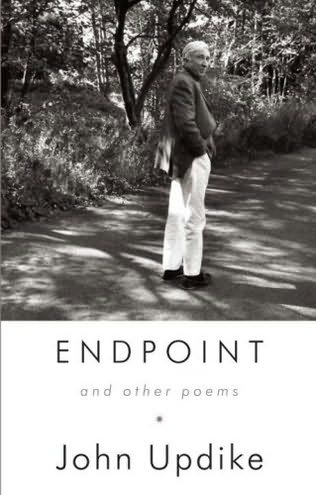
endpointReading John Updike’s final book, a collection of poems, is like receiving a dispatch from the afterlife.  The poems take us nearly up to the point of his death from lung cancer in January this year. He sent the manuscript off and then he died.

The cover photo has a poignancy to it, with its spontaneous, snapshot quality, the sombre ordinariness of it in its black and whiteness, and the sense that John is about to head off down a path we can’t follow him down, not yet.

The collection starts with the ‘Endpoint’ sequence that takes us through each of his last birthdays, starting with his seventieth in 2002, and then into his diagnosis and swift death. His thoughts range across his life, from childhood to old age, as he reflects on mortality, aging, memory. In 2005 he writes

A life poured into words – apparent waste
intended to preserve the thing consumed.
For who, in that unthinkable future
when I am dead, will read? (p.8)

In hospital, having learnt of his death he writes:

Must I do this, uphold the social lie
that binds us all together in blind faith
that nothing ends, not youth nor age nor strength,
as in a motion picture which, once seen,
can be rebought on DVD? My tongue
says yes; within, I lamely drown. (p. 23)

His final reflections are baldly honest.  His poetry is less ornate than his prose, and it makes him seem more vulnerable, frail. He has let me in on the final secret journey he took, which I only learned he had taken when his death was announced that hot, hot January day.

After the ‘Endpoint’ sequence, are pages and pages of other poems, as if to say John is not really dead, as if to say he’s still alive like he should be, like I thought he would be.

[Thursday 3pm # 19] Journal writing : a quote

06 Thursday Aug 2009

Posted by Nathan Hobby in death, Series: Thursday 3pm feature posts (2009), writing

≈ Leave a comment

Tags

death

Father kept himself under control by writing in his journal. This was a system too, the system of language and conceptualization. it proposed that human beings, by the act of making witness, warranted times and places for their existence other than the time and place they were living through.

– E.L. Doctorow Ragtime, p. 63

[Thursday 3pm #12] Art that never dies?

18 Thursday Jun 2009

Posted by Nathan Hobby in death, Series: Thursday 3pm feature posts (2009), writing

≈ 6 Comments

Tags

Borges, Christian writing, Christianity, death, Surprised By Hope, Tom Wright

I picture a different audience for this, my literary blog, than my theology blog. (Theology students, at least the ones at the library I work at, don’t read novels, except maybe Tolkien, to their great loss.) You, my imagined reader, are probably not a christian. In fact, you probably have a distaste for evangelicalism and for anyone who talks about the bible too much. There are good reasons for this. I am in sympathy with you. I have these two sides of me, that aren’t separate in my mind or soul, but are often separate socially – the literary world and the christian world.

But the two have to come together at the moment, because I’m writing a paper for the Newbigin Group (a theological discussion group) called ‘Beautiful Stories : writing novels for the kingdom’. In this paper, I have to use the framework for building for the kingdom laid out by Tom Wright in Surprised By Hope to talk about how my particular activity – writing – might be thought of as building for the kingdom.

Here’s a blurb on Wright’s book from the publisher:

Wright convincingly argues that what we believe about life after death directly affects what we believe about life before death. For if God intends to renew the whole creation—and if this has already begun in Jesus’s resurrection—the church cannot stop at “saving souls” but must anticipate the eventual renewal by working for God’s kingdom in the wider world, bringing healing and hope in the present life.

While you, my intelligent reader, might be most suspicious of Christians who believe in the literal resurrection of Jesus, Wright uses the resurrection as the basis of Christian hope and action for justice, beauty and evangelism in the world. (You probably like the first two and not the third.) For Wright (and for me) God’s action in the world is not confined to the saving of some individual souls, whisked off to ‘heaven’ after death. Instead, God is at work redeeming, renewing the whole creation, which one day will culminate in an intervention when everything is finally set right.

You might remember weeks ago me quoting Julian Barnes piece on the fate of all writers:

For writers, the process of being forgotten isn’t clear-cut. ‘Is it better for a writer to die before he is forgotten, or to be forgotten before he dies?’ But ‘forgotten’ here is only a comparative term, meaning: fall out of fashion, be used up, seen through, superseded, judged too superficial – or, for that matter, too ponderous, too serious – for a later age. But truly forgotten, now that’s much more interesting. First, you fall out of print, consigned to the recesses of the secondhand bookshop and dealer’s website. Then a brief revival, if you’re lucky, with a title or two reprinted; then another fall, and a period when a few graduate students, pushed for a thesis topic, will wearily turn your pages and wonder why you wrote so much. Eventually, the publishing houses forget, academic interest recedes, society changes, and humanity evolves a little further, as evolution carries out its purposeless purpose of rendering us all the equivalent of bacteria and amoebae. This is inevitable. And at some point – it must logically happen – a writer will have a last reader. I am not asking for sympathy; this aspect of a writer’s living and dying is a given. At some point between now and the six-billion-years-away death of the planet, every writer will have his or her last reader. (Nothing to be frightened of : 225)

Yet the incredible claim that Wright makes is that not all art will pass away. For him, God has given us tasks to do here and now that are part of his/her ultimate plans. Part of the task artists have is to depict the beauty of creation – while taking seriously its woundedness and looking forward to its redemption. The picture he offers is of Christ’s resurrected body, still with the nail wounds in his hands – and not as something incidental to Christ, but as the means by which he is identified.

Wright doesn’t know how God will use art (or anything else) in his/her renewed heavens and earth. We have to do our bit, without yet seeing the masterplan. When the time comes, it will fit into place somehow.

A wonderful, comforting idea. But I can’t help thinking of the practicalities. It’s okay for me, writing literary fiction with claims to seriousness and meaningfulness. What about the genre writer writing another crime novel? Does their novel get forgotten or remembered?

Are novels transformed and redeemed themselves? Do they become what they should have been? Does God take their potential and fulfill it? (What would a novel look like edited by God? If the Bible is the book we have from him/her, God seems less interested in perfection and tidiness than we might expect.)

And who reads them? What form do they take? I hope it’s not anything like Borges’ Library of Babel, where very possible book, every combination of letters has been written; that is a kind of hell.

If you want to hear my paper, you’re welcome to come listen at Vose Seminary, 20 Hayman Rd Bentley on Monday 29 June at 7:30pm. Alternatively, stick around and I will be posting it here and on An Anabaptist in Perth.

A film about everything: a review of Synecdoche, New York

18 Monday May 2009

Posted by Nathan Hobby in death, film review

≈ 4 Comments

Tags

Charlie Kaufman, death, Synecdoche

Spoiler alert

Synecdoche, New York is one of the most ambitious films I’ve ever seen. It has a span of decades and attempts to depict, on a huge scale, themes of mortality, loss, the meaning of life and the relationship of art to life. It’s the directorial debut of my favourite screenwriter Charlie Kaufman (Adaptation; Eternal Sunshine of the Spotless Mind) and stars my favourite actor, Philip Seymor Hoffman (Before the Devil Knows You’re Dead; Capote; Charlie Wilson’s War).

The film begins mutedly. A sad, poetic meditation comes over the clock radio announcing the first day of fall and reflecting on the decline of all things. The main character, theatre director Caden, is entering the ‘fall’ of his life. Over breakfast each morning he reads a new obituary of someone famous dying.

The mode is mainly realist in these early scenes, as Kaufman skilfully documents the breakdown of Caden’s marriage and the way the small success of his production of Death of a Salesman is unfulfilling. There are beautifully handled, bleakly funny scenes of domestic drama and conflict – driving in the car, their daughter becomes distressed when Caden tells her she has blood running through her body. His wife Adele assures her she doesn’t have blood; Caden tells her it’s not good to tell her daughter she doesn’t have blood.

As Caden’s health deteriorates and he visits doctors in dark Kafkaesque corridors (another text mentioned early is Kafka’s The Trial) his wife leaves for Berlin with their daughter. His search for his daughter becomes a recurring subplot for the rest of the film, a surreal nightmare as he reads of her being tattooed, sees a poster of her as a stripper and final only meets her again as a dying middle-aged women who blames him for what happens.

If I’m getting ahead of the film it’s because from here the narrative fragments further and further; time and reality become unstable. Rather than a cause and effect narrative, we have echoes, recurrences and variations of themes, played out on a loose narrative.

The loose narrative is this: just as Caden’s life has unraveled, he receives a genius fellowship, a massive grant to do something important for his community. He buys a massive warehouse to stage his biggest production ever. Working with a burgeoning cast of actors, he begins rehearsals that are to go on for the rest of his life. He is attempting to recreate the experience of life itself on the stage, with hundreds of scenes in different buildings running simultaneously. The play just keeps on expanding, a new warehouse built over the top of the city to engulf the previous warehouse and blocks of the city, and then another.

Meanwhile, he becomes entangled in a love triangle that has a key part in the film, a triangle that evokes the spirit of Woody Allen, albeit played out in a surreal universe. Over the decades he switches between the two women, but the relationships are further tangled as actors are recruited to play their parts in the play.

Caden’s own part begins to be taken over, first by the man, Sammy, we’ve glimpsed throughout the film, a man who has dedicated years of his life to following Caden, observing everything he does and is now capable of assuming his role in the great play. The idea of Sammy, of an observer who cares about everything someone does, is one which has fascinated me in the past: if only there was someone watching and remembering, then what we do wouldn’t be forgotten and wouldn’t be wasted.

Life and art inevitably blur; what is being staged and what is being lived? I let go of any attempts to completely comprehend what I was watching and just let the scenes delight me in their variations on the themes Kaufman set up.

Just as the whole thing seems impossible to end, more time passes; Caden moves out of the director’s chair and a final apocalyptic scene ends things perfectly. The last years of his life, Caden has what perhaps we might sometimes long for: a director speaking to him through an earpiece, telling him exactly what do next, right down to the final command, ‘Die now.’

9/10

[Thursday 3pm #3] ‘I don’t believe in God but I miss him’ : Julian Barnes’s Nothing to be frightened of

16 Thursday Apr 2009

Posted by Nathan Hobby in book review, death, Series: Thursday 3pm feature posts (2009)

≈ 6 Comments

Tags

death, Julian Barnes

Nothing to be frightened of / Julian Barnes (2008)

I couldn’t put this memoir down. I didn’t mean to read it all but I couldn’t help it. I could discern no structure at all, but just followed Barnes for two hundred pages of reflections on death and God through the lens of his family. The whole memoir has the sort of wistfulness of the opening line quoted in the title of this post: ‘I don’t believe in God but I miss him.’

Despite the constant humour, it is a frightening book to read. I have never thought through so fully the consequences of not believing in life after death. Even in my moments of strongest doubts about Christianity, I haven’t sustained the outlook that death means the permanent extinguishment of my consciousness. No wonder he’s even more scared of death than me. I think it’s immensely brave of atheists and agnostics to live with hope, meaning and purpose. I don’t know how I would. (Indeed, at times Barnes seems to be suggesting that he has to suspend thinking about the way things actually are in order to live with meaning.)

The title is even cleverer than it sounds; it’s nothingness, extinction that he’s frightened of.

He mentions his wife only once, yet about the time the book was published, she died. I wonder if he wrote with a knowledge that she was dying. If he did, he is a remarkably disciplined writer, probably marshalling all the insights his wife’s dying brought him, but recasting them to protect her privacy. The amazing achievement of the memoir that seems to tell all, that so casually reveals so much about his mother, father, brother, self – and yet keeps hidden bigger parts of his life that he didn’t want to or couldn’t tell us about.

Perhaps my favourite passages were the ones reflecting on the art of writing from the perspective of not only our own deaths but the ultimate forgetting of our work. Every work, he tells us, must have a final reader:

For writers, the process of being forgotten isn’t clear-cut. ‘Is it better for a writer to die before he is forgotten, or to be forgotten before he dies?’ But ‘forgotten’ here is only a comparative term, meaning: fall out of fashion, be used up, seen through, superseded, judged too superficial – or, for that matter, too ponderous, too serious – for a later age. But truly forgotten, now that’s much more interesting. First, you fall out of print, consigned to the recesses of the secondhand bookshop and dealer’s website. Then a brief revival, if you’re lucky, with a title or two reprinted; then another fall, and a period when a few graduate students, pushed for a thesis topic, will wearily turn your pages and wonder why you wrote so much. Eventually, the publishing houses forget, academic interest recedes, society changes, and humanity evolves a little further, as evolution carries out its purposeless purpose of rendering us all the equivalent of bacteria and amoebae. This is inevitable. And at some point – it must logically happen – a writer will have a last reader. I am not asking for sympathy; this aspect of a wrtier’s living and dying is a given. At some point between now and the six-billion-years-away death of the planet, every writer will have his or her last reader. (225)

Barnes then addresses his last reader, at first thanking them but then realising that by definition this last reader has not passed on his work to anyone else, and so cursing them. A sobering thought. This reasonably insignificant post, my one book, this entire blog, everything I have ever written will have a last reader. Is it you?


“I was here too”

26 Thursday Mar 2009

Posted by Nathan Hobby in death, writing

≈ Leave a comment

Tags

death, Julian Barnes

I have tried in the past to express what Julian Barnes expresses so well in this quote from his memoir Nothing to be frightened of. (I’m reading it at the moment, a healthy way to deal with my fear of death – reading about the fear of death.)

Those proud lines of Gautier’s I was once so attached to – everything passes except art in its robustness; kings die, but sovereign poetry lasts longer than bronze – now read as adolescent consolation. Tastes change; truth become cliches; whole art forms disappear. Even the greatest art’s triumph over death is risibly temporary. A novelist might hope for another generation of readers – two or three if lucky – which may feel like a scorning of death; but it’s really just scratching on the wall of the condemned cell. We do it to say: I was here too.
(205)

Updike at rest

30 Friday Jan 2009

Posted by Nathan Hobby in authors, death, R.I.P.

≈ 3 Comments

Tags

death

I was sad to read in the paper yesterday that John Updike died on Tuesday. Just a few weeks ago I was thinking how he was immortal, publishing yet another book, a sequel to the Witches of Eastwick. I thought he had another ten or twenty years with many more novels to come; I didn’t know he was battling for his life.

He was my second favourite writer for a time. I came to grow a little disenchanted with him, but still rated him very highly. I have the illusion of being friends with him, or at least him being a kindly risque uncle I’ve had long conversations with.

I’ve been thinking of his line, ‘After all, you survive every moment except your last,’ as a comfort for my fear of death. But that was when he had survived it all too.

Now there’s no chance of a sixth Rabbit book. It would have been set in 2009, if he had continued the trend. I know it seemed unlikely, given he killed off Rabbit two books ago, but I always thought my hopes would come true and I would have another slice of the Angstrom world.

I will have to write a longer piece about his work and my interactions with it, but I’m at an internet cafe in Richmond and I’ve got to go.

The real skull

28 Friday Nov 2008

Posted by Nathan Hobby in life

≈ 2 Comments

Tags

Andre Tchaikowsky, death

I was disturbed  after reading how musician Andre Tchaikowsky’s skull was used in the latest production of Hamlet. Perhaps more than anything it is seeing a photo of the skull as well as a photo of Andre himself on his website. And pondering the terrible process whereby one becomes the other. Remembering what lies ahead for all of us. The terrible fact, the terrible remainder of bones. And what did they do with his head as they waited for it to become just a skull? One shouldn’t ponder these things.

← Older posts
Newer posts →

Enter your email address to follow this blog and receive notifications of new posts by email.

Join 287 other subscribers

Nathan on Twitter

My Tweets

Categories

  • academic (9)
  • archives and sources (10)
  • autobiographical (62)
  • biographers (10)
  • biographical method (28)
  • biographical quests (18)
  • biographies (21)
    • political biography (2)
  • biographies of living subjects (2)
  • biographies of writers, artists & musicians (12)
  • biographies of writers, artists and musicians (20)
  • biography as a literary form (9)
  • biography in fiction (2)
  • biography in the news (2)
  • books (236)
    • authors (19)
    • book review (173)
    • reading (23)
  • Covid (2)
  • creative nonfiction (11)
  • daily life (2)
  • Daily Prompt (2)
  • death (21)
  • digital humanities (3)
  • family history (1)
  • fiction (8)
  • film and television biographies (5)
  • film review (48)
  • found objects (3)
  • historical biographies (1)
  • history (20)
  • In the steps of KSP (4)
  • John Curtin (12)
  • Katharine Susannah Prichard (114)
    • Glimpses of KSP (7)
    • My KSP biography (31)
      • deleted scenes (1)
  • Katharine Susannah Prichard's associates and connections (16)
  • Katharine Susannah Prichard's writings (34)
  • libraries (5)
  • life (20)
  • link (23)
  • links (41)
  • lists (28)
  • local history and heritage (1)
  • media (4)
  • memes and urban myths (1)
  • memoirs (10)
  • meta (2)
  • music (18)
  • news (9)
  • news and events (43)
  • obituary (1)
  • Old writing found on a floppy disk (1)
  • poetry (5)
  • politics and current affairs (26)
    • climate change (1)
  • prologues and introductions (2)
  • psychological aspects of biography (3)
  • quotes (22)
  • R.I.P. (10)
  • reading report (3)
  • religion (1)
  • religious biography (1)
  • research (5)
  • role of the biographer within the biography (2)
  • Series: A-Z of Katharine Susannah Prichard (26)
  • Series: Corona Diary (1)
  • Series: Saturday 10am (14)
  • Series: Short Stories (2016) (6)
  • Series: The Tourist (2013) (6)
  • Series: Thursday 3pm feature posts (2009) (35)
  • structure of biographies (3)
  • technology and the digital world (2)
  • television (4)
  • the nature of biography (4)
  • this blog (10)
  • Uncategorized (33)
  • Western Australia (26)
  • writing (41)

Archives

Recent Comments

Nathan Hobby's avatarNathan Hobby on Katharine’s birthday tou…
Nathan Hobby's avatarNathan Hobby on Review – The Good Fight:…
Nathan Hobby's avatarNathan Hobby on Katharine’s birthday tou…
David J. Gilchrist's avatarDavid J. Gilchrist on Katharine’s birthday tou…

Bookmarks

  • Adventures in Biography
  • ANZ LitLovers LitBlog
  • Bernice Barry
  • It only goes up to your knees
  • Jane Bryony Rawson
  • Jenn Plays Recorder
  • Katharine Susannah Prichard Writers' Centre
  • Laura Sewell Matter: Essayist and Biographer
  • Mutually said: Poets Vegan Anarchist Pacifist
  • Resident Judge
  • Speaking Thylacine
  • The Australian Legend
  • Timothy Parkin Poetry
  • Treefall Writing – Melinda Tognini
  • Whispering Gums
  • Wrapped up in books: the home of Guy Salvidge

Top Posts

  • The Little Free Library
  • Paul Auster's Moon Palace : an overview
  • Liking Tim Winton
  • '1940 handwritten diary / unknown female / New York'
  • Katharine Susannah Prichard's The Pioneers, redux part 1

Blog Stats

  • 208,732 hits

Tag Cloud

9/11 19th century 33 1920s 1921 1930s 1950s 1970s 1971 1981 2000s 2004 2011 2015 2017 20000 Days on Earth A.S. Byatt Aboriginals activism Adam Begley Adrian Mole adultery afterlife Agatha Christie Alan Hollinghurst Alberto Manguel Alfred Deakin Amazing Grace Americana Amy Grant An American Romance Andre Tchaikowsky Andrew McGahan angela myers anne fadiman Anne Rice Arabian Nights archives art arts funding A Serious Man Ash Wednesday ASIO atheism Atonement Australia Australian film Australian literature Australian Short Story Festival autism autobiography autodidact Barbara Vine beach Belle Costa da Greene Bell Jar best best-of Bible Big Issue Bill Callahan biographical ethics biographical quest genre biographies birthday birthdays Black Opal Bleak House Blinky Bill blogging blogs Blue Blades Bodega's Bunch bog Booker book launch booksale Borges Brenda Niall Brian Matthews Brian McLaren Britney Spears Burial Rites Burke and Wills buskers C.S. Lewis C.S. Lewis canon capitalism Carol Shields Carson McCullers Catcher in the Rye Catholicism celebrities Charles Dickens Charlie Kaufman childhood Child of the Hurricane children's books Choir of Gravediggers Christianity Christian writing Christina Stead Christmas Christopher Beha Cinque Terra Claire Tomalin classics cliches climate change Coen brothers coincidence Collie Collyer coming of age Communism concert Condensed Books consumerism Coonardoo Cormac McCarthy Corrections cosy fiction Dara Horn David Copperfield David Ireland David Marr David Suchet death Death of a president definition demolition Dennis LeHane dentist diaries divorce doctorow Doctor Who documentaries donald shriver Don DeLillo Don DeLillo Donna Mazza Donna Tartt Don Watson Dostovesky doubt drama dreams of revolution Drusilla Modjeska E.M. Forster ebooks editing Eichmann Eisenstein Elizabeth Kostova email empathy ensmallification existentialism faith Falling Man fame families fantasy fiction film and television folk football Frank Barscombe Fremantle Press G.K. Chesterton Gabrielle Carey Gallipoli genealogical fiction Genesis Geoff Nicholson George W. Bush Gerald Glaskin Gilead Golden Miles Goldfields Trilogy Graham Greene grandad great novels Greenmount Guinness World Records Guy Salvidge Hannah Arendt Hannah Kent Hans Koning Hans Koningsberger Harper Lee Haxby's Circus Hazel Rowley He-Man headers heaven Heidegger hell Henrietta Lacks Henry Morton Stanley Herman Hesse heroes Hey Dad! historical fiction history Holden Caulfield holidays Homer & Langley Home Song Stories House of Cards House of Zealots house of zealots Hugo Throssell humour Ian McEwan In between the sheets Indonesia Infamous Inside Llewyn Davis interstellar interview Intimate Strangers Invisible Ireland ISBNs Ishiguro itunes J.D. Salinger J.M. Coetzee J.S. Battye Janet Malcolm Jennifer Egan JFK JFK assassination Joanna Rakoff Joel Schumacher John Burbidge John Fowles John Howard John Kinsella John Updike John Updike Jonathan Franzen journal writing JSB Judgment Day Julia Baird Julian Barnes Kafka Kalgoorlie Kate Grenville Katherine Mansfield Kevin Brockmeier King's Park KSP Writers' Centre language last ride Laurie Steed Left Behind Leonard Cohen Leo Tolstoy Libra Library of Babel Library of Babel Lila Lily and Madeleine links Lionel Shriver lionel shriver lists literary fiction literature Lleyton Hewitt lost book Louisa Louisa Lawson Louis Esson louis nowra love letter Lubbock Lytton Strachey Madelaine Dickie Man Booker man in the dark Margaret Atwood Margaret River Press Marilynne Robinson mark sandman meaning of life Melbourne Mel Hall meme memorialisation memory MH17 Michael Faber Mike Riddell Miles Franklin mining boom missionaries moleskine Moon Palace morphine Mother Teresa movies Music of Chance My Brilliant Career names Napoleon Narnia narrative Narrow Road to the Deep North Narziss and Goldmund Natalie Portman Nathaniel Hobbie national anthem Nick Cave Nina Bawden non-fiction nonfiction noughties novelists novels obituaries obscurity On Chesil Beach Parade's End Paris Hilton Passion of the Christ past patriotism Paul Auster Paul de Man Perth Perth Writers Festival Peter Ackroyd Peter Cowan Writers Centre phd Philip K. Dick Philip Seymour Hoffman pierpontmorgan poetry slam politics popular fiction popular science Possession postapocalyptic postmodernism Pride prophetic imagination publications Pulp Purity Queen Victoria Rabbit Angstrom radio Radio National Randolph Stow rating: 5/10 rating: 6/10 rating: 7/10 rating: 8/10 rating: 9/10 rating: 10/10 ratings reading fiction autobiographically reading report Rebecca Skloot recap red wine reincarnation juvenile fiction rejection review - music reviewing rewriting Richard Flanagan Richard Ford Rick Moody Roaring Nineties Robert Banks Robert Hughes Robert Silverberg Robert Wadlow Robinson Crusoe Rolf Harris romance Rome ruins Russell Crowe Ruth Rendell Sarah Murgatroyd scalpers science fiction Science of Sleep secondhand books Secret River sermon illustration sex short stories Silent Woman Simone Lazaroo Simpsons Siri Hustvedt slavery Smashing Pumpkins social interactions social justice some people i hate sources South Australia souvenirs speculation speech speeches sport status anxiety Stephen Lawhead Stranger's Child subtitles Subtle Flame Sue Townsend suicide Surprised By Hope Suzanne Falkiner Sylvia Plath Synecdoche TAG Hungerford Award tapes teabags Ted Hughes The Children Act The Cure The Fur The Imitation Game theology The Pioneers The Revolutionary Thomas Disch Thomas Hardy Thomas Henry Prichard Thomas Mann thriller time Tim La Haye Tim Winton Tolstoy Tom Wright top 10 Towering Inferno Tracy Ryan Trove Truman Capote tshirts TS Spivet Twelve Years a Slave underrated writers Underworld unwritten biographies urban myth USA vampires Venice Victoria Cross Victoriana Victorian era Victorianism Victoria Park video Voltron w Wake in Fright Walkabout Walter M. Miller war War and Peace war on terror Water Diviner Wellington St Bus Station Westerly Western Australia West Wing What Happened to Sophie Wilder? Whitlams wikipedia Wild Oats of Hans William Wilberforce Winston Churchill Witches of Eastwick Working Bullocks workshop World War One writers writing Writing NSW youth Zadie Smith Zeitgeist Zelig

Enter your email address to follow this blog and receive notifications of new posts by email.

Join 287 other subscribers

Pages

  • About
  • My novel: The Fur
  • The Red Witch: A Biography of Katharine Susannah Prichard

Categories

  • academic (9)
  • archives and sources (10)
  • autobiographical (62)
  • biographers (10)
  • biographical method (28)
  • biographical quests (18)
  • biographies (21)
    • political biography (2)
  • biographies of living subjects (2)
  • biographies of writers, artists & musicians (12)
  • biographies of writers, artists and musicians (20)
  • biography as a literary form (9)
  • biography in fiction (2)
  • biography in the news (2)
  • books (236)
    • authors (19)
    • book review (173)
    • reading (23)
  • Covid (2)
  • creative nonfiction (11)
  • daily life (2)
  • Daily Prompt (2)
  • death (21)
  • digital humanities (3)
  • family history (1)
  • fiction (8)
  • film and television biographies (5)
  • film review (48)
  • found objects (3)
  • historical biographies (1)
  • history (20)
  • In the steps of KSP (4)
  • John Curtin (12)
  • Katharine Susannah Prichard (114)
    • Glimpses of KSP (7)
    • My KSP biography (31)
      • deleted scenes (1)
  • Katharine Susannah Prichard's associates and connections (16)
  • Katharine Susannah Prichard's writings (34)
  • libraries (5)
  • life (20)
  • link (23)
  • links (41)
  • lists (28)
  • local history and heritage (1)
  • media (4)
  • memes and urban myths (1)
  • memoirs (10)
  • meta (2)
  • music (18)
  • news (9)
  • news and events (43)
  • obituary (1)
  • Old writing found on a floppy disk (1)
  • poetry (5)
  • politics and current affairs (26)
    • climate change (1)
  • prologues and introductions (2)
  • psychological aspects of biography (3)
  • quotes (22)
  • R.I.P. (10)
  • reading report (3)
  • religion (1)
  • religious biography (1)
  • research (5)
  • role of the biographer within the biography (2)
  • Series: A-Z of Katharine Susannah Prichard (26)
  • Series: Corona Diary (1)
  • Series: Saturday 10am (14)
  • Series: Short Stories (2016) (6)
  • Series: The Tourist (2013) (6)
  • Series: Thursday 3pm feature posts (2009) (35)
  • structure of biographies (3)
  • technology and the digital world (2)
  • television (4)
  • the nature of biography (4)
  • this blog (10)
  • Uncategorized (33)
  • Western Australia (26)
  • writing (41)

Archives

Recent Comments

Nathan Hobby's avatarNathan Hobby on Katharine’s birthday tou…
Nathan Hobby's avatarNathan Hobby on Review – The Good Fight:…
Nathan Hobby's avatarNathan Hobby on Katharine’s birthday tou…
David J. Gilchrist's avatarDavid J. Gilchrist on Katharine’s birthday tou…

Bookmarks

  • Adventures in Biography
  • ANZ LitLovers LitBlog
  • Bernice Barry
  • It only goes up to your knees
  • Jane Bryony Rawson
  • Jenn Plays Recorder
  • Katharine Susannah Prichard Writers' Centre
  • Laura Sewell Matter: Essayist and Biographer
  • Mutually said: Poets Vegan Anarchist Pacifist
  • Resident Judge
  • Speaking Thylacine
  • The Australian Legend
  • Timothy Parkin Poetry
  • Treefall Writing – Melinda Tognini
  • Whispering Gums
  • Wrapped up in books: the home of Guy Salvidge

Top Posts

  • The Little Free Library
  • Paul Auster's Moon Palace : an overview
  • Liking Tim Winton
  • '1940 handwritten diary / unknown female / New York'
  • Katharine Susannah Prichard's The Pioneers, redux part 1

Blog Stats

  • 208,732 hits

Tag Cloud

9/11 19th century 33 1920s 1921 1930s 1950s 1970s 1971 1981 2000s 2004 2011 2015 2017 20000 Days on Earth A.S. Byatt Aboriginals activism Adam Begley Adrian Mole adultery afterlife Agatha Christie Alan Hollinghurst Alberto Manguel Alfred Deakin Amazing Grace Americana Amy Grant An American Romance Andre Tchaikowsky Andrew McGahan angela myers anne fadiman Anne Rice Arabian Nights archives art arts funding A Serious Man Ash Wednesday ASIO atheism Atonement Australia Australian film Australian literature Australian Short Story Festival autism autobiography autodidact Barbara Vine beach Belle Costa da Greene Bell Jar best best-of Bible Big Issue Bill Callahan biographical ethics biographical quest genre biographies birthday birthdays Black Opal Bleak House Blinky Bill blogging blogs Blue Blades Bodega's Bunch bog Booker book launch booksale Borges Brenda Niall Brian Matthews Brian McLaren Britney Spears Burial Rites Burke and Wills buskers C.S. Lewis C.S. Lewis canon capitalism Carol Shields Carson McCullers Catcher in the Rye Catholicism celebrities Charles Dickens Charlie Kaufman childhood Child of the Hurricane children's books Choir of Gravediggers Christianity Christian writing Christina Stead Christmas Christopher Beha Cinque Terra Claire Tomalin classics cliches climate change Coen brothers coincidence Collie Collyer coming of age Communism concert Condensed Books consumerism Coonardoo Cormac McCarthy Corrections cosy fiction Dara Horn David Copperfield David Ireland David Marr David Suchet death Death of a president definition demolition Dennis LeHane dentist diaries divorce doctorow Doctor Who documentaries donald shriver Don DeLillo Don DeLillo Donna Mazza Donna Tartt Don Watson Dostovesky doubt drama dreams of revolution Drusilla Modjeska E.M. Forster ebooks editing Eichmann Eisenstein Elizabeth Kostova email empathy ensmallification existentialism faith Falling Man fame families fantasy fiction film and television folk football Frank Barscombe Fremantle Press G.K. Chesterton Gabrielle Carey Gallipoli genealogical fiction Genesis Geoff Nicholson George W. Bush Gerald Glaskin Gilead Golden Miles Goldfields Trilogy Graham Greene grandad great novels Greenmount Guinness World Records Guy Salvidge Hannah Arendt Hannah Kent Hans Koning Hans Koningsberger Harper Lee Haxby's Circus Hazel Rowley He-Man headers heaven Heidegger hell Henrietta Lacks Henry Morton Stanley Herman Hesse heroes Hey Dad! historical fiction history Holden Caulfield holidays Homer & Langley Home Song Stories House of Cards House of Zealots house of zealots Hugo Throssell humour Ian McEwan In between the sheets Indonesia Infamous Inside Llewyn Davis interstellar interview Intimate Strangers Invisible Ireland ISBNs Ishiguro itunes J.D. Salinger J.M. Coetzee J.S. Battye Janet Malcolm Jennifer Egan JFK JFK assassination Joanna Rakoff Joel Schumacher John Burbidge John Fowles John Howard John Kinsella John Updike John Updike Jonathan Franzen journal writing JSB Judgment Day Julia Baird Julian Barnes Kafka Kalgoorlie Kate Grenville Katherine Mansfield Kevin Brockmeier King's Park KSP Writers' Centre language last ride Laurie Steed Left Behind Leonard Cohen Leo Tolstoy Libra Library of Babel Library of Babel Lila Lily and Madeleine links Lionel Shriver lionel shriver lists literary fiction literature Lleyton Hewitt lost book Louisa Louisa Lawson Louis Esson louis nowra love letter Lubbock Lytton Strachey Madelaine Dickie Man Booker man in the dark Margaret Atwood Margaret River Press Marilynne Robinson mark sandman meaning of life Melbourne Mel Hall meme memorialisation memory MH17 Michael Faber Mike Riddell Miles Franklin mining boom missionaries moleskine Moon Palace morphine Mother Teresa movies Music of Chance My Brilliant Career names Napoleon Narnia narrative Narrow Road to the Deep North Narziss and Goldmund Natalie Portman Nathaniel Hobbie national anthem Nick Cave Nina Bawden non-fiction nonfiction noughties novelists novels obituaries obscurity On Chesil Beach Parade's End Paris Hilton Passion of the Christ past patriotism Paul Auster Paul de Man Perth Perth Writers Festival Peter Ackroyd Peter Cowan Writers Centre phd Philip K. Dick Philip Seymour Hoffman pierpontmorgan poetry slam politics popular fiction popular science Possession postapocalyptic postmodernism Pride prophetic imagination publications Pulp Purity Queen Victoria Rabbit Angstrom radio Radio National Randolph Stow rating: 5/10 rating: 6/10 rating: 7/10 rating: 8/10 rating: 9/10 rating: 10/10 ratings reading fiction autobiographically reading report Rebecca Skloot recap red wine reincarnation juvenile fiction rejection review - music reviewing rewriting Richard Flanagan Richard Ford Rick Moody Roaring Nineties Robert Banks Robert Hughes Robert Silverberg Robert Wadlow Robinson Crusoe Rolf Harris romance Rome ruins Russell Crowe Ruth Rendell Sarah Murgatroyd scalpers science fiction Science of Sleep secondhand books Secret River sermon illustration sex short stories Silent Woman Simone Lazaroo Simpsons Siri Hustvedt slavery Smashing Pumpkins social interactions social justice some people i hate sources South Australia souvenirs speculation speech speeches sport status anxiety Stephen Lawhead Stranger's Child subtitles Subtle Flame Sue Townsend suicide Surprised By Hope Suzanne Falkiner Sylvia Plath Synecdoche TAG Hungerford Award tapes teabags Ted Hughes The Children Act The Cure The Fur The Imitation Game theology The Pioneers The Revolutionary Thomas Disch Thomas Hardy Thomas Henry Prichard Thomas Mann thriller time Tim La Haye Tim Winton Tolstoy Tom Wright top 10 Towering Inferno Tracy Ryan Trove Truman Capote tshirts TS Spivet Twelve Years a Slave underrated writers Underworld unwritten biographies urban myth USA vampires Venice Victoria Cross Victoriana Victorian era Victorianism Victoria Park video Voltron w Wake in Fright Walkabout Walter M. Miller war War and Peace war on terror Water Diviner Wellington St Bus Station Westerly Western Australia West Wing What Happened to Sophie Wilder? Whitlams wikipedia Wild Oats of Hans William Wilberforce Winston Churchill Witches of Eastwick Working Bullocks workshop World War One writers writing Writing NSW youth Zadie Smith Zeitgeist Zelig

Blog at WordPress.com.

  • Subscribe Subscribed
    • Nathan Hobby, a biographer in Perth
    • Join 287 other subscribers
    • Already have a WordPress.com account? Log in now.
    • Nathan Hobby, a biographer in Perth
    • Subscribe Subscribed
    • Sign up
    • Log in
    • Report this content
    • View site in Reader
    • Manage subscriptions
    • Collapse this bar
 

Loading Comments...