The incredible shrinking novel which became a short story

Tags

, ,

Post #7 in my Australian Short Story Festival series

In my writing career, I have had the triumph of a short story which became a novel – a familiar enough transformation – but also the tragedy of a full length novel which only ever saw publication as a short story. There’s nothing tragic about short stories, of course, but generally a writer doesn’t like to spend twelve years on one. Continue reading

Donna Mazza’s “The Exhibit”

Tags

, , ,

Post #6 in my Australian Short Story Festival series

I found Donna Mazza’s “The Exhibit” a terrifying story to read. It starts with a pregnant narrator, Stacey, in a troubled relationship – ripe drama for a short story – but before long we realise the full picture: as part of a de-extinction project, her baby has been spliced with neanderthal DNA. The ordinariness of Stacey’s concerns about things like an unfriendly radiographer makes the scenario feel so much more real. It happens as it would in real life: the person at the centre of it not being told the full picture, not in control, at the mercy of radiographers and doctors, and quite remote from the scientists driving it. I’ve recently been through the anxiety and hope of my wife’s pregnancy and this story conveyed much of that experience but amplified it so well. It’s great literary science fiction, inhabiting the same dark territory as the Black Mirror television series.

“The Exhibit” appeared in Westerly 60.1 last year, but you can read it online here. Donna’s the author of the TAG Hungerford Award winning novel The Albanian. I’ll be appearing alongside her on the Australian Short Story Festival panel, Voices From the West on Saturday.

Katharine Susannah on Twitter!

Tags

ksp-twitter

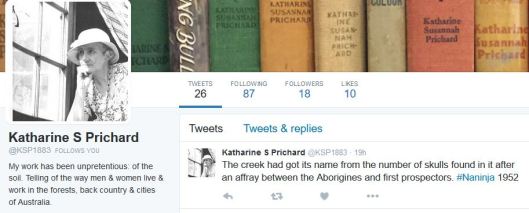
It’s rather speculative to imagine what Katharine Susannah Prichard would make of Twitter. She had a mixed relationship with technology. She flew in an aeroplane in 1916 when that was novel and dangerous, and travelled by motorbike and car around Western Australia with Hugo in 1919. Late in life she came to enjoy the wireless but disliked the advent of television and lived without many of the “modcons” of the postwar era.

I hope she wouldn’t mind that I’ve created a Twitter account for her, “Katharine S. Prichard”, https://twitter.com/KSP1883. After enjoying snippets of Samuel Pepys’ diary, as well as the tweets of Vita Sackville-West and C.S. Lewis, I decided Twitter would be a wonderful platform to serve up morsels of Katharine’s writing. 140 characters does not give room for context or nuance, but I believe it can give people a flavour of her writing and encourage them to seek out her books.

I’ll be tweeting quotes from across her oeuvre. The idea is to keep it entirely in her own voice.  Where there’s room I’ll give the name of the work as a hashtag, and I’ll also give the year of publication. It’ll often be a case of me live-tweeting whatever work of hers I’m reading at the moment, hence the wild veering across the years so far.

Even the profile for a Twitter account has to keep within the 140 character limit, so I was so pleased to find just the right words to fit the limit from a late article by Katharine, “Some Perceptions and Aspirations” (Southerly, 1968):

My work has been unpretentious: of the soil. Telling of the way men & women live & work in the forests, back country & cities of Australia.

Please come and follow her!

A working writer: N’goola and Other Stories by Katharine Susannah Prichard

Tags

, ,

img_0731

Post #5 in my Australian Short Story Festival series

Katharine Susannah Prichard published two books in the 1950s – Winged Seeds, a goldfields novel, at the beginning of the decade in 1950, and N’goola and Other Stories at the end of the decade in 1959. It was a difficult decade for Katharine -she felt the sting of Cold War persecution as a Communist; her health was poor; her only son was living overseas and then interstate; and the writing projects she had envisaged in 1950 did not work out how she hoped. N’goola brings together this decade of troubled writing. There’s much in it which surprised and interested me. Continue reading

Structurally speaking

Tags

structure_paris_les_halles

Photo by Procsllas Mosas, Flickr

Post #4 in my Australian Short Story Festival series

One of the panels I’m appearing on at the Australian Short Story Festival is “The Importance of Structure: How to Put What Where”. Structure’s a slippery term, especially when it comes to writing. I need to think aloud about just what it is we’re talking about. Continue reading

Stand for the national anthem, or we’ll call the police

Tags

, ,

The ABC understands one of the boys was questioned two years ago by New South Wales Police and the Australian Federal Police over an incident at his school.

It is understood that incident involved him refusing to stand for the national anthem at the morning assembly of his school — East Hills Boys High School – in June 2014 when the boy was 14.

When questioned why he would not stand for the national anthem, the boy said “he only stands for God”, “does not respect this country” and “this country sends troops to Afghanistan to kill our men and rape our women”.

http://www.abc.net.au/news/2016-10-12/counter-terrorism-police-two-men-over-bayonet-incident-in-sydney/7926188

The news of sixteen-year-olds plotting terrorism is frightening. But just as frightening, buried in today’s story of the arrests, is the report that police were called to a school two years ago because one of the suspects would not stand for the national anthem. I cannot imagine a better way to radicalise a fourteen-year-old. It’s disturbing that he doesn’t respect Australia, the country he lives in, although it’s unsurprising that he’s upset about Australia’s involvement in disastrous wars overseas. It’s disruptive when people won’t stand for the national anthem. And this boy has gone on to plan violence. But however we regard it, refusing to stand for the national anthem itself must never be a police matter. When it becomes one, we are living in a dystopia. In the “war on terror” we are losing the very freedom we are meant to be fighting for.

Twenty tiny chapters: why structure matters in short stories

Tags

, ,

Post #3 in my Australian Short Story Festival series

Why does structure matter? How does it shape the meanings of a story, and the reader’s response to it?

For one thing, structure gives signals to readers. I break my long short-story “The Zealot” into twenty tiny chapters. It’s quite a filmic story and the “chapterettes” function as scenes.  It seemed like a necessary thing to do for a piece like this which is written in the present tense. It’s an intense story through the eyes of an unstable teenage-activist and perhaps it offers some relief for the reader, a containment. On the other hand, it’s also a trace of that story’s origins as an entire novel, and a signal that perhaps it’s not exactly a short story. It’s rare to have a short story which is broken into numbered sections, but it’s quite common for them to be structured with many scene-breaks, marked off with asterisks. I’ve got a misbegotten tendency to think of short stories which are “one take” – no breaks of any kind – as being a purer example of the genre.


Kiss on the Lips and Other Stories by Katharine Susannah Prichard: a review

Tags

, , , ,

kiss-on-the-lips

Post #2 in my Australian Short Story Festival series

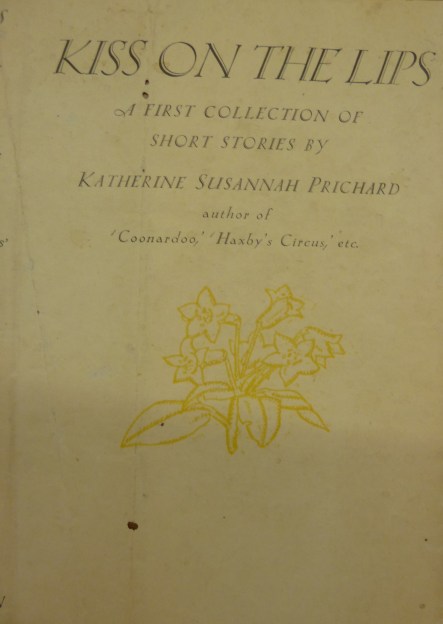
Katharine Susannah Prichard’s first collection of short stories, Kiss on the Lips, was published in 1932, the same year as her collection of poetry, The Earth Lover and Other Verses. It came at the height of her career, soon after her three great novels – Working Bullocks (1926), Coonardoo (1929) and Haxby’s Circus (1930) – as well as her underrated “children’s” novel Wild Oats of Han (1928). It was the last book she was to publish before the devastation of the death of her husband, Hugo, in 1933.

It’s a diverse collection, spanning two decades across genres, landscapes, readerships, and quality. The book offers no guidance to readers, not even an acknowledgement of previous publications, and I can imagine some of them feeling bewildered. Continue reading

Angela Carter: Far from the fairytale | Books | The Guardian

Tags

,

The otherworldly figure conjured after her death in 1992 doesn’t do Angela Carter justice. Her biographer Edmund Gordon attempts a more accurate portrayal of a complex, sensual and highly intellectual woman

Source: Angela Carter: Far from the fairytale | Books | The Guardian

This is a great article in the Guardian from Angela Carter’s biographer, Edmund Gordon. He does a splendid job of creating a capsule biography of her in the article, giving a sense of her whole life in a few thousand words, while making it interesting to read and illuminated with revealing moments. This must be so hard to do after coming to know her life so well in its details and agonising over any summary, given any summary will tend to distort by simplification or omission.

He describes the mythology she has been reduced to and sketches something of how he reinterprets Carter. It takes insight and courage to successfully and fairly reinterpret a life. And there’s a pressure on biographers to do so – because if you’re not offering a new interpretation, why are you writing? (In this case, though, it is the first biography of her.) Another point of interest for me: how will he be received as a man writing about a woman?

Re-reading my first short story 20 years later; or, confessions of a coal-powered writer

Tags

,

Post #1 in my Australian Short Story Festival series

I have a confession to make: the beginning of my literary career was powered by coal company. The arts festival presented by Griffin Coal is a big event in the life of Collie, the coal-mining town in the south-west of WA where I grew up. Winning second-prize in the open category of the 1996 Griffin Festival Literary Awards at the age of fifteen – beaten by my drama teacher – made me think I could be a writer. Continue reading