
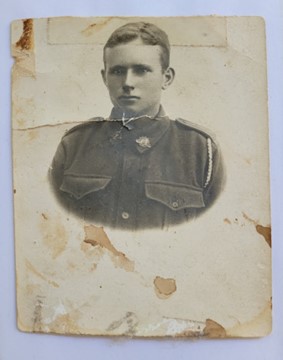
When I was fifteen, my grandmother sent me a photo of her father, Bert Sewell, in military uniform during the Great War. He was twenty but he looks younger. She was offering it to me because she thought I resembled him. Her attention was unpredictable and her true thoughts and feelings inscrutable; I felt honoured to have been chosen like this out of six grandsons. I placed the photo in the concertina folder I had for important documents, which also put it out of sight and out of mind for many years. I don’t remember my grandmother ever talking about him again. But when she died we found a correction she’d made in biro to Bert’s entry in a family history book.
Bert died on 9 December 1967 in Perth’s Hollywood Repatriation Hospital. Ten days later, his wife, Iris, died too. Their entry in the family history book claims, ‘An unfortunate accident followed by prolonged litigation brought about their hastened deaths’ (Sewell 167). My grandmother scribbled those lines out and wrote that Bert died of bladder cancer and Iris died ‘following a third stroke’. What my grandmother wrote is technically closer to the truth. But just before he died, Bert shot a man in the thigh and spent nine days in the Meekathara lockup. Although it wasn’t actually an accident and the litigation wasn’t prolonged, its proximity connects it to his death and Iris’s death. My dad was thirteen at the time; he was told about their deaths but not about the shooting.
Continue reading Nathan Hobby, a biographer in Perth