• About
  • The Red Witch: A Biography of Katharine Susannah Prichard
  • My novel: The Fur

Nathan Hobby, a biographer in Perth

~ The lives of John Curtin & Katharine Susannah Prichard, the art of biography, and other things

Nathan Hobby, a biographer in Perth

Category Archives: book review

Review – Damned Good : A Poker Novel by J.J. Deceglie

22 Monday Feb 2010

Posted by Nathan Hobby in book review, Western Australia

≈ 1 Comment

Fontaine Press, 2010. 128p. www.damnedgood.com.au

Damned Good is  a season in the life of the Rookie, an emerging poker player who takes the Perth poker scene by storm before heading to Melbourne to take on Australia’s best, Rawlins. It’s a short novel full of booze, cards and philosophising, with few first names but instead characters called the Rookie, the Kid, Rawlins, Indersmith.

It’s subtitled ‘a poker novel’, but it could as easily be subtitled ‘an existential novel’. For the Rookie, poker is a mode of existence, a lens to see the world through:

For him it was where he had to be.

Severe naked existence.

This was living in the world.

There was not a thing else like it.

Moments he guessed were like the cards falling from the deck, destined randomness and predetermined chance, opportunities bobbing up and it there for you to take or blow. (p.7)

It’s in high-stakes poker that the Rookie has found what it means to live authentically, dangerously. The novel may leave many readers wishing they were as cool as the Rookie. He’s a man who thinks existential thoughts, writes manifestos he burns, and can drink bourbon continuously without it affecting his poker.

The two writers this novel reminds me of most are William Gibson and Cormac McCarthy. The Rookie is a hero in the tradition of those streetwise heroes of Gibson’s cyberpunk novels, brilliant at what they do. The prose has similar crisp, unexpected metaphors. Yet it’s also close to the prose and characters of McCarthy’s Border Trilogy, the brave cowboys who don’t say too much, but think deep thoughts and experience a kind of brutal beauty in their world. And the prose has a similar clipped, sparse beauty. Minimal dialogue, no speech marks.

After the climax of the showdown with Rawlins, the narrative is interrupted by an eight page booklet called “Authentic Poker”, presumably the Rookie’s manuscript, a cross between a poker manual and Nietzche.

Try to remember as often as possible that you will one day die. It is the surest method of allowing yourself to seek authenticity and essence with a full and unswerving heart.

Part Two skips forward a while in the Rookie’s life, after an ‘off-screen’ fall. The novel closes with a fascinatingly surreal poker game.

Damned Good is a worthy follow up to Deceglie’s  debut novel, The Sea Is Not Yet Full. I love the evocation of a kind of underground Perth and Fremantle.  It’s a compact and interesting story with a character and a milieu which are refreshing for Australian literature.
Barbara Vine’s The Blood Doctor as a Biographer’s Tale and Some Narrative Analysis

17 Thursday Dec 2009

Posted by Nathan Hobby in book review, writing

≈ Leave a comment

Tags

Barbara Vine

Barbara Vine, The Blood Doctor (2002)

The Blood Doctor is a biographer’s tale. Martin Nanther is researching the life of his great-great grandfather, Lord Henry Nanther, specialist in haemophilia and personal physician to Queen Victoria.

The story is set in 1999, as Martin sits out the last days of his life as a hereditary peer in the House of Lords. A bill is going through to abolish hereditary peers and he sees the logic of it, as much as he is deeply sad to leave behind a world he has come to love. Vine’s treatment of this aspect of the novel is repetitious at times, although it is an interesting subplot, relating as it does to the peership bestowed upon Henry Nanther.

Toward the end of the novel, Martin is short of money and contemplates taking on a real job while exiled from his former home at the House of Lords. Vine provides a resolution to this by having the government offer him as a position as chief whip; he returns to his beloved House. She makes some effort to foreshadow this by having several characters comment on how well-liked Martin is and how they would like to see him stay on in the house. It still comes as something of a bolt out of the blue, the sort of event quite standard in real life, but not making particular narrative sense.

The other subplot is the fertility problem of Martin and his wife Jude. Martin has a son from his first marriage and doesn’t want another child – except for Jude’s sake; she desperately wants one and at 37, time is running out. She has already miscarried once, and the novel is punctuated by a couple more miscarriages. Again, we have something of a deus ex machina in the form of IVF treatment, giving Jude a healthy baby who won’t spontaneously abort. The resonance with the blood theme is apparent; I’m undecided whether it’s a satisfactory narrative solution.

But the main plotline is Martin’s research into the life of Henry Nanther. Certain problems confront the writer attempting to write the biographer’s tale. Firstly, the problem of two timelines: there is the action in the present day in which the biographer lives and discovers things about the figure of the past. And there is also the timeline of the past in which the subject of the biography lived and died. The problem is that it would seem much too contrived for the discoveries of the biographer in the present day to neatly follow the sequence of events in the life of the subject. Discoveries are going to come from different periods and have to be sorted chronologically by the biographer. This works against creating a coherent narrative.

Vine attempts to solve this problem by giving us an outline of what Martin already knows about Henry’s life early in the novel. This makes sense; the biographer starts out knowing something about the subject, and these facts are revealed over several chapters, some through exposition and some through convenient conversations. The gaps in the biographer’s knowledge are also revealed. In the case of The Blood Doctor, Martin’s ‘gap’ is the revelation that Henry had a mistress in a letter written by Martin’s great-aunt. The second ‘gap’ Vine leaves hidden until it comes up in a dinner party conversation – Henry was engaged to a woman who was thrown from a train and murdered. Soon after, he married the murdered woman’s sister.

Working from Henry’s diary and some other sources, Martin concludes that Henry engineered a meeting with the murdered fiancée by saving her father from an arranged mugging. The central mystery of the whole book hangs on why he was so obsessed with marrying into this unprestigious family. Martin begins to conclude that Henry had his first fiancée murdered. In the end, the murder proves to be a complicating coincidence, a red herring to throw us off Henry’s real crime – a possibly unsatisfying narrative outcome.

The second problem facing the writer of a biographer’s tale is the limits of biography itself. A novel lets us – usually – into the hearts and minds of its characters. A historical biography is a reconstruction, limited by the available evidence, the sources that the biographer finds. In Possession, A.S. Byatt makes this task easier by supplying passionately written letters between the subjects and poetry. But Henry Nanther was no poet and it may have been out of place to make him a good writer, in touch with his feelings. So what we are left with is Martin Nanther’s speculations based on Henry’s emotionless and scant journal entries and notebook.

Vine further handicaps herself by creating a second notebook which Martin manages to trace to a distant relative. Only he’s too late; his cousin’s senile father accidentally threw out the notebook with the recycling – the notebook in which Henry finally tells the truth about what he has done, why he was obsessed with marrying one of the Robinson sisters. Thankfully, the senile father remembers the gist of it, which he feebly relates to Martin. It’s rather unsatisfactory and unnecessary; if it was a postmodern novel, it might be telling us of the transmissions of texts or reveling in the uncertainty. But it’s not; it’s a psychological thriller which doesn’t evoke its own psychology enough.

Blood Doctor is an interesting novel to read for me; it highlights the narrative challenges of its subject and gives me some clues about strategies good and bad. But if you’re reading for pleasure, I would suggest Barbara Vine’s earlier novel, The Chimney Sweeper’s Boy. I would say that at her best Barbara Vine is a wonderful guilty pleasure for litfiction readers.

[Thursday 3pm #34] Paul Auster’s Invisible : a review

19 Thursday Nov 2009

Posted by Nathan Hobby in book review, Series: Thursday 3pm feature posts (2009)

≈ 1 Comment

Tags

Invisible, Paul Auster

It’s been a prolific decade for my favourite author, Paul Auster –he has just published his sixth novel of the noughties. As prolific as he’s been, he’s also published some of his weakest works –I don’t care for the crowd-pleasing Brooklyn Follies nor Travels in the Scriptorium, although at least they’re better than Timbuktu, his late nineties novel told through the eyes of a dog. I rate his new novel, Invisible, the second best of the six of the decade, after The Book of Illusions. It is the most typical of his whole career, with many of his recurring elements appearing – a mysterious stranger, a change of fortune, a struggling poet translating French texts, a random act of violence, and a framed narrative.

As almost always happens in Auster’s novels, the protagonist is a male New Yorker born in 1947 and a student at Columbia. Adam Walker is a college student and aspiring poet and the novel is about the defining year of his life, 1967.

Adam meets a mysterious stranger at a party – Rudolf Born – who makes him an offer that will change his life; Born will pay Adam to edit a literary magazine. Born is called away on business, and Adam is seduced by Born’s girlfriend, Margot. Yet it isn’t this that causes a rift between them, but Born’s violent stabbing of a mugger. Adam spends much of the rest of the novel hoping to see justice served on Born for the murder.

In between, he has lots of sex with his sister, and even though there’s been hints of incest in Auster’s work before (In The Country of Last Things, The Red Notebook, from memory) it is the sexual explicitness of this novel that is its most atypical feature. Usually Auster summarizes sex without going into much detail at all, but this time he is more anatomical.

Complicating the story is a complicated framing device. The first part about Walker meeting Born and things going wrong, is revealed to be the first chapter of a manuscript Walker has written in the present day and sent to his friend Jim, a famous writer. Walker is terminally ill and is trying to finish the memoir before he dies. (A situation which recalls Thomas Effing telling Fogg his life story in Moon Palace for his obituary, and Hector Mann bringing Zimmer to his ranch to see his secret films before he dies in The Book of Illusions.)  After Jim’s framing, the second part of the novel is told in second person to overcome Walker’s writer’s block. The third part of the novel is filled out by Jim from Walker’s rough notes. As Walker’s narrative ends, Jim does some detective work, tracking down the people involved and trying to solve some of the mysteries.

It is a compulsively readable story, fascinating and littered with insights into the way we make meaning of life and how we decide what to do with ourselves. In her review, Lionel Shriver contended that there is nothing to take away from the book, that it’s like a glass of lemonade. I think part of what she is noticing and what disappoints her is an insistence by Auster that his narratives attempt to mimic some of the randomness of life, with both its coincidence and its failure to resolve. I read a reviewer once describe Auster’s work as a handful of smooth stones rubbing against each other, but not yielding anything as simple as meaning.

Perhaps Auster has had a bad influence on me over the last nine years that I’ve been reading him. Particularly in my first two novels and in an abandoned novel or two, I attempted to emulate his randomness, thinking I could just add it as one more element in a palimpsest of all my favourite writers – a bit of Auster’s randomness, a bit of Joyce’s stream of consciousness, a bit of Dick’s madness – in the one narrative. Not possible. The whole narrative world has to be driven by randomness, if one wants to write about the music of chance.

[Thursday 3pm #29] Janet Hobhouse and The Furies

15 Thursday Oct 2009

Posted by Nathan Hobby in book review, Series: Thursday 3pm feature posts (2009)

≈ 1 Comment

Janet Hobhouse died of ovarian cancer in 1991 in her forties. She didn’t finish editing The Furies, but it’s seen as her greatest work.  It deserves to be read.

Reviewers invariably treat it as autobiography rather than the novel it was published as, and it certainly has the feel of autobiography. The trajectory of the narrative has all the repetitiousness and random intrusions of life itself. It starts before the narrator is born, with the tangle of family that led to her:

That my mother, who viewed herself as as related to very few other beings in the universe, should have descended in a mere three generations from this world of wealth and kindness, this reliable multiplicity of connected others, this cohabitation of cousins, aunts, servants etc., says something about the speed of American life in this century, which cannot only provide a solitary immigrant with the means to create, in a matter of decades, a secure and well-populated dynasty, but can also, and at the same rate, take all these steps in reverse, reducing, as in our case, a huge, prosperous, civically active and internationally connected clan to a mere handful of desperate solitaries, operating like ball-bearings in outer space.

The book follows the narrator through childhood and adulthood, to the horror of her mother’s suicide and the sudden plunge into cancer. A postscript of apparent recovery; we know this wasn’t to last. It’s a book and a life with many tragedies. I felt the same as one reviewer who said to read this book is to get to know Janet Hobhouse, only to lose her. She seems like someone who would have been worth knowing.

Her prose has an unusual quality: confessional, honest without a hint of apology. Her story is compelling, giving the feel of life without even zooming in on many scenes, but capturing the flow of it.

(PS: Couldn’t help being delighted by the similarity of title and name to my novel. Hobhouse/Hobby – The Furies/ The Fur.)

[Thursday 3pm #28] The Hoarding Recluses: A Review of E.L. Doctorow’s “Homer and Langley”

08 Thursday Oct 2009

Posted by Nathan Hobby in book review, books, history, Series: Thursday 3pm feature posts (2009)

≈ 1 Comment

Tags

Collyer, doctorow, Homer & Langley

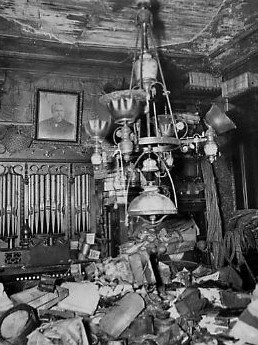
CollyerHomer and Langley Collyer were two hoarding recluses who suffered notorious celebrity, at least in New York City, in the 1940s as they fought against the power company, the bank, and the city council. They lived in a large house inherited from their parents and filled it with everything they could get their hands on. Homer was blind; Langley saved years of newspapers in massive piles (‘like cotton bales’ Doctorow imagines) in case Homer ever got his sight back and wanted to catch up on the news. By the end, the paranoid brothers had set traps around the house and could barely move through the narrow passageways between junk. They died within days of each other in 1947 and compulsive hoarding is named after them – Collyer Syndrome. According to Wikipedia, 103 tonnes of rubbish was removed from their house:

Items removed from the house included baby carriages, a doll carriage, rusted bicycles, old food, potato peelers, a collection of guns, glass chandeliers, bowling balls, camera equipment, the folding top of a horse-drawn carriage, a sawhorse, three dressmaking dummies, painted portraits, pinup girl photos, plaster busts, Mrs. Collyer’s hope chests, rusty bed springs, the kerosene stove, a child’s chair (the brothers were lifelong bachelors and childless), more than 25,000 books (including thousands about medicine and engineering and more than 2,500 on law), human organs pickled in jars, eight live cats, the chassis of the old Model T Langley had been tinkering with, tapestries, hundreds of yards of unused silks and fabric, clocks, fourteen pianos (both grand and upright), a clavichord, two organs, banjos, violins, bugles, accordions, a gramophone and records, and countless bundles of newspapers and magazines, some of them decades old.

From such promising source material in the hands of a masterful novelist, Homer & Langley disappointed me. It feels like a novel which never takes off. Narrated by Homer, it is an episodic account of his life from childhood to the late 1970s (Doctorow has the brothers live on several decades longer than they did in real life). A gangster and a group of hippies stay with the brothers at different times, and many others come into their lives for a little time only to leave again. Doctorow doesn’t stay with any of these characters long enough for their interactions with the Collyers to take on enough significance.

The other problem is the first person narration. It doesn’t suit the story Doctorow is telling. We need a narrator who can see the significance and full eccentricity of the Collyers, rather than one to whom their life is insignificant. We need fresh eyes – and Homer has no sight at all – to describe the wonders of the hoarded house.

Perhaps the conflict with the power company and banks would have been more compelling if there was a character representing one of them, an antagonist in ongoing conflict with the Collyers, instead of a couple of faceless stand-offs at the front door.

The charms of this novel are in Homer’s philosophy of the world and his mad projects.

He wanted to fix American life finally in one edition, what he called Collyer’s eternally current dateless newspaper, the only newspaper anyone would ever need. For five cents, Langley said, the reader will have a portrait in newsprint of our life on earth. The stories will not have overly particular details as you find in ordinary daily rags, because the real news here is of the Universal Forms of which any particular detail would be only an example. The reader will always be up to date, and au courant with what is going on. He will be assured that he reads the indispensable truths of the day including that of his own impending death, which will be dutifully recorded as a number in the blank box on the last page under the heading Obituaries. (p.49)

At moments like these, the novel brings to mind Paul Auster and the fascinating life projects of his characters.

I could find only one non-fiction book written about the Collyers; it’s called Ghosty men : the strange but true story of the Collyer brothers by Franz Lidz.

[Thursday 3pm #25] Endpoint and other poems : a dispatch from the afterlife

17 Thursday Sep 2009

Posted by Nathan Hobby in book review, death, poetry, Series: Thursday 3pm feature posts (2009)

≈ Leave a comment

Tags

death, John Updike

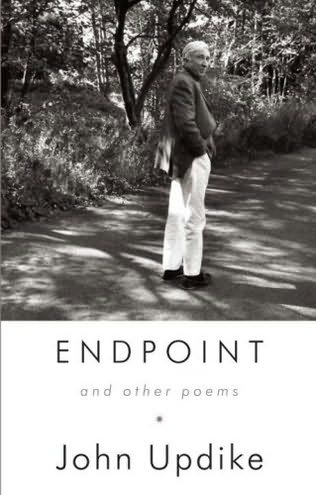
endpointReading John Updike’s final book, a collection of poems, is like receiving a dispatch from the afterlife.  The poems take us nearly up to the point of his death from lung cancer in January this year. He sent the manuscript off and then he died.

The cover photo has a poignancy to it, with its spontaneous, snapshot quality, the sombre ordinariness of it in its black and whiteness, and the sense that John is about to head off down a path we can’t follow him down, not yet.

The collection starts with the ‘Endpoint’ sequence that takes us through each of his last birthdays, starting with his seventieth in 2002, and then into his diagnosis and swift death. His thoughts range across his life, from childhood to old age, as he reflects on mortality, aging, memory. In 2005 he writes

A life poured into words – apparent waste
intended to preserve the thing consumed.
For who, in that unthinkable future
when I am dead, will read? (p.8)

In hospital, having learnt of his death he writes:

Must I do this, uphold the social lie
that binds us all together in blind faith
that nothing ends, not youth nor age nor strength,
as in a motion picture which, once seen,
can be rebought on DVD? My tongue
says yes; within, I lamely drown. (p. 23)

His final reflections are baldly honest.  His poetry is less ornate than his prose, and it makes him seem more vulnerable, frail. He has let me in on the final secret journey he took, which I only learned he had taken when his death was announced that hot, hot January day.

After the ‘Endpoint’ sequence, are pages and pages of other poems, as if to say John is not really dead, as if to say he’s still alive like he should be, like I thought he would be.

[Thursday 3pm #23] Possession: the novel and the film

03 Thursday Sep 2009

Posted by Nathan Hobby in book review, film review, Series: Thursday 3pm feature posts (2009)

≈ Leave a comment

Tags

A.S. Byatt, Possession

Novel: Possession: A Romance / A.S. Byatt (1990)
Film: Possession (2002)

The novel

I found Possession an engrossing novel. It is the story of two contemporary literary scholars – Roland Mitchell and Maud Bailey – who discover a secret affair between two (fictional) nineteenth century poets – Randolph Ash and Christobel LaMotte. The scholarly world is captured with all its interesting intrigues.

At one level, the novel’s title refers to questions of ownership over history and historical figures and their traces. The theme is illuminated by Roland Mitchell’s initial act of theft of a draft of a letter from Ash to LaMotte when he discovers it in a book Ash once owned. Mitchell feels it’s his discovery and he should ‘possess’ it; a feeling intensified as he enlists Maud’s help and they find themselves on the run from other Randolph Ash scholars, including the American collector Mortimer Cropper whose massive cheque-book allows him to ‘possess’ many Ash relics.

The word ‘possession’ also sums up the exploration of romance and relationships. In both the nineteenth century affair between Ash and LaMotte and the contemporary one between Roland and Maud, the lovers struggle with the nature of love. Is it about possessing the other?

The nineteenth century narrative is created purely through documents (with the exception of the epilogue) – including letters written by the lovers, diaries by their respective partners (Ash’s wife, LaMotte’s lesbian partner), and pages and pages of their poems. The poems read just like nineteenth century poems; an incredible achievement. But they bored me and I skipped over pages of them – I wanted to read a novel, not poems!

The film

The film version of Possession takes just 98 minutes to adapt a 511 page novel. It is both a simplification and a ‘greatest hits’ collection of scenes that on its own – without knowledge of the novel – lacks emotional power and significance. Trying to develop two parallel romances in different centuries in that short amount of time is impossible, and the film makers barely even try – Maud and Roland, the present day lovers, are reduced to one awkward encounter and then discussion of it.

The thriller element of the novel, with different parties pursuing the secret of Ash and LaMotte is only lightly used in the film, a strange decision given its cinematic potential. The film-makers do use the dramatic grave robbing climax, but in a truncated and disappointing scene which doesn’t make much sense. Roland Mitchell wrestles the box from Cropper and takes it away to look at it with Maud, no more ethical than Cropper himself.

The most disconcerting aspect of the film is the casting of big jawed hunk Aaron Eckhart as the supposedly shy and bookish unemployed scholar Roland Mitchell. In the book his girlfriend calls him ‘Mole’, a name no-one would apply to Aaron Eckhart’s character. Probably to appeal to the American audience, he has also become American, when his Englishness was so central to his character in the novel.

[Thursday 3pm #13] A weekend of assassination texts : Libra, JFK and Death of a President

25 Thursday Jun 2009

Posted by Nathan Hobby in book review, film review, history

≈ 6 Comments

Tags

Death of a president, documentaries, Don DeLillo, George W. Bush, JFK, JFK assassination, Libra, politics, Zelig

On Saturday, I finished DeLillo’s Libra and the Kennedy assassination was going through my mind so much, I was desperate to finally watch JFK. But Nicole had already seen it, so I also got out Death of a President as well, a mock documentary made in 2006 about the assassination of George W. Bush. Death of a President was so weak, Nicole went to bed after half an hour and I turned it off to start watching JFK. I stayed up late, but still only got halfway through. I woke up early and put it on at 7am to watch the second half, the earliest I’ve ever seen a film. I think I was dreaming about it all.

Libra and JFK make for interesting comparison. DeLillo uses the contradictions and paradoxes of the assassination and of what we know of Lee Oswald to create a complex situation and a paradoxical character, represented by the scales of Libra – a man weighing contradictory things at the same time, ready to tip one way or the other. The paradoxes make for a postmodern novel, a postmodern character, a postmodern world like DeLillo always evokes.

In JFK, Stone takes the same contradictions and paradoxes and irons them out with a much more elaborate conspiracy theory. A surface reading makes it much more convincing than DeLillo’s vision, but that is exactly because it is so neat, so unwilling to accept that the truth of JFK’s assassination might be impossible to get to.

So, for example, what are we to make of Oswald setting up a pro-Castro organisation in the same building as Guy Bannister, a far-right private detective working against Castro? For DeLillo, it is about Oswald’s own contradictions, wanting attention and taking it wherever he can get it, giving some information to FBI agents, applying for work with a  man like Guy Bannister – anything to get noticed. For DeLillo, pro- and anti- Castro forces in this context are not opposing forces, but two sides of the scales, the same type of men, disenchanted, extreme men. In Libra, Oswald doesn’t know what he actually wants, beyond being listened to, glory, vindication of his genius, of his confused view of the world. And this, in its own way, is utterly convincing.

Stone’s interpretation of the same event? Jim Garrison, the DA heading the New Orleans investigation, sees it as clear proof that Oswald is not a communist at all, but an undercover agent for a nefarious coalition of the Office of Naval Intelligence, the FBI, the CIA, all three with offices within a block of the building. Which, in the context of a conspiracy thriller is, in its own way, utterly convincing.

While Libra is a brilliant novel and JFK is an excellent film, Death of a President is a competent waste of time. It has the exact feel of what a decent, uninspired documentary might be like if George W. Bush had been assassinated in 2007. As I watched, I imagined how fooled a class of sixteen year olds would be in a few years if I was an English teacher showing it to them. It has all the tedious overnarration and overexplanation of certain documentaries, intercutting each action scene with interviews with key players. Utterly convincing; but because we know none of it happened, rather boring.

It needed an edge to it. Think Woody Allen’s Zelig, the fake documentary of a man with chameleon abilities who manages to make it into every significant event of the early twentieth century. It was worthwhile because it was funny, the fake documentary had a purpose.

But they didn’t have to make this one funny. They could have made it hallucinatory and surreal, using the plausibility of the documentary style to lead the viewer not just over a tedious fake assassination but one with outrageous elements. Or it could have been political, with some interesting point about either Bush or the anti-Bush protestors, about what it meant for a country to live under his rule for eight years. But it studiously avoided doing this. It did exactly what it was trying to do and gets marks for that, but what it was trying to do was so unremarkable.

[Thursday 3pm #7] Youth and age : a review of Tolstoy’s War and Peace

14 Thursday May 2009

Posted by Nathan Hobby in book review, history, Series: Thursday 3pm feature posts (2009)

≈ 3 Comments

Tags

Lubbock, Napoleon, War and Peace

War and Peace / Leo Tolstoy (1865-8; translated by Rosemary Edmonds 1958)

It’s common to hear that War and Peace contains all of life, depicting the full range of human experiences. As a reader, it also evoked the full range of reading experiences for me, from the exhiliration of acute insight that resonated with my experience of life, to boring pages I wanted to flick over; from thrilling narrative drive to moments of narrative listlessness.

I have spent so long reading it – five weeks – that I have begun to feel that I was never going to read another novel, that this was the novel which would last me the rest of my life.

My dad asked me to sum up the plot. I couldn’t do that. How about this: it’s about three Russian families in the time of the wars against Napoleon’s army between 1804 and 1812, with an epilogue set several years later?

Percy Lubbock thinks ‘War and Peace’ is a bad title and I agree. (Even though it captures the epic nature of the work and has become a cliche in itself.) Or it’s not a bad title, but it focuses attention on one half of the novel, and the less interesting part to my mind – war and peace are the backdrop for an exploration of ‘Youth and Age’. Has a ring to it, I think. Better than its insights into war are the insights into the impetuousness of youth, the mad zeal which would drive young men to throw their lives away for the sake of glory; or the dive into marriages ranging at first from the unsatisfying to the miserable; and the insights into the quiet wisdom of age, or the fastidious fussiness of it; or just the depiction of characters – particularly Pierre and Natasha – moving from youth and into age.

In the first half, as possible ideas for this review ran through my head, I was going to write how remarkable it is that Tolstoy avoids the intrusiveness of so much nineteenth century writing; he doesn’t intervene with pages of boring exposition about history or culture but lets the story tell itself. And yet in the second half, Tolstoy becomes very interventionist, hammering home several key points that are worthy in themselves but are belaboured and out of place.

A lot of the problem seems to come about because Tolstoy spends so much time debating the historians of his age. He wants to rehibiliate the reputation of the commander of the Russian army, Kutuzov, who Tolstoy saw as a hero and not a fool for abandoning Moscow and refusing to directly engage the retreating French army.

He wants to prove that Napoleon was no genius.

He wants to elucidate his own theory of history and of war, that it is not made by Great Men but by inscrutable forces, the sum of millions of individual decisions which no one person can particularly influence one way or the other. A theory that sits well with contemporary views of history, but that he shows so well in his novel he doesn’t even need to explain.

In short, Tolstoy addresses the concerns of his day, the debates around the Napoleonic Wars that were going on fifty years after the event but which matter very little to most readers of War and Peace today. If only he knew that he would one day be as famous as Napolean and that readers would be more interested in the brilliance of his psychological depictions of his characters than in his contribution to historical debates.

My favourite character is Pierre. He has an ineffectual idealism; he stumbles into life. The illegitimate son of a rich prince, he receives a massive inheritance thanks to an older woman’s political acumen. He goes from being treated as a shabby, uncouth zealot to a desirable bachelor. He marries the wrong woman because she charms him; he lets himself be robbed and mistreated over and over. Stuck in a carriage with a freemason, he joins that movement with high ideals, only to find that the other members don’t share them, that the movement can’t live up to its own claims.

Perhaps the most fascinating, almost Dostoeveskian passage, involves him staying behind in Moscow as the French army invades and getting in his head the idea that he is the chosen one destined to assasinate Napoleon. Being Pierre, it doesn’t turn out right and he is captured as a prisoner of war while rescuing a baby from a fire. Perhaps I should have known that there had to be a happy ending for him; after being set free, he finally marries the woman who was meant for him all along.

Tolstoy finishes with two epilogues; the second is regrettable, a long meditation on war and history not at home in a novel at all. But the first is fascinating, a glimpse into the lives of the characters years later, as the surviving ones come together, now with children, another generation arising, and yet so many of the old quirks and problems remaining. It gives the novel an even bigger sense of expanse, a glimpse that this could keep on going on forever if only Tolstoy had more pages.

[Thursday 3pm #3] ‘I don’t believe in God but I miss him’ : Julian Barnes’s Nothing to be frightened of

16 Thursday Apr 2009

Posted by Nathan Hobby in book review, death, Series: Thursday 3pm feature posts (2009)

≈ 6 Comments

Tags

death, Julian Barnes

Nothing to be frightened of / Julian Barnes (2008)

I couldn’t put this memoir down. I didn’t mean to read it all but I couldn’t help it. I could discern no structure at all, but just followed Barnes for two hundred pages of reflections on death and God through the lens of his family. The whole memoir has the sort of wistfulness of the opening line quoted in the title of this post: ‘I don’t believe in God but I miss him.’

Despite the constant humour, it is a frightening book to read. I have never thought through so fully the consequences of not believing in life after death. Even in my moments of strongest doubts about Christianity, I haven’t sustained the outlook that death means the permanent extinguishment of my consciousness. No wonder he’s even more scared of death than me. I think it’s immensely brave of atheists and agnostics to live with hope, meaning and purpose. I don’t know how I would. (Indeed, at times Barnes seems to be suggesting that he has to suspend thinking about the way things actually are in order to live with meaning.)

The title is even cleverer than it sounds; it’s nothingness, extinction that he’s frightened of.

He mentions his wife only once, yet about the time the book was published, she died. I wonder if he wrote with a knowledge that she was dying. If he did, he is a remarkably disciplined writer, probably marshalling all the insights his wife’s dying brought him, but recasting them to protect her privacy. The amazing achievement of the memoir that seems to tell all, that so casually reveals so much about his mother, father, brother, self – and yet keeps hidden bigger parts of his life that he didn’t want to or couldn’t tell us about.

Perhaps my favourite passages were the ones reflecting on the art of writing from the perspective of not only our own deaths but the ultimate forgetting of our work. Every work, he tells us, must have a final reader:

For writers, the process of being forgotten isn’t clear-cut. ‘Is it better for a writer to die before he is forgotten, or to be forgotten before he dies?’ But ‘forgotten’ here is only a comparative term, meaning: fall out of fashion, be used up, seen through, superseded, judged too superficial – or, for that matter, too ponderous, too serious – for a later age. But truly forgotten, now that’s much more interesting. First, you fall out of print, consigned to the recesses of the secondhand bookshop and dealer’s website. Then a brief revival, if you’re lucky, with a title or two reprinted; then another fall, and a period when a few graduate students, pushed for a thesis topic, will wearily turn your pages and wonder why you wrote so much. Eventually, the publishing houses forget, academic interest recedes, society changes, and humanity evolves a little further, as evolution carries out its purposeless purpose of rendering us all the equivalent of bacteria and amoebae. This is inevitable. And at some point – it must logically happen – a writer will have a last reader. I am not asking for sympathy; this aspect of a wrtier’s living and dying is a given. At some point between now and the six-billion-years-away death of the planet, every writer will have his or her last reader. (225)

Barnes then addresses his last reader, at first thanking them but then realising that by definition this last reader has not passed on his work to anyone else, and so cursing them. A sobering thought. This reasonably insignificant post, my one book, this entire blog, everything I have ever written will have a last reader. Is it you?


← Older posts
Newer posts →

Enter your email address to follow this blog and receive notifications of new posts by email.

Join 287 other subscribers

Nathan on Twitter

My Tweets

Categories

  • academic (9)
  • archives and sources (10)
  • autobiographical (62)
  • biographers (10)
  • biographical method (28)
  • biographical quests (18)
  • biographies (21)
    • political biography (2)
  • biographies of living subjects (2)
  • biographies of writers, artists & musicians (12)
  • biographies of writers, artists and musicians (20)
  • biography as a literary form (9)
  • biography in fiction (2)
  • biography in the news (2)
  • books (236)
    • authors (19)
    • book review (173)
    • reading (23)
  • Covid (2)
  • creative nonfiction (11)
  • daily life (2)
  • Daily Prompt (2)
  • death (21)
  • digital humanities (3)
  • family history (1)
  • fiction (8)
  • film and television biographies (5)
  • film review (48)
  • found objects (3)
  • historical biographies (1)
  • history (20)
  • In the steps of KSP (4)
  • John Curtin (13)
  • Katharine Susannah Prichard (114)
    • Glimpses of KSP (7)
    • My KSP biography (31)
      • deleted scenes (1)
  • Katharine Susannah Prichard's associates and connections (16)
  • Katharine Susannah Prichard's writings (34)
  • libraries (5)
  • life (20)
  • link (23)
  • links (41)
  • lists (28)
  • local history and heritage (1)
  • media (4)
  • memes and urban myths (1)
  • memoirs (10)
  • meta (2)
  • music (18)
  • news (9)
  • news and events (43)
  • obituary (1)
  • Old writing found on a floppy disk (1)
  • poetry (5)
  • politics and current affairs (26)
    • climate change (1)
  • prologues and introductions (2)
  • psychological aspects of biography (3)
  • quotes (22)
  • R.I.P. (10)
  • reading report (3)
  • religion (1)
  • religious biography (1)
  • research (5)
  • role of the biographer within the biography (2)
  • Series: A-Z of Katharine Susannah Prichard (26)
  • Series: Corona Diary (1)
  • Series: Saturday 10am (14)
  • Series: Short Stories (2016) (6)
  • Series: The Tourist (2013) (6)
  • Series: Thursday 3pm feature posts (2009) (35)
  • structure of biographies (3)
  • technology and the digital world (2)
  • television (4)
  • the nature of biography (4)
  • this blog (10)
  • Uncategorized (33)
  • Western Australia (26)
  • writing (41)

Archives

Recent Comments

amphisbaenathoroughly79c20f19aa's avataramphisbaenathoroughl… on John Curtin’s vision…
Nathan Hobby's avatarNathan Hobby on John Curtin’s vision…
karenlee thompson's avatarkarenlee thompson on John Curtin’s vision…
Nathan Hobby's avatarNathan Hobby on John Curtin’s vision…

Bookmarks

  • Adventures in Biography
  • ANZ LitLovers LitBlog
  • Bernice Barry
  • It only goes up to your knees
  • Jane Bryony Rawson
  • Jenn Plays Recorder
  • Katharine Susannah Prichard Writers' Centre
  • Laura Sewell Matter: Essayist and Biographer
  • Mutually said: Poets Vegan Anarchist Pacifist
  • Resident Judge
  • Speaking Thylacine
  • The Australian Legend
  • Timothy Parkin Poetry
  • Treefall Writing – Melinda Tognini
  • Whispering Gums
  • Wrapped up in books: the home of Guy Salvidge

Top Posts

  • The Joy of Knowledge Encyclopedia
  • The forgotten and the remembered: brief notes on the history of the Hodder & Stoughton £1000 Novel Competition
  • Book review - John Fowles : Daniel Martin
  • Paul Auster's Moon Palace : an overview
  • Book review: Strong Motion - Jonathan Franzen

Blog Stats

  • 234,921 hits

Tag Cloud

9/11 19th century 33 1920s 1921 1930s 1950s 1970s 1971 1981 2000s 2004 2011 2015 2017 20000 Days on Earth A.S. Byatt Aboriginals activism Adam Begley Adrian Mole adultery afterlife Agatha Christie Alan Hollinghurst Alberto Manguel Alfred Deakin Amazing Grace Americana Amy Grant An American Romance Andre Tchaikowsky Andrew McGahan angela myers anne fadiman Anne Rice Arabian Nights archives art arts funding A Serious Man Ash Wednesday ASIO atheism Atonement Australia Australian film Australian literature Australian Short Story Festival autism autobiography autodidact Barbara Vine beach Belle Costa da Greene Bell Jar best best-of Bible Big Issue Bill Callahan biographical ethics biographical quest genre biographies birthday birthdays Black Opal Bleak House Blinky Bill blogging blogs Blue Blades Bodega's Bunch bog Booker book launch booksale Borges Brenda Niall Brian Matthews Brian McLaren Britney Spears Burial Rites Burke and Wills buskers C.S. Lewis C.S. Lewis canon capitalism Carol Shields Carson McCullers Catcher in the Rye Catholicism celebrities Charles Dickens Charlie Kaufman childhood Child of the Hurricane children's books Choir of Gravediggers Christianity Christian writing Christina Stead Christmas Christopher Beha Cinque Terra Claire Tomalin classics cliches climate change Coen brothers coincidence Collie Collyer coming of age Communism concert Condensed Books consumerism Coonardoo Cormac McCarthy Corrections cosy fiction Dara Horn David Copperfield David Ireland David Marr David Suchet death Death of a president definition demolition Dennis LeHane dentist diaries divorce doctorow Doctor Who documentaries donald shriver Don DeLillo Don DeLillo Donna Mazza Donna Tartt Don Watson Dostovesky doubt drama dreams of revolution Drusilla Modjeska E.M. Forster ebooks editing Eichmann Eisenstein Elizabeth Kostova email empathy ensmallification existentialism faith Falling Man fame families fantasy fiction film and television folk football Frank Barscombe Fremantle Press G.K. Chesterton Gabrielle Carey Gallipoli genealogical fiction Genesis Geoff Nicholson George W. Bush Gerald Glaskin Gilead Golden Miles Goldfields Trilogy Graham Greene grandad great novels Greenmount Guinness World Records Guy Salvidge Hannah Arendt Hannah Kent Hans Koning Hans Koningsberger Harper Lee Haxby's Circus Hazel Rowley He-Man headers heaven Heidegger hell Henrietta Lacks Henry Morton Stanley Herman Hesse heroes Hey Dad! historical fiction history Holden Caulfield holidays Homer & Langley Home Song Stories House of Cards House of Zealots house of zealots Hugo Throssell humour Ian McEwan In between the sheets Indonesia Infamous Inside Llewyn Davis interstellar interview Intimate Strangers Invisible Ireland ISBNs Ishiguro itunes J.D. Salinger J.M. Coetzee J.S. Battye Janet Malcolm Jennifer Egan JFK JFK assassination Joanna Rakoff Joel Schumacher John Burbidge John Fowles John Howard John Kinsella John Updike John Updike Jonathan Franzen journal writing JSB Judgment Day Julia Baird Julian Barnes Kafka Kalgoorlie Kate Grenville Katherine Mansfield Kevin Brockmeier King's Park KSP Writers' Centre language last ride Laurie Steed Left Behind Leonard Cohen Leo Tolstoy Libra Library of Babel Library of Babel Lila Lily and Madeleine links Lionel Shriver lionel shriver lists literary fiction literature Lleyton Hewitt lost book Louisa Louisa Lawson Louis Esson louis nowra love letter Lubbock Lytton Strachey Madelaine Dickie Man Booker man in the dark Margaret Atwood Margaret River Press Marilynne Robinson mark sandman meaning of life Melbourne Mel Hall meme memorialisation memory MH17 Michael Faber Mike Riddell Miles Franklin mining boom missionaries moleskine Moon Palace morphine Mother Teresa movies Music of Chance My Brilliant Career names Napoleon Narnia narrative Narrow Road to the Deep North Narziss and Goldmund Natalie Portman Nathaniel Hobbie national anthem Nick Cave Nina Bawden non-fiction nonfiction noughties novelists novels obituaries obscurity On Chesil Beach Parade's End Paris Hilton Passion of the Christ past patriotism Paul Auster Paul de Man Perth Perth Writers Festival Peter Ackroyd Peter Cowan Writers Centre phd Philip K. Dick Philip Seymour Hoffman pierpontmorgan poetry slam politics popular fiction popular science Possession postapocalyptic postmodernism Pride prophetic imagination publications Pulp Purity Queen Victoria Rabbit Angstrom radio Radio National Randolph Stow rating: 5/10 rating: 6/10 rating: 7/10 rating: 8/10 rating: 9/10 rating: 10/10 ratings reading fiction autobiographically reading report Rebecca Skloot recap red wine reincarnation juvenile fiction rejection review - music reviewing rewriting Richard Flanagan Richard Ford Rick Moody Roaring Nineties Robert Banks Robert Hughes Robert Silverberg Robert Wadlow Robinson Crusoe Rolf Harris romance Rome ruins Russell Crowe Ruth Rendell Sarah Murgatroyd scalpers science fiction Science of Sleep secondhand books Secret River sermon illustration sex short stories Silent Woman Simone Lazaroo Simpsons Siri Hustvedt slavery Smashing Pumpkins social interactions social justice some people i hate sources South Australia souvenirs speculation speech speeches sport status anxiety Stephen Lawhead Stranger's Child subtitles Subtle Flame Sue Townsend suicide Surprised By Hope Suzanne Falkiner Sylvia Plath Synecdoche TAG Hungerford Award tapes teabags Ted Hughes The Children Act The Cure The Fur The Imitation Game theology The Pioneers The Revolutionary Thomas Disch Thomas Hardy Thomas Henry Prichard Thomas Mann thriller time Tim La Haye Tim Winton Tolstoy Tom Wright top 10 Towering Inferno Tracy Ryan Trove Truman Capote tshirts TS Spivet Twelve Years a Slave underrated writers Underworld unwritten biographies urban myth USA vampires Venice Victoria Cross Victoriana Victorian era Victorianism Victoria Park video Voltron w Wake in Fright Walkabout Walter M. Miller war War and Peace war on terror Water Diviner Wellington St Bus Station Westerly Western Australia West Wing What Happened to Sophie Wilder? Whitlams wikipedia Wild Oats of Hans William Wilberforce Winston Churchill Witches of Eastwick Working Bullocks workshop World War One writers writing Writing NSW youth Zadie Smith Zeitgeist Zelig

Enter your email address to follow this blog and receive notifications of new posts by email.

Join 287 other subscribers

Pages

  • About
  • My novel: The Fur
  • The Red Witch: A Biography of Katharine Susannah Prichard

Categories

  • academic (9)
  • archives and sources (10)
  • autobiographical (62)
  • biographers (10)
  • biographical method (28)
  • biographical quests (18)
  • biographies (21)
    • political biography (2)
  • biographies of living subjects (2)
  • biographies of writers, artists & musicians (12)
  • biographies of writers, artists and musicians (20)
  • biography as a literary form (9)
  • biography in fiction (2)
  • biography in the news (2)
  • books (236)
    • authors (19)
    • book review (173)
    • reading (23)
  • Covid (2)
  • creative nonfiction (11)
  • daily life (2)
  • Daily Prompt (2)
  • death (21)
  • digital humanities (3)
  • family history (1)
  • fiction (8)
  • film and television biographies (5)
  • film review (48)
  • found objects (3)
  • historical biographies (1)
  • history (20)
  • In the steps of KSP (4)
  • John Curtin (13)
  • Katharine Susannah Prichard (114)
    • Glimpses of KSP (7)
    • My KSP biography (31)
      • deleted scenes (1)
  • Katharine Susannah Prichard's associates and connections (16)
  • Katharine Susannah Prichard's writings (34)
  • libraries (5)
  • life (20)
  • link (23)
  • links (41)
  • lists (28)
  • local history and heritage (1)
  • media (4)
  • memes and urban myths (1)
  • memoirs (10)
  • meta (2)
  • music (18)
  • news (9)
  • news and events (43)
  • obituary (1)
  • Old writing found on a floppy disk (1)
  • poetry (5)
  • politics and current affairs (26)
    • climate change (1)
  • prologues and introductions (2)
  • psychological aspects of biography (3)
  • quotes (22)
  • R.I.P. (10)
  • reading report (3)
  • religion (1)
  • religious biography (1)
  • research (5)
  • role of the biographer within the biography (2)
  • Series: A-Z of Katharine Susannah Prichard (26)
  • Series: Corona Diary (1)
  • Series: Saturday 10am (14)
  • Series: Short Stories (2016) (6)
  • Series: The Tourist (2013) (6)
  • Series: Thursday 3pm feature posts (2009) (35)
  • structure of biographies (3)
  • technology and the digital world (2)
  • television (4)
  • the nature of biography (4)
  • this blog (10)
  • Uncategorized (33)
  • Western Australia (26)
  • writing (41)

Archives

Recent Comments

amphisbaenathoroughly79c20f19aa's avataramphisbaenathoroughl… on John Curtin’s vision…
Nathan Hobby's avatarNathan Hobby on John Curtin’s vision…
karenlee thompson's avatarkarenlee thompson on John Curtin’s vision…
Nathan Hobby's avatarNathan Hobby on John Curtin’s vision…

Bookmarks

  • Adventures in Biography
  • ANZ LitLovers LitBlog
  • Bernice Barry
  • It only goes up to your knees
  • Jane Bryony Rawson
  • Jenn Plays Recorder
  • Katharine Susannah Prichard Writers' Centre
  • Laura Sewell Matter: Essayist and Biographer
  • Mutually said: Poets Vegan Anarchist Pacifist
  • Resident Judge
  • Speaking Thylacine
  • The Australian Legend
  • Timothy Parkin Poetry
  • Treefall Writing – Melinda Tognini
  • Whispering Gums
  • Wrapped up in books: the home of Guy Salvidge

Top Posts

  • The Joy of Knowledge Encyclopedia
  • The forgotten and the remembered: brief notes on the history of the Hodder & Stoughton £1000 Novel Competition
  • Book review - John Fowles : Daniel Martin
  • Paul Auster's Moon Palace : an overview
  • Book review: Strong Motion - Jonathan Franzen

Blog Stats

  • 234,921 hits

Tag Cloud

9/11 19th century 33 1920s 1921 1930s 1950s 1970s 1971 1981 2000s 2004 2011 2015 2017 20000 Days on Earth A.S. Byatt Aboriginals activism Adam Begley Adrian Mole adultery afterlife Agatha Christie Alan Hollinghurst Alberto Manguel Alfred Deakin Amazing Grace Americana Amy Grant An American Romance Andre Tchaikowsky Andrew McGahan angela myers anne fadiman Anne Rice Arabian Nights archives art arts funding A Serious Man Ash Wednesday ASIO atheism Atonement Australia Australian film Australian literature Australian Short Story Festival autism autobiography autodidact Barbara Vine beach Belle Costa da Greene Bell Jar best best-of Bible Big Issue Bill Callahan biographical ethics biographical quest genre biographies birthday birthdays Black Opal Bleak House Blinky Bill blogging blogs Blue Blades Bodega's Bunch bog Booker book launch booksale Borges Brenda Niall Brian Matthews Brian McLaren Britney Spears Burial Rites Burke and Wills buskers C.S. Lewis C.S. Lewis canon capitalism Carol Shields Carson McCullers Catcher in the Rye Catholicism celebrities Charles Dickens Charlie Kaufman childhood Child of the Hurricane children's books Choir of Gravediggers Christianity Christian writing Christina Stead Christmas Christopher Beha Cinque Terra Claire Tomalin classics cliches climate change Coen brothers coincidence Collie Collyer coming of age Communism concert Condensed Books consumerism Coonardoo Cormac McCarthy Corrections cosy fiction Dara Horn David Copperfield David Ireland David Marr David Suchet death Death of a president definition demolition Dennis LeHane dentist diaries divorce doctorow Doctor Who documentaries donald shriver Don DeLillo Don DeLillo Donna Mazza Donna Tartt Don Watson Dostovesky doubt drama dreams of revolution Drusilla Modjeska E.M. Forster ebooks editing Eichmann Eisenstein Elizabeth Kostova email empathy ensmallification existentialism faith Falling Man fame families fantasy fiction film and television folk football Frank Barscombe Fremantle Press G.K. Chesterton Gabrielle Carey Gallipoli genealogical fiction Genesis Geoff Nicholson George W. Bush Gerald Glaskin Gilead Golden Miles Goldfields Trilogy Graham Greene grandad great novels Greenmount Guinness World Records Guy Salvidge Hannah Arendt Hannah Kent Hans Koning Hans Koningsberger Harper Lee Haxby's Circus Hazel Rowley He-Man headers heaven Heidegger hell Henrietta Lacks Henry Morton Stanley Herman Hesse heroes Hey Dad! historical fiction history Holden Caulfield holidays Homer & Langley Home Song Stories House of Cards House of Zealots house of zealots Hugo Throssell humour Ian McEwan In between the sheets Indonesia Infamous Inside Llewyn Davis interstellar interview Intimate Strangers Invisible Ireland ISBNs Ishiguro itunes J.D. Salinger J.M. Coetzee J.S. Battye Janet Malcolm Jennifer Egan JFK JFK assassination Joanna Rakoff Joel Schumacher John Burbidge John Fowles John Howard John Kinsella John Updike John Updike Jonathan Franzen journal writing JSB Judgment Day Julia Baird Julian Barnes Kafka Kalgoorlie Kate Grenville Katherine Mansfield Kevin Brockmeier King's Park KSP Writers' Centre language last ride Laurie Steed Left Behind Leonard Cohen Leo Tolstoy Libra Library of Babel Library of Babel Lila Lily and Madeleine links Lionel Shriver lionel shriver lists literary fiction literature Lleyton Hewitt lost book Louisa Louisa Lawson Louis Esson louis nowra love letter Lubbock Lytton Strachey Madelaine Dickie Man Booker man in the dark Margaret Atwood Margaret River Press Marilynne Robinson mark sandman meaning of life Melbourne Mel Hall meme memorialisation memory MH17 Michael Faber Mike Riddell Miles Franklin mining boom missionaries moleskine Moon Palace morphine Mother Teresa movies Music of Chance My Brilliant Career names Napoleon Narnia narrative Narrow Road to the Deep North Narziss and Goldmund Natalie Portman Nathaniel Hobbie national anthem Nick Cave Nina Bawden non-fiction nonfiction noughties novelists novels obituaries obscurity On Chesil Beach Parade's End Paris Hilton Passion of the Christ past patriotism Paul Auster Paul de Man Perth Perth Writers Festival Peter Ackroyd Peter Cowan Writers Centre phd Philip K. Dick Philip Seymour Hoffman pierpontmorgan poetry slam politics popular fiction popular science Possession postapocalyptic postmodernism Pride prophetic imagination publications Pulp Purity Queen Victoria Rabbit Angstrom radio Radio National Randolph Stow rating: 5/10 rating: 6/10 rating: 7/10 rating: 8/10 rating: 9/10 rating: 10/10 ratings reading fiction autobiographically reading report Rebecca Skloot recap red wine reincarnation juvenile fiction rejection review - music reviewing rewriting Richard Flanagan Richard Ford Rick Moody Roaring Nineties Robert Banks Robert Hughes Robert Silverberg Robert Wadlow Robinson Crusoe Rolf Harris romance Rome ruins Russell Crowe Ruth Rendell Sarah Murgatroyd scalpers science fiction Science of Sleep secondhand books Secret River sermon illustration sex short stories Silent Woman Simone Lazaroo Simpsons Siri Hustvedt slavery Smashing Pumpkins social interactions social justice some people i hate sources South Australia souvenirs speculation speech speeches sport status anxiety Stephen Lawhead Stranger's Child subtitles Subtle Flame Sue Townsend suicide Surprised By Hope Suzanne Falkiner Sylvia Plath Synecdoche TAG Hungerford Award tapes teabags Ted Hughes The Children Act The Cure The Fur The Imitation Game theology The Pioneers The Revolutionary Thomas Disch Thomas Hardy Thomas Henry Prichard Thomas Mann thriller time Tim La Haye Tim Winton Tolstoy Tom Wright top 10 Towering Inferno Tracy Ryan Trove Truman Capote tshirts TS Spivet Twelve Years a Slave underrated writers Underworld unwritten biographies urban myth USA vampires Venice Victoria Cross Victoriana Victorian era Victorianism Victoria Park video Voltron w Wake in Fright Walkabout Walter M. Miller war War and Peace war on terror Water Diviner Wellington St Bus Station Westerly Western Australia West Wing What Happened to Sophie Wilder? Whitlams wikipedia Wild Oats of Hans William Wilberforce Winston Churchill Witches of Eastwick Working Bullocks workshop World War One writers writing Writing NSW youth Zadie Smith Zeitgeist Zelig

Blog at WordPress.com.

  • Subscribe Subscribed
    • Nathan Hobby, a biographer in Perth
    • Join 287 other subscribers
    • Already have a WordPress.com account? Log in now.
    • Nathan Hobby, a biographer in Perth
    • Subscribe Subscribed
    • Sign up
    • Log in
    • Report this content
    • View site in Reader
    • Manage subscriptions
    • Collapse this bar
 

Loading Comments...