• About
  • The Red Witch: A Biography of Katharine Susannah Prichard
  • My novel: The Fur

Nathan Hobby, a biographer in Perth

~ The lives of John Curtin & Katharine Susannah Prichard, the art of biography, and other things

Nathan Hobby, a biographer in Perth

Author Archives: Nathan Hobby

[Thursday 3pm #21] Belle Costa Da Greene : ‘Girl Librarian’

20 Thursday Aug 2009

Posted by Nathan Hobby in history, Series: Thursday 3pm feature posts (2009)

≈ 4 Comments

Tags

Belle Costa da Greene, Library of Babel

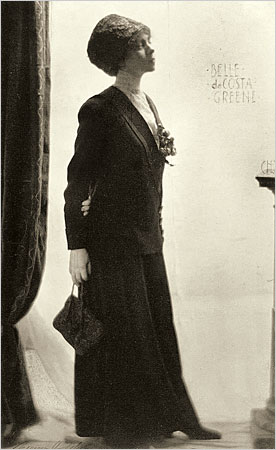
bellegreeneAn Illuminated Life : Belle Costa Da Greene’s Journey From Prejudice to Privilege / Heidi Ardizzone (Norton, 2007)

Pierpont Morgan’s librarian, Belle Costa Da Greene (1879-1950) is a fascinating woman. Her parents were of mixed ancestry – black and white. Her father, Richard Greener, was the first black graduate of Harvard. After early success, he was involved in scandal while ambassador to Russia and returned to the US to live out his life in obscurity. He had become estranged from the rest of his family, who wanted to ‘pass’ as white, while he wanted to stand up for black rights.

Belle lied constantly about her life story; she told people she had Portugese ancestry, and this is what gave her such ‘exotic’ features. Her biographer Heidi Ardizzone writes:

The tactic she would take, whether regarding her ancestry or her affair with Bernard, would be one of misleading openness. Consciously or not, Belle dealt with suspicious about first her ethnicity and now her sexual behaviour by acknowledging, even drawing attention to the rumours and the questions…. This tactic of hiding in the light flirted with true exposure, but it also allowed her the appearance of frankness, which veiled her growing collection of secrets. (207)

Belle was working with Pierpont Morgan’s nephew Junius when he recommended her in 1905 for the post of librarian for Morgan’s library. Morgan had devoted himself to building up a collection of rare books and manuscripts for several years now and his basement was overflowing; he was building a library next to his house to hold his collection.

Perhaps it was Belle’s charisma that persuaded Pierpont to take her on, even though she was a woman in a very masculine world and had no formal qualifications. She proved to be the best librarian one could imagine, building the library into an incredible collection. She was, we are told, brilliant at negotiating prices on rare items, a formidable and lively personality in society both in New York and Europe. She is marked by caprice and unpredictability; at time sounding feminist and yet joining the anti-suffragette movement; shifting from pacifist to vehemently pro-war over the course of the Great War.

It would seem she didn’t want her story told. Ardizzone writes- “But in her generation Belle was not alone in scorning personal history as irrelevant, in destroying personal papers, and in maintaining very different public and private personas.” (9) In her final illness in 1950, she burned all her papers, an act that means many of her secrets will never be revealed. Indeed, it was not until 2007 that a full length biography – this one – was finally published. The biography is built on the letters Belle wrote to her lover and friend of over forty years, Bernard Berenson. He lamented that in burning the letters he sent her, she had destroyed his autobiography; he could not bring himself to do the same to hers, in spite of her request.

Bernard, then, plays a massive role in the biography. It made me think about the difficult task of reconstructing a life, and the way sources skew any portrait. Was Bernard as significant in her life as the biography suggests? We’ll never know, but I would say he probably wasn’t, that he becomes significant as the source behind the biography. He is almost like the narrator of a novel.. and yet not; the letters Ardizzone is working from them are Belle addressing herself to him. Belle is the narrator, but Bernard is the audience.

Her love affair with Bernard has its tragedy. At first, it was a chaste exchange of passionate letters; he was in Europe, she in New York. She was constrained by the shadow of the other man in her life: Pierpont Morgan himself. Morgan was jealous and possessive of her as a twisted sort of father figure in her life; he didn’t want her having affairs with any man and especially not Bernard. Indeed, he didn’t even want her marrying.

But the affair was finally consumated on a trip to Venice in 1910. Ardizzone’s narration of this is unimaginative and anticlimatic after chapters leading up to it. Belle fell pregnant and was sent to London for an abortion. ‘In 1921 she remembered the “really innocent… utter and world-excluding worship I once gave you.” She commented that her ability to have that kind of feeling for anyone ceased to exist “when I left you to go to London,” although she did not realise it at the time.’ (199)

When she returned to New York from London, she was a different woman. While once chastely flirting, she had no inhibitions any longer and, Ardizzone documents, affairs with many men.

One thing I have loved in reading this biography is the strange intersections with famous and unlikely lives. Belle’s lover Bernard Berenson was married to the daughter of the still popular evangelical devotional writer, Hannah Whitall Smith. Hannah’s daughter, Mary, did not share her mother’s morality; she instituted an open marriage with Bernard, only to regret it later when he began his long love affair with Belle. Then there was Belle’s good friend Cardinal Ratti – former head of Vatican library – who became Pope Pius XI in the 1920s. She had friends in high places.

Biographies are a strange narrative. Without the simpler narrative arc of a conventional novel, they draw toward the only ending they can : the deathbed, the funeral, the legacy. The middle of this biography feels as boring as life itself can be: the seemingly endless twists and turns of a love affair between Bernard and Belle, none of them decisive. But then things do change; her endless youth and energy desert her. She grows old, the death of her nephew in World War Two – an unacknowledged suicide – breaks her; she dies.

It was, finally, for me a fascinating story, impressively researched, a remarkable feat, to bring this woman to life in a book. Albeit truncated, distorted, with gaps we would like to fill.
[Thursday 3pm #20] The Book Collector With the Big Nose: Pierpont Morgan

13 Thursday Aug 2009

Posted by Nathan Hobby in history, Series: Thursday 3pm feature posts (2009)

≈ 7 Comments

Tags

doctorow, pierpontmorgan

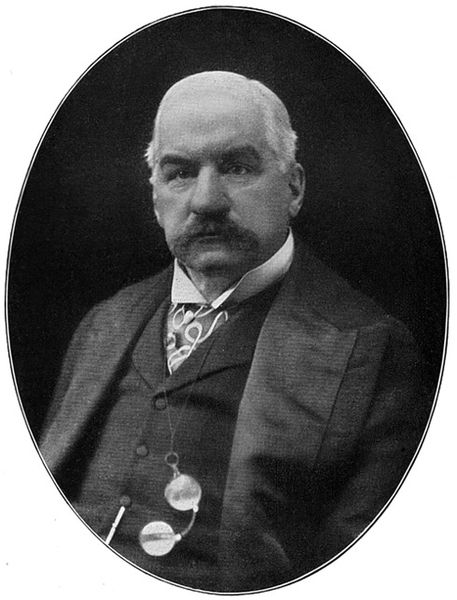
JohnPierpontMorganPierpont Morgan (1837-1913) is a fascinating figure. My interest in him stems from his library of treasures, the Pierpont Morgan Library in New York. But the library, his legacy, is only the last phase in the life of a preposterous man, the king of his milieu.

He was born knowing that he would be ‘great’. His hero was Napoleon and his father was a wealthy industrialist, anticipating his own career.

In her 1999 biography, Morgan, Jean Strouse writes:

He began to keep diaries in 1850 – small “Line-a-day” books. Like most masculine journal writers of his time and social class, he was far more interested in registering what happened than in exploring subjective responses or ideas. “Sleighing, skating; beat father in backgammon,” he wrote in early January 1850. The next day, “wound 7 skeins of cotton for mother A man fell off one of the towers of the new depot & killed.” He rarely mentions his siblings. Over the following months he recorded: “Dancing school. Ladies to tea.” “Father did not come home.” “Mother ill.”… “Finished 3rd Book of Virgil. Picked some cherries.” Not even death evoked a comment: “Mr S.B. Paddock [with whom he was living] died at 10 o’clock aged 56. In evening staid home and read.”

What the diaries chiefly portray is a young mind intent on order and control. Next to the day and date printed on each page, Pierpont entered the number of days gone by and remaining for the year – on October first, for instance: ‘Days past, 274.” “To come, 91.” At the end of 1851 he tabulated “Places resided” between January and July – there were seventeen – and the diary pages convering each place. He kept lists of his income, expenses, the initials of girls he liked, and all the letters he sent and received, including postage paid. (38)

I am amazed by the detail of Morgan’s life that Strouse can give us. Most lives do not leave this many traces – childhood diaries, folders and folders of correspondence. There is barely a week of his life that Strouse cannot tell us something about. I compare it to my own family. I know almost nothing of Joseph Hobby, my great-grandfather born in the 1870s, let alone his father, a contemporary of Morgan’s. Not one letter, let alone the detail of a life, the happenings of the days, weeks and months which make it up.

Morgan was involved in some suspicious arms deals during the Civil War, financing the refurbishing of old guns bought cheaply off the army and selling them back at a large profit.

He built up an empire; he had so much money it attracted more money. He came to singlehandedly influence the stockmarket and control investment confidence.

Rhinophyma disfigured his face, a condition in which the nose spreads out red and bulbous. He didn’t want it fixed, superstitiously thinking it would lead to other conditions. He dared people not to stare at it; but he also avoided the public gaze and photographs.

He also lived in the shadow of his father, and it was only when his father died that he embarked with vigour acquiring valuable manuscripts from around the world. He treated with the spirit of competition and acquisitiveness with which he had amassed his empire and soon the basement of his mansion was overflowing with Gutenberg Bibles and rare manuscripts.

In 1906, a library was built next to his house to keep all his treasures. A tunnel connected it to his house. He hired a feisty young librarian who lied about her age and racial background, Belle Costa da Greene, who set about expanding his collection even further.

Hearings into his undue influence over the economy hastened his demise in 1913. He went travelling in Egypt afterwards and slipped into a delusional depression, convinced of conspiracies against him: ‘On the Nile in early February he slid into a delusional depression. He could not eat, had ‘horrid’ dreams, asked constantly about conspiracies, subpoenas, and citations for contempt of court, and felt, reported Louisa, that ‘the country was going to ruin, that his race was run, and his whole life work was for naught!’ (Strouse: 14) His death made headlines around the world. But who has heard of him today?

In his brilliant novel of this milleiu, Ragtime, E.L. Doctorow depicts a fascinating fictional J.P. Morgan. In Doctorow’s account, Pierpont believes himself to be the reincarnation of a special higher class of human, and tries to convince Henry Ford that he is one too. When Ford only partly joins this exclusive club of elites, Pierpont travels to Egypt alone to spend a night in a pyramid. In his absence, the finale of the novel occurs in his library.

[Thursday 3pm # 19] Journal writing : a quote

06 Thursday Aug 2009

Posted by Nathan Hobby in death, Series: Thursday 3pm feature posts (2009), writing

≈ Leave a comment

Tags

death

Father kept himself under control by writing in his journal. This was a system too, the system of language and conceptualization. it proposed that human beings, by the act of making witness, warranted times and places for their existence other than the time and place they were living through.

– E.L. Doctorow Ragtime, p. 63

[Thursday 3pm #18] American Habits

30 Thursday Jul 2009

Posted by Nathan Hobby in autobiographical, lists, reading, Series: Thursday 3pm feature posts (2009)

≈ 1 Comment

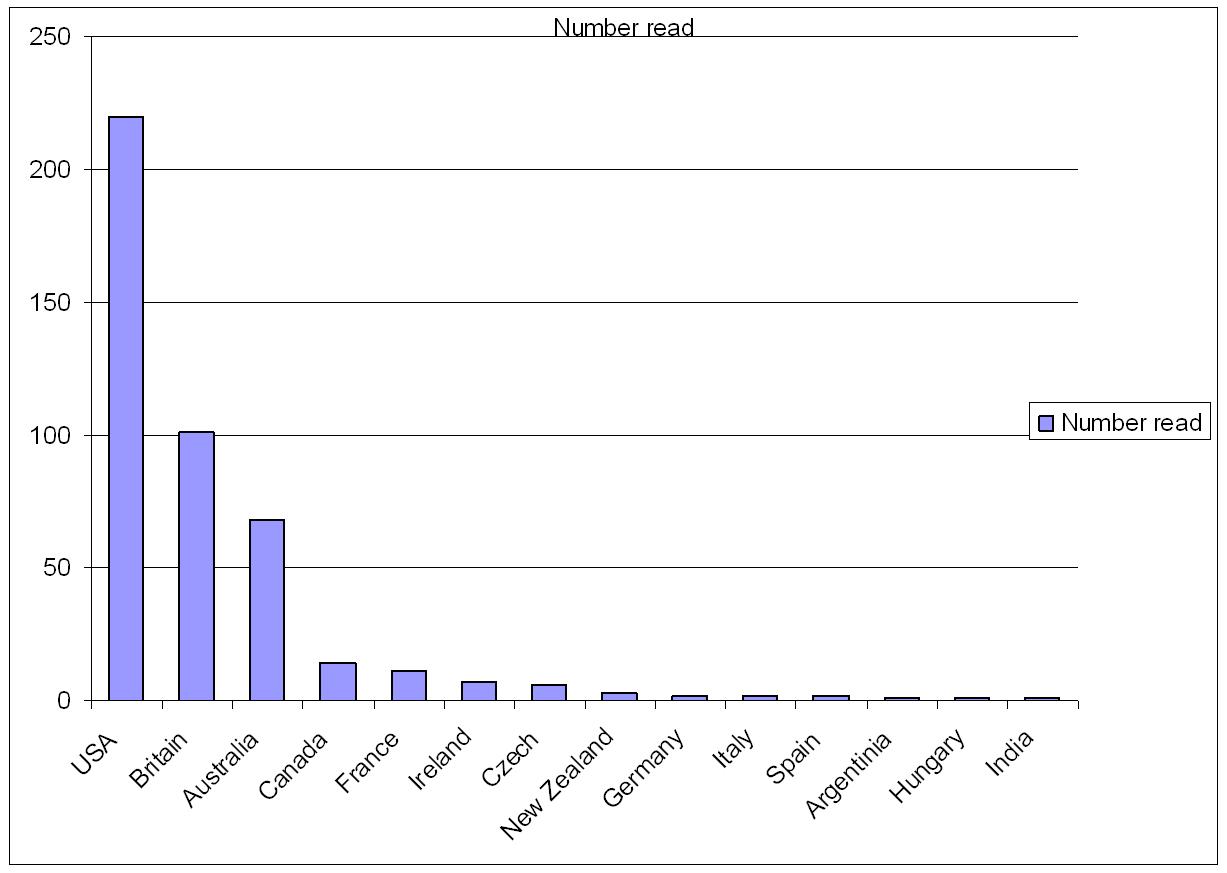
On Tuesday night, when I should have been doing something productive or relaxing, I created a graph showing how many novels (and other narratives) I had read by country since 1996. The results were predictably homogenous, but even more weighted toward the USA than I imagined.

Novelsbycountry

There you have it – 220 from the USA, 101 from Britain, 68 from Australia, 14 from Canada for the top four places. I don’t have records from 98-00; maybe I was much more cosmpolitan in those years. The figures are also skewed toward the USA because in 96 and 97 when I was a science fiction addict, just about everything I read came from there.

I was thinking of resolving to read more Australian, European, Asian and African texts to broaden my horizons. And maybe I will. But I’m not going to worry too much. There’s too many things in this world to feel guilty about.

But I am curious about why I’m so drawn to American fiction. I have an aversion to consumerism, patriotism, fundamentalism and unchecked capitalism, all those things America is famous for. But I am also fascinated by America, and even to prod and gawk at those things I hate. Many of my favourite authors are American – Auster, DeLillo, Franzen, Moody, McCullers, Updike. I’d like to visit the USA some day; I’ll just have a hard time convincing my wife. (I think I would like to travel by train across its heartland; keep meaning to read Don Watson’s account of this.)

I think its easier to read in tune with our own culture, rather than cross cultural boundaries; and interestingly I don’t feel like I have to cross much of a boundary to read American fiction – or British fiction, I suppose, but I’ve found less authors there whom I love.

Interestingly just about every European novel I have read has been brilliant. This is merely a reflection of how selective I’ve been, but there’s an untapped continent there. In fact, there’s at least four of them.

What are your reading habits like? Regale and shame me with the stories of how you spend your leisure time reading Afghani novels in the original or 13th century Chinese epics. Go on, show me up. 🙂

[Thursday 3pm #17] Good writing : a quote

23 Thursday Jul 2009

Posted by Nathan Hobby in quotes, Series: Thursday 3pm feature posts (2009), writing

≈ 2 Comments

Good writing, surely, occurs when we somehow make ourselves as open as possible to intense, half-conscious impulses, even though the expression of them will make us uncomfortable because they matter so much. Revision is learning to read our work as if someone else had written it, paying attention to our confusions, lapses of interest, our disbelief or failure to care.

– Mattison, A. (2004). “Coincidence in Stories : An Essay Against Craft.” Writer’s Chronicle 36(6): 10.

[Thursday 3pm #16] Film reviews : W and Last Ride

16 Thursday Jul 2009

Posted by Nathan Hobby in film review, Series: Thursday 3pm feature posts (2009)

≈ Leave a comment

Tags

last ride, w

W. – Oliver Stone’s latest film has just come out on DVD. It’s a biopic of George W. Bush, focusing on the family dynamics that – in this story at least – pushed him into wanting to be president and into invading Iraq. Stone’s take is that Bush was haunted by his early mess-ups, his drunkenness and occupational failures, and wanted to prove himself to his disproving father, who always preferred older brother Jeb. I found it interesting for its attempt to dramatise such recent history and the uncanny moments of resemblance to their real life counterparts in the different actors’ performances. But it lacks bite; it never touches the profound and never seems to resolve just what tone it is capturing or what it is trying to say. A good, watchable film, when I half expected something brilliant. 3/5

Last Ride – an Australian film currently showing in arthouse cinemas, it tells the story of a man on the run with his son somewhere between Port Augusta and Adelaide. The narrative tension is strong even as things move slowly, as pieces of their past are unfurled and the police close in. It is a visually interesting – at times beautiful – film with a good script and great performances. But it made me think that I like best films with articulate heroes and transcendence, not the inarticulate hero and bleak, full sun realism. 3.5/5

[Thursday 3pm #15] J.S. Battye : state librarian for life

09 Thursday Jul 2009

Posted by Nathan Hobby in history, Series: Thursday 3pm feature posts (2009), Western Australia

≈ 2 Comments

Tags

J.S. Battye, Library of Babel

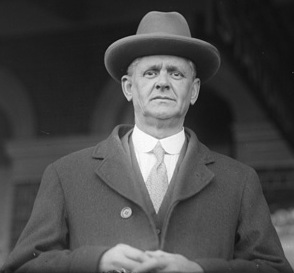
JSBattyeI’m researching James Sykes Battye (1871-1954) for my novel. He was the first state librarian in Western Australia, establishing what was then called the Victoria Public Libary, now the State Library of Western Australia.

He was only 23 when he was appointed state librarian in 1894, and incredibly he was appointed for life. He stayed on in this role – also in control of the museum and art gallery – for more than half a century, dying on the job in 1954 at age 82.

At the time of his death, the state cabinet was trying to negotiate his retirement; he apparently wanted to stay on. In her thesis on him, Celia Chesney mentions intriguingly that the cabinet was prepared to let him live on in the house attached to the library after his retirement. I am fascinated by this image of an octogenarian librarian clinging to his position, living in the library itself, having ruled the library and the cultural life of the state for the first half of the century, through two world wars and a depression.

Born into a working class Victorian family, he worked his way up the ladder of society. He was heavily involved in the freemasons, an intriguing and disturbing – though commonplace – link for men in high places in Australian society in the early twentieth century. He is best remembered today because the collection of Westraliana in the state library is named after him and because of the cyclopedia of Western Australia he compiled. (I am fascinated by the polymathic nature of prominent people in the early twentieth century; this man having his finger in so many pies is something that’s going to inform one of my characters.)

The picture I’ve got of him from my reading is an ambitious man who started the library well, building an impressive collection and engaging the interest of the public. But a long decay set in as funding dropped during the Depression and the library atrophied. He came to obstinately cling to his position, unable to relinquish the role, unable to admit to himself that his time had passed.

There are two significant sources of information on him. Firstly, the entry in the Australian Dictionary of Biography, written by historian Fred Alexander. Alexander and Battye were not, apparently, always on good terms and one can see evidence of conflict in Alexander’s assessment of Battye’s contribution to UWA:

he rarely revealed constructive imagination and, despite a certain skill and finesse in negotiation, was no match for the subtler academic minds. Partly because of his relatively low public service standing, his achievements as ambassador for the university were limited.

Secondly, an unpublished thesis of 15000 words written for a diploma of history at UWA by Celia Chesney. Called “A man of progress : Dr James Sykes Battye”, it includes a helpful annotated bibliography and is available, of course, in the Battye Library.

RIP Mark Sandman, died 3 July 1999

03 Friday Jul 2009

Posted by Nathan Hobby in music, R.I.P.

≈ 11 Comments

Tags

mark sandman, morphine

Continue reading →

[Thursday 3pm #14] The Christian novel : a brief history of falling short

02 Thursday Jul 2009

Posted by Nathan Hobby in lists, Series: Thursday 3pm feature posts (2009)

≈ 3 Comments

Tags

Brian McLaren, Christian writing, Graham Greene, Tom Wright

This is an extract from a paper I gave this week; you can find the whole paper on my other blog.

It might be much more appropriate to go off and write a novel (and not a ‘Christian’ novel where half the characters are Christians and all the other half become Christians on the last page) but a novel which grips people with the structure of Christian thought, and with Christian motivation set deep into the heart and structure of the narrative, so that people would read that and resonate with it and realize that that story can be my story.
– N.T. Wright, “How can the Bible be authoritative?”

The kingdom novel is an elusive, mythical creature. We’re not even sure if we have any living specimens. We do have some prescriptions for what it should look like, and numerous rumours of sightings.

One of the problems is that most evangelicals who write novels write inferior popular fiction, romance, science fiction or thriller, usually promulgating popular piety. It’s rare to find any fiction on the shelves of Koorong with profound spirituality or reflecting a thoughtful theology. I’m not a fan of secular popular fiction; evangelical fiction is much the same only with even worse writing and bad theology.

Some theologians have used the novel form to get their message across, and we do at least get better theology from them. Brian McLaren wrote A New Kind of Christian and its two sequels; the theology is good, or at least I generally like it, but as a novel it’s appalling. It is dominated by slabs of dialogue which put ideas in characters’ mouths; the descriptive interruptions feel like filler. The plot, characterisation and prose are all uncompelling. It seems to work for a lot of people, at least for getting across some ideas in an accessible way, but it’s not the novel Wright is describing. Paul Wallis, who lives in Canberra, has done a better job in his recent publication, The New Monastic, which I’m reading at the moment.

There are some good literary novelists who have Christian faith, but they are usually much better writers than Christians. We might think of Graham Greene (1904-1991), whose work often reflected Christian concerns, but who struggled to even believe in God’s existence. He wrote what I regard as one of the great Christian novels, The Power and the Glory, following the fugitive whisky priest travelling illegally around a South American republic, administering the sacraments and comforting the people while trying to escape the police and struggling with his own sins. But Greene’s religious concerns faded from prominence the further he went into his career. A polemical biography (Michael Shelden’s The Man Within) I read paints his faith as a cynical veneer. Adultery seems to have been one of his lifelong hobbies and it’s also a preoccupation of his writing.

Adultery was also a preoccupation of the other great 20th century Christian novelist, John Updike (1932-2009). He wrote beautifully and his short story “The Christian Room-mates” is one of the best pieces of Christian literature I’ve read. He might best be described as a liberal Episcopalian who acknowledged the limits of theological liberalism and admired Barth and Kierkegaard. But his Christian themes, whether liberal or not, feel, in the end feel like the subset of a warm humanism. He is one of the greatest postwar American novelists, but he never wrote the sort of novel Wright was imagining.

Closer to home, we have Tim Winton (1960-), one of Australia’s most important novelists. He was brought up a fundamentalist in the Church of Christ, but as a teenager read John Yoder and Jim Wallis, who influenced him to a social justice faith. On the face of it, this is extremely promising. But if Yoder has shaped Winton’s writing, I struggle to find it in anything he’s published since 1992 when Cloudstreet came out. (I haven’t read his early work yet, which might be where I’m more likely to find it.)

Instead, faith in Winton’s writing is more of a subterranean mood. His writings are often described as ‘spiritual’ – the transformative experience of the boys surfing in Breath or the significance of the Swan River to the characters in Cloudstreet. In the Winter issue of Zadok Papers, Lisa Jacobson writes:

Winton’s writing is infused with his Christian faith, although he is not so much a Christian writer, as a Christian who writes. Dirt Music nevertheless reflects his spiritual worldview, and the novel is imbued with biblical language.

This ‘infusion’ is at the level of spirituality and symbolism, the suggestion of spiritual experience and perhaps even divine encounter in the consciousness of the individual. Jacobson goes on to say:

Winton’s work is steadfastly concerned with a faith swept clean of iconic paraphernalia. This aligns him closely with what Bonhoeffer has called a ‘religious imaginative life’ instead of any clear devotional theme. Rather it displays, as Vincent Buckley says of what constitutes religious writing, a ‘tremor undertow of feeling, indicating one pole toward which the temperament is driven by the facts of living.’

Perhaps in reaction to evangelical fiction, Jacobson and others seem glad that the Christianity in Winton’s fiction remains implicit and mystical. Winton’s achievements are significant, and we should be grateful that one of Australia’s greatest novelists writes out of a Christian orientation. Yet his writing only goes a little of the way toward what Wright is hoping for. What his work doesn’t have – or Updike’s or Greene’s – is a Christian community. I think the best kind of kingdom novel would depict a Christian community.

Appendix: Wright’s Great Christian novel: the best attempts I’ve read

1. Marilynne Robinson, Gilead (2004)
In 1954, told he is not long for this world, 74 year old Congregationalist pastor John Ames sets out to write a testament of his life for his seven year old son. Robinson’s prose is careful, precise, close to perfect even as she writes in the cadence and idiom of an old man fifty years ago. It is wise and grace-filled. It is Christian in many senses, but perhaps most importantly because its heart is grace: grace is embedded in the narrator and the novel. (I don’t think Christianity is or should be simply grace at its heart, but I think the novel and the novelist might contend so.) A novel Barrack Obama lists as one of his favourites.

2. Graham Greene, The Power and the Glory (1940); also The Heart of the Matter (1948)

3. Victor Hugo Les Miserables (1862)
No novel is quoted more often in sermons and with good reason; it’s one of the most beautiful stories of redemption written.

4. John Updike, “The Christian Room-mates” [short story] (1964)
The cultural Protestantism and mild faith of a college student is unsettled by the impassioned Christian pacifist he is forced to share a room with.

5. Tim Winton, Cloudstreet (1991)

6. Fydor Dostoevsky, The Brothers Karamazov (1880)
The novel most quoted by theologians, at least its famous ‘Grand Inquisitor’ parable.

7. C.S. Lewis, The Chronicles of Narnia (1949-1954) and The Cosmic Trilogy (1938-1945)

8. Mike Riddell, The Insatiable Moon (1997)
The author is a New Zealand Baptist turned Catholic and his novel features a man who may be Jesus returned or may be crazy. Watch out for the new feature film based on it.

9. Flannery O’Connor, The Violent Bear It Away

10. Morris West, The Last Confession

Books I haven’t read but should have

1. Madelaine L’Engle A Wrinkle In Time

2. The works of Charles Williams – A theologian and novelist much admired by C.S. Lewis; I have tried unsuccessfully to read several of his works.

3. The works of Rudy Wiebe – the most famous Mennonite novelist; I haven’t been able to get into his rather dense prose.

4. The works of Annie Dillard

[Thursday 3pm #13] A weekend of assassination texts : Libra, JFK and Death of a President

25 Thursday Jun 2009

Posted by Nathan Hobby in book review, film review, history

≈ 6 Comments

Tags

Death of a president, documentaries, Don DeLillo, George W. Bush, JFK, JFK assassination, Libra, politics, Zelig

On Saturday, I finished DeLillo’s Libra and the Kennedy assassination was going through my mind so much, I was desperate to finally watch JFK. But Nicole had already seen it, so I also got out Death of a President as well, a mock documentary made in 2006 about the assassination of George W. Bush. Death of a President was so weak, Nicole went to bed after half an hour and I turned it off to start watching JFK. I stayed up late, but still only got halfway through. I woke up early and put it on at 7am to watch the second half, the earliest I’ve ever seen a film. I think I was dreaming about it all.

Libra and JFK make for interesting comparison. DeLillo uses the contradictions and paradoxes of the assassination and of what we know of Lee Oswald to create a complex situation and a paradoxical character, represented by the scales of Libra – a man weighing contradictory things at the same time, ready to tip one way or the other. The paradoxes make for a postmodern novel, a postmodern character, a postmodern world like DeLillo always evokes.

In JFK, Stone takes the same contradictions and paradoxes and irons them out with a much more elaborate conspiracy theory. A surface reading makes it much more convincing than DeLillo’s vision, but that is exactly because it is so neat, so unwilling to accept that the truth of JFK’s assassination might be impossible to get to.

So, for example, what are we to make of Oswald setting up a pro-Castro organisation in the same building as Guy Bannister, a far-right private detective working against Castro? For DeLillo, it is about Oswald’s own contradictions, wanting attention and taking it wherever he can get it, giving some information to FBI agents, applying for work with a  man like Guy Bannister – anything to get noticed. For DeLillo, pro- and anti- Castro forces in this context are not opposing forces, but two sides of the scales, the same type of men, disenchanted, extreme men. In Libra, Oswald doesn’t know what he actually wants, beyond being listened to, glory, vindication of his genius, of his confused view of the world. And this, in its own way, is utterly convincing.

Stone’s interpretation of the same event? Jim Garrison, the DA heading the New Orleans investigation, sees it as clear proof that Oswald is not a communist at all, but an undercover agent for a nefarious coalition of the Office of Naval Intelligence, the FBI, the CIA, all three with offices within a block of the building. Which, in the context of a conspiracy thriller is, in its own way, utterly convincing.

While Libra is a brilliant novel and JFK is an excellent film, Death of a President is a competent waste of time. It has the exact feel of what a decent, uninspired documentary might be like if George W. Bush had been assassinated in 2007. As I watched, I imagined how fooled a class of sixteen year olds would be in a few years if I was an English teacher showing it to them. It has all the tedious overnarration and overexplanation of certain documentaries, intercutting each action scene with interviews with key players. Utterly convincing; but because we know none of it happened, rather boring.

It needed an edge to it. Think Woody Allen’s Zelig, the fake documentary of a man with chameleon abilities who manages to make it into every significant event of the early twentieth century. It was worthwhile because it was funny, the fake documentary had a purpose.

But they didn’t have to make this one funny. They could have made it hallucinatory and surreal, using the plausibility of the documentary style to lead the viewer not just over a tedious fake assassination but one with outrageous elements. Or it could have been political, with some interesting point about either Bush or the anti-Bush protestors, about what it meant for a country to live under his rule for eight years. But it studiously avoided doing this. It did exactly what it was trying to do and gets marks for that, but what it was trying to do was so unremarkable.

← Older posts
Newer posts →

Enter your email address to follow this blog and receive notifications of new posts by email.

Join 287 other subscribers

Nathan on Twitter

My Tweets

Categories

  • academic (9)
  • archives and sources (10)
  • autobiographical (62)
  • biographers (10)
  • biographical method (28)
  • biographical quests (18)
  • biographies (21)
    • political biography (2)
  • biographies of living subjects (2)
  • biographies of writers, artists & musicians (12)
  • biographies of writers, artists and musicians (20)
  • biography as a literary form (9)
  • biography in fiction (2)
  • biography in the news (2)
  • books (236)
    • authors (19)
    • book review (173)
    • reading (23)
  • Covid (2)
  • creative nonfiction (11)
  • daily life (2)
  • Daily Prompt (2)
  • death (21)
  • digital humanities (3)
  • family history (1)
  • fiction (8)
  • film and television biographies (5)
  • film review (48)
  • found objects (3)
  • historical biographies (1)
  • history (20)
  • In the steps of KSP (4)
  • John Curtin (13)
  • Katharine Susannah Prichard (114)
    • Glimpses of KSP (7)
    • My KSP biography (31)
      • deleted scenes (1)
  • Katharine Susannah Prichard's associates and connections (16)
  • Katharine Susannah Prichard's writings (34)
  • libraries (5)
  • life (20)
  • link (23)
  • links (41)
  • lists (28)
  • local history and heritage (1)
  • media (4)
  • memes and urban myths (1)
  • memoirs (10)
  • meta (2)
  • music (18)
  • news (9)
  • news and events (43)
  • obituary (1)
  • Old writing found on a floppy disk (1)
  • poetry (5)
  • politics and current affairs (26)
    • climate change (1)
  • prologues and introductions (2)
  • psychological aspects of biography (3)
  • quotes (22)
  • R.I.P. (10)
  • reading report (3)
  • religion (1)
  • religious biography (1)
  • research (5)
  • role of the biographer within the biography (2)
  • Series: A-Z of Katharine Susannah Prichard (26)
  • Series: Corona Diary (1)
  • Series: Saturday 10am (14)
  • Series: Short Stories (2016) (6)
  • Series: The Tourist (2013) (6)
  • Series: Thursday 3pm feature posts (2009) (35)
  • structure of biographies (3)
  • technology and the digital world (2)
  • television (4)
  • the nature of biography (4)
  • this blog (10)
  • Uncategorized (33)
  • Western Australia (26)
  • writing (41)

Archives

Recent Comments

amphisbaenathoroughly79c20f19aa's avataramphisbaenathoroughl… on John Curtin’s vision…
Nathan Hobby's avatarNathan Hobby on John Curtin’s vision…
karenlee thompson's avatarkarenlee thompson on John Curtin’s vision…
Nathan Hobby's avatarNathan Hobby on John Curtin’s vision…

Bookmarks

  • Adventures in Biography
  • ANZ LitLovers LitBlog
  • Bernice Barry
  • It only goes up to your knees
  • Jane Bryony Rawson
  • Jenn Plays Recorder
  • Katharine Susannah Prichard Writers' Centre
  • Laura Sewell Matter: Essayist and Biographer
  • Mutually said: Poets Vegan Anarchist Pacifist
  • Resident Judge
  • Speaking Thylacine
  • The Australian Legend
  • Timothy Parkin Poetry
  • Treefall Writing – Melinda Tognini
  • Whispering Gums
  • Wrapped up in books: the home of Guy Salvidge

Top Posts

  • The Joy of Knowledge Encyclopedia
  • Anger and Love by Justina Williams
  • Paul Auster's Moon Palace : an overview
  • The forgotten and the remembered: brief notes on the history of the Hodder & Stoughton £1000 Novel Competition
  • Biography workshop on 17 March 2018

Blog Stats

  • 235,232 hits

Tag Cloud

9/11 19th century 33 1920s 1921 1930s 1950s 1970s 1971 1981 2000s 2004 2011 2015 2017 20000 Days on Earth A.S. Byatt Aboriginals activism Adam Begley Adrian Mole adultery afterlife Agatha Christie Alan Hollinghurst Alberto Manguel Alfred Deakin Amazing Grace Americana Amy Grant An American Romance Andre Tchaikowsky Andrew McGahan angela myers anne fadiman Anne Rice Arabian Nights archives art arts funding A Serious Man Ash Wednesday ASIO atheism Atonement Australia Australian film Australian literature Australian Short Story Festival autism autobiography autodidact Barbara Vine beach Belle Costa da Greene Bell Jar best best-of Bible Big Issue Bill Callahan biographical ethics biographical quest genre biographies birthday birthdays Black Opal Bleak House Blinky Bill blogging blogs Blue Blades Bodega's Bunch bog Booker book launch booksale Borges Brenda Niall Brian Matthews Brian McLaren Britney Spears Burial Rites Burke and Wills buskers C.S. Lewis C.S. Lewis canon capitalism Carol Shields Carson McCullers Catcher in the Rye Catholicism celebrities Charles Dickens Charlie Kaufman childhood Child of the Hurricane children's books Choir of Gravediggers Christianity Christian writing Christina Stead Christmas Christopher Beha Cinque Terra Claire Tomalin classics cliches climate change Coen brothers coincidence Collie Collyer coming of age Communism concert Condensed Books consumerism Coonardoo Cormac McCarthy Corrections cosy fiction Dara Horn David Copperfield David Ireland David Marr David Suchet death Death of a president definition demolition Dennis LeHane dentist diaries divorce doctorow Doctor Who documentaries donald shriver Don DeLillo Don DeLillo Donna Mazza Donna Tartt Don Watson Dostovesky doubt drama dreams of revolution Drusilla Modjeska E.M. Forster ebooks editing Eichmann Eisenstein Elizabeth Kostova email empathy ensmallification existentialism faith Falling Man fame families fantasy fiction film and television folk football Frank Barscombe Fremantle Press G.K. Chesterton Gabrielle Carey Gallipoli genealogical fiction Genesis Geoff Nicholson George W. Bush Gerald Glaskin Gilead Golden Miles Goldfields Trilogy Graham Greene grandad great novels Greenmount Guinness World Records Guy Salvidge Hannah Arendt Hannah Kent Hans Koning Hans Koningsberger Harper Lee Haxby's Circus Hazel Rowley He-Man headers heaven Heidegger hell Henrietta Lacks Henry Morton Stanley Herman Hesse heroes Hey Dad! historical fiction history Holden Caulfield holidays Homer & Langley Home Song Stories House of Cards House of Zealots house of zealots Hugo Throssell humour Ian McEwan In between the sheets Indonesia Infamous Inside Llewyn Davis interstellar interview Intimate Strangers Invisible Ireland ISBNs Ishiguro itunes J.D. Salinger J.M. Coetzee J.S. Battye Janet Malcolm Jennifer Egan JFK JFK assassination Joanna Rakoff Joel Schumacher John Burbidge John Fowles John Howard John Kinsella John Updike John Updike Jonathan Franzen journal writing JSB Judgment Day Julia Baird Julian Barnes Kafka Kalgoorlie Kate Grenville Katherine Mansfield Kevin Brockmeier King's Park KSP Writers' Centre language last ride Laurie Steed Left Behind Leonard Cohen Leo Tolstoy Libra Library of Babel Library of Babel Lila Lily and Madeleine links Lionel Shriver lionel shriver lists literary fiction literature Lleyton Hewitt lost book Louisa Louisa Lawson Louis Esson louis nowra love letter Lubbock Lytton Strachey Madelaine Dickie Man Booker man in the dark Margaret Atwood Margaret River Press Marilynne Robinson mark sandman meaning of life Melbourne Mel Hall meme memorialisation memory MH17 Michael Faber Mike Riddell Miles Franklin mining boom missionaries moleskine Moon Palace morphine Mother Teresa movies Music of Chance My Brilliant Career names Napoleon Narnia narrative Narrow Road to the Deep North Narziss and Goldmund Natalie Portman Nathaniel Hobbie national anthem Nick Cave Nina Bawden non-fiction nonfiction noughties novelists novels obituaries obscurity On Chesil Beach Parade's End Paris Hilton Passion of the Christ past patriotism Paul Auster Paul de Man Perth Perth Writers Festival Peter Ackroyd Peter Cowan Writers Centre phd Philip K. Dick Philip Seymour Hoffman pierpontmorgan poetry slam politics popular fiction popular science Possession postapocalyptic postmodernism Pride prophetic imagination publications Pulp Purity Queen Victoria Rabbit Angstrom radio Radio National Randolph Stow rating: 5/10 rating: 6/10 rating: 7/10 rating: 8/10 rating: 9/10 rating: 10/10 ratings reading fiction autobiographically reading report Rebecca Skloot recap red wine reincarnation juvenile fiction rejection review - music reviewing rewriting Richard Flanagan Richard Ford Rick Moody Roaring Nineties Robert Banks Robert Hughes Robert Silverberg Robert Wadlow Robinson Crusoe Rolf Harris romance Rome ruins Russell Crowe Ruth Rendell Sarah Murgatroyd scalpers science fiction Science of Sleep secondhand books Secret River sermon illustration sex short stories Silent Woman Simone Lazaroo Simpsons Siri Hustvedt slavery Smashing Pumpkins social interactions social justice some people i hate sources South Australia souvenirs speculation speech speeches sport status anxiety Stephen Lawhead Stranger's Child subtitles Subtle Flame Sue Townsend suicide Surprised By Hope Suzanne Falkiner Sylvia Plath Synecdoche TAG Hungerford Award tapes teabags Ted Hughes The Children Act The Cure The Fur The Imitation Game theology The Pioneers The Revolutionary Thomas Disch Thomas Hardy Thomas Henry Prichard Thomas Mann thriller time Tim La Haye Tim Winton Tolstoy Tom Wright top 10 Towering Inferno Tracy Ryan Trove Truman Capote tshirts TS Spivet Twelve Years a Slave underrated writers Underworld unwritten biographies urban myth USA vampires Venice Victoria Cross Victoriana Victorian era Victorianism Victoria Park video Voltron w Wake in Fright Walkabout Walter M. Miller war War and Peace war on terror Water Diviner Wellington St Bus Station Westerly Western Australia West Wing What Happened to Sophie Wilder? Whitlams wikipedia Wild Oats of Hans William Wilberforce Winston Churchill Witches of Eastwick Working Bullocks workshop World War One writers writing Writing NSW youth Zadie Smith Zeitgeist Zelig

Enter your email address to follow this blog and receive notifications of new posts by email.

Join 287 other subscribers

Pages

  • About
  • My novel: The Fur
  • The Red Witch: A Biography of Katharine Susannah Prichard

Categories

  • academic (9)
  • archives and sources (10)
  • autobiographical (62)
  • biographers (10)
  • biographical method (28)
  • biographical quests (18)
  • biographies (21)
    • political biography (2)
  • biographies of living subjects (2)
  • biographies of writers, artists & musicians (12)
  • biographies of writers, artists and musicians (20)
  • biography as a literary form (9)
  • biography in fiction (2)
  • biography in the news (2)
  • books (236)
    • authors (19)
    • book review (173)
    • reading (23)
  • Covid (2)
  • creative nonfiction (11)
  • daily life (2)
  • Daily Prompt (2)
  • death (21)
  • digital humanities (3)
  • family history (1)
  • fiction (8)
  • film and television biographies (5)
  • film review (48)
  • found objects (3)
  • historical biographies (1)
  • history (20)
  • In the steps of KSP (4)
  • John Curtin (13)
  • Katharine Susannah Prichard (114)
    • Glimpses of KSP (7)
    • My KSP biography (31)
      • deleted scenes (1)
  • Katharine Susannah Prichard's associates and connections (16)
  • Katharine Susannah Prichard's writings (34)
  • libraries (5)
  • life (20)
  • link (23)
  • links (41)
  • lists (28)
  • local history and heritage (1)
  • media (4)
  • memes and urban myths (1)
  • memoirs (10)
  • meta (2)
  • music (18)
  • news (9)
  • news and events (43)
  • obituary (1)
  • Old writing found on a floppy disk (1)
  • poetry (5)
  • politics and current affairs (26)
    • climate change (1)
  • prologues and introductions (2)
  • psychological aspects of biography (3)
  • quotes (22)
  • R.I.P. (10)
  • reading report (3)
  • religion (1)
  • religious biography (1)
  • research (5)
  • role of the biographer within the biography (2)
  • Series: A-Z of Katharine Susannah Prichard (26)
  • Series: Corona Diary (1)
  • Series: Saturday 10am (14)
  • Series: Short Stories (2016) (6)
  • Series: The Tourist (2013) (6)
  • Series: Thursday 3pm feature posts (2009) (35)
  • structure of biographies (3)
  • technology and the digital world (2)
  • television (4)
  • the nature of biography (4)
  • this blog (10)
  • Uncategorized (33)
  • Western Australia (26)
  • writing (41)

Archives

Recent Comments

amphisbaenathoroughly79c20f19aa's avataramphisbaenathoroughl… on John Curtin’s vision…
Nathan Hobby's avatarNathan Hobby on John Curtin’s vision…
karenlee thompson's avatarkarenlee thompson on John Curtin’s vision…
Nathan Hobby's avatarNathan Hobby on John Curtin’s vision…

Bookmarks

  • Adventures in Biography
  • ANZ LitLovers LitBlog
  • Bernice Barry
  • It only goes up to your knees
  • Jane Bryony Rawson
  • Jenn Plays Recorder
  • Katharine Susannah Prichard Writers' Centre
  • Laura Sewell Matter: Essayist and Biographer
  • Mutually said: Poets Vegan Anarchist Pacifist
  • Resident Judge
  • Speaking Thylacine
  • The Australian Legend
  • Timothy Parkin Poetry
  • Treefall Writing – Melinda Tognini
  • Whispering Gums
  • Wrapped up in books: the home of Guy Salvidge

Top Posts

  • The Joy of Knowledge Encyclopedia
  • Anger and Love by Justina Williams
  • Paul Auster's Moon Palace : an overview
  • The forgotten and the remembered: brief notes on the history of the Hodder & Stoughton £1000 Novel Competition
  • Biography workshop on 17 March 2018

Blog Stats

  • 235,232 hits

Tag Cloud

9/11 19th century 33 1920s 1921 1930s 1950s 1970s 1971 1981 2000s 2004 2011 2015 2017 20000 Days on Earth A.S. Byatt Aboriginals activism Adam Begley Adrian Mole adultery afterlife Agatha Christie Alan Hollinghurst Alberto Manguel Alfred Deakin Amazing Grace Americana Amy Grant An American Romance Andre Tchaikowsky Andrew McGahan angela myers anne fadiman Anne Rice Arabian Nights archives art arts funding A Serious Man Ash Wednesday ASIO atheism Atonement Australia Australian film Australian literature Australian Short Story Festival autism autobiography autodidact Barbara Vine beach Belle Costa da Greene Bell Jar best best-of Bible Big Issue Bill Callahan biographical ethics biographical quest genre biographies birthday birthdays Black Opal Bleak House Blinky Bill blogging blogs Blue Blades Bodega's Bunch bog Booker book launch booksale Borges Brenda Niall Brian Matthews Brian McLaren Britney Spears Burial Rites Burke and Wills buskers C.S. Lewis C.S. Lewis canon capitalism Carol Shields Carson McCullers Catcher in the Rye Catholicism celebrities Charles Dickens Charlie Kaufman childhood Child of the Hurricane children's books Choir of Gravediggers Christianity Christian writing Christina Stead Christmas Christopher Beha Cinque Terra Claire Tomalin classics cliches climate change Coen brothers coincidence Collie Collyer coming of age Communism concert Condensed Books consumerism Coonardoo Cormac McCarthy Corrections cosy fiction Dara Horn David Copperfield David Ireland David Marr David Suchet death Death of a president definition demolition Dennis LeHane dentist diaries divorce doctorow Doctor Who documentaries donald shriver Don DeLillo Don DeLillo Donna Mazza Donna Tartt Don Watson Dostovesky doubt drama dreams of revolution Drusilla Modjeska E.M. Forster ebooks editing Eichmann Eisenstein Elizabeth Kostova email empathy ensmallification existentialism faith Falling Man fame families fantasy fiction film and television folk football Frank Barscombe Fremantle Press G.K. Chesterton Gabrielle Carey Gallipoli genealogical fiction Genesis Geoff Nicholson George W. Bush Gerald Glaskin Gilead Golden Miles Goldfields Trilogy Graham Greene grandad great novels Greenmount Guinness World Records Guy Salvidge Hannah Arendt Hannah Kent Hans Koning Hans Koningsberger Harper Lee Haxby's Circus Hazel Rowley He-Man headers heaven Heidegger hell Henrietta Lacks Henry Morton Stanley Herman Hesse heroes Hey Dad! historical fiction history Holden Caulfield holidays Homer & Langley Home Song Stories House of Cards House of Zealots house of zealots Hugo Throssell humour Ian McEwan In between the sheets Indonesia Infamous Inside Llewyn Davis interstellar interview Intimate Strangers Invisible Ireland ISBNs Ishiguro itunes J.D. Salinger J.M. Coetzee J.S. Battye Janet Malcolm Jennifer Egan JFK JFK assassination Joanna Rakoff Joel Schumacher John Burbidge John Fowles John Howard John Kinsella John Updike John Updike Jonathan Franzen journal writing JSB Judgment Day Julia Baird Julian Barnes Kafka Kalgoorlie Kate Grenville Katherine Mansfield Kevin Brockmeier King's Park KSP Writers' Centre language last ride Laurie Steed Left Behind Leonard Cohen Leo Tolstoy Libra Library of Babel Library of Babel Lila Lily and Madeleine links Lionel Shriver lionel shriver lists literary fiction literature Lleyton Hewitt lost book Louisa Louisa Lawson Louis Esson louis nowra love letter Lubbock Lytton Strachey Madelaine Dickie Man Booker man in the dark Margaret Atwood Margaret River Press Marilynne Robinson mark sandman meaning of life Melbourne Mel Hall meme memorialisation memory MH17 Michael Faber Mike Riddell Miles Franklin mining boom missionaries moleskine Moon Palace morphine Mother Teresa movies Music of Chance My Brilliant Career names Napoleon Narnia narrative Narrow Road to the Deep North Narziss and Goldmund Natalie Portman Nathaniel Hobbie national anthem Nick Cave Nina Bawden non-fiction nonfiction noughties novelists novels obituaries obscurity On Chesil Beach Parade's End Paris Hilton Passion of the Christ past patriotism Paul Auster Paul de Man Perth Perth Writers Festival Peter Ackroyd Peter Cowan Writers Centre phd Philip K. Dick Philip Seymour Hoffman pierpontmorgan poetry slam politics popular fiction popular science Possession postapocalyptic postmodernism Pride prophetic imagination publications Pulp Purity Queen Victoria Rabbit Angstrom radio Radio National Randolph Stow rating: 5/10 rating: 6/10 rating: 7/10 rating: 8/10 rating: 9/10 rating: 10/10 ratings reading fiction autobiographically reading report Rebecca Skloot recap red wine reincarnation juvenile fiction rejection review - music reviewing rewriting Richard Flanagan Richard Ford Rick Moody Roaring Nineties Robert Banks Robert Hughes Robert Silverberg Robert Wadlow Robinson Crusoe Rolf Harris romance Rome ruins Russell Crowe Ruth Rendell Sarah Murgatroyd scalpers science fiction Science of Sleep secondhand books Secret River sermon illustration sex short stories Silent Woman Simone Lazaroo Simpsons Siri Hustvedt slavery Smashing Pumpkins social interactions social justice some people i hate sources South Australia souvenirs speculation speech speeches sport status anxiety Stephen Lawhead Stranger's Child subtitles Subtle Flame Sue Townsend suicide Surprised By Hope Suzanne Falkiner Sylvia Plath Synecdoche TAG Hungerford Award tapes teabags Ted Hughes The Children Act The Cure The Fur The Imitation Game theology The Pioneers The Revolutionary Thomas Disch Thomas Hardy Thomas Henry Prichard Thomas Mann thriller time Tim La Haye Tim Winton Tolstoy Tom Wright top 10 Towering Inferno Tracy Ryan Trove Truman Capote tshirts TS Spivet Twelve Years a Slave underrated writers Underworld unwritten biographies urban myth USA vampires Venice Victoria Cross Victoriana Victorian era Victorianism Victoria Park video Voltron w Wake in Fright Walkabout Walter M. Miller war War and Peace war on terror Water Diviner Wellington St Bus Station Westerly Western Australia West Wing What Happened to Sophie Wilder? Whitlams wikipedia Wild Oats of Hans William Wilberforce Winston Churchill Witches of Eastwick Working Bullocks workshop World War One writers writing Writing NSW youth Zadie Smith Zeitgeist Zelig

Blog at WordPress.com.

  • Subscribe Subscribed
    • Nathan Hobby, a biographer in Perth
    • Join 287 other subscribers
    • Already have a WordPress.com account? Log in now.
    • Nathan Hobby, a biographer in Perth
    • Subscribe Subscribed
    • Sign up
    • Log in
    • Report this content
    • View site in Reader
    • Manage subscriptions
    • Collapse this bar
 

Loading Comments...