• About
  • The Red Witch: A Biography of Katharine Susannah Prichard
  • My novel: The Fur

Nathan Hobby, a biographer in Perth

~ The lives of John Curtin & Katharine Susannah Prichard, the art of biography, and other things

Nathan Hobby, a biographer in Perth

Author Archives: Nathan Hobby

My ten favourite novels read in 2009

08 Friday Jan 2010

Posted by Nathan Hobby in books, lists

≈ 1 Comment

  1. Libra / Don DeLillo (1989)
    DeLillo uses the contradictions and paradoxes of the assassination and of what we know of Lee Oswald to create a complex situation and a paradoxical character, represented by the scales of Libra – a man weighing contradictory things at the same time, ready to tip one way or the other. The paradoxes make for a postmodern novel, a postmodern character, a postmodern world like DeLillo always evokes.
  2. Ragtime / E.L. Doctorow (1975)
    Perhaps Doctorow achieves what Geoff Nicholson wishes he could achieve – to say much and to say it with brilliant comedy. But more precisely he brings to mind Don DeLillo with his ambitiousness, tackling big American themes through real historical figures. He writes with a lot of wit. His panorama shot captures a millieu, a decade of American life. The family at the centre recur throughout without ever being named – Father, Mother, Son, Grandfather. Harry Houdini makes several appearences; Pierpont Morgan too few as a man obssessed by pyramids and attempting to set up a secret society with the only man made of the same stuff – Henry Ford.
  3. Gilead / Marilynne Robinson (2004)
    Her characters have a wisdom and identity tied to family and place that make me wish I had all these things. A novel which embodies grace.
  4. The Furies / Janet Hobhouse (1993)
    Everyone treats it as autobiography rather than the novel it was published as, and it certainly has the feel of autobiography. The trajectory of the narrative has all the repetitiousness and random intrusions of life itself. Her prose has an unusual quality: confessional, honest without a hint of apology. Her story is compelling, giving the feel of life without even zooming in on many scenes, but capturing the flow of it.
  5. Possession / A.S. Byatt (1990)
    An engrossing story of two contemporary literary scholars – Roland Mitchell and Maud Bailey – who discover a secret affair between two (fictional) nineteenth century poets – Randolph Ash and Christobel LaMotte. The scholarly world is captured with all its interesting intrigues.
  6. Kafka on the Shore / Haruki Murakami (2002)
    A strange world and a strange voice, colloquial yet elegant.
  7. The Line of Beauty / Alan Hollinghurst (2004)
    An engrossing and elegant portrait of the top end of town during the Thatcher years, through the eyes of a young gay man attaching himself to a well-to-do family.
  8. Invisible / Paul Auster (2009)
    Familiar themes – the mysterious stranger offering a young man the chance of a lifetime; the allure of his beautiful girlfriend. More complete as a novel than Man In The Dark but less complete than the glory days of Leviathan, Moon Palace, Music of Chance. Notable for being the most sexually explicit of his novels.
  9. War and Peace / Leo Tolstoy (1868)
    It’s common to hear that War and Peace contains all of life, depicting the full range of human experiences. As a reader, it also evoked the full range of reading experiences for me, from the exhiliration of acute insight that resonated with my experience of life, to boring pages I wanted to flick over; from thrilling narrative drive to moments of narrative listlessness.
  10. The Cement Garden / Ian McEwan (1978)
    A transgressive novel set over a hot summer as orphaned children negotiate life and sex together. I couldn’t put it down.
  11. Bech at Bay / John Updike
    A superbly entertaining book, written in Updike’s exquisite prose, about Bech, the Jewish writer.

(What was I going to do, leave Updike out the year he died?)

Non fiction

  1. Library: An Unquiet History / Matthew Battles (2002)
    A highly readable but immensely learned and witty accounts of libraries through history, and their inevitable destruction.
  2. Nothing To Be Frightened Of / Julian Barnes (2008)
    I couldn’t put this memoir down. I didn’t mean to read it all but I couldn’t help it. I could discern no structure at all, but just followed Barnes for two hundred pages of reflections on death and God through the lens of his family. The whole memoir has the sort of wistfulness of the opening line quoted in the title of this post: ‘I don’t believe in God but I miss him.’
  3. Ex Libris / Anne Fadiman (1998)
    A delightful book of ‘reading memoirs’ – Anne Fadiman’s life in books. The kind of essays this blog would aspire to.
  4. The Genessee Diary / Henri Nouwen (1976)
    A profound exploration of one man’s spirituality, as he reflects each day on the world and himself during a season in a monastery.
  5. American Journeys / Don Watson (2008)
    A rambling travelogue, beautifully written, that keeps recurring around the centrality of fundamentalist Christianity to the experience of living in America. I have an endless fascination and horror with fundamentalist Christianity, and so I find this interesting, all the things he hears on the radio and sees on the telly, all the signs he sees about Jesus. There’s a lot more to it, of course, it’s just as much about politics and history and travel.

(That’s it for the lists for a while. )

My favourite novels of the decade

02 Saturday Jan 2010

Posted by Nathan Hobby in books, lists

≈ 1 Comment

Tags

noughties, novels

I don’t read many new release novels – maybe only a couple a year. I’d rather draw on the decades of great novels published in the past. But there’s something to be said for reading current fiction – it keeps one’s finger on the pulse and engaged with the current conversation. This list is an account of my favourite novels published between 2000 and 2009 – of the limited number I’ve read. There are quite a few obvious choices which made a big impact on the world, as well as some underrated, lesser known works. What do you think of my choices? And what are your favourites?

1. Atonement / Ian McEwan (2001)
One of the most beautifully written novels I have ever read. McEwan’s prose has an exquisite transparency and elegance. His page turning story of a young girl’s jealous accusation against her sister’s working class lover turns into a bigger exploration of forgiveness and writing itself. He has such insight into the characters’ minds, and an ability to represent everyone’s reality. For me, a perfect novel.

2. The Corrections / Jonathan Franzen (2001)
This is the best portrait of the decade I’ve read, even though it’s probably set in the late nineties. It is an engrossing picture of a family set against all the anxieties of a world of economic rationalization and a middle class which doesn’t know why it’s alive. A bit like John Updike, but darker, more blackly humorous and less warm. Like Updike writing as Easton Ellis. It has the funniest scenes I have ever read in any book, especially when Chip tries to steal a fish stuffed down his pants and when he decides at the last moment to send out some Christmas presents.

3. What I Loved / Siri Hustvedt (2003)
A story of art and a story of family, full of the poignancy of years. It is a strange novel, spanning a couple of genres with some twists that reflect life itself. The elegiac beauty of the title captures the tone of the whole work.

4. The Book of Illusions / Paul Auster (2002)
Auster near his best. A grieving academic is summoned to the house of a silent film star, Hector Mann, long thought to be dead. It’s a sophisticated page turner, a kind of treasure hunt where the treasure is some films previously unknown to the world. But it’s also an examination of death and the meaning of life.

5. The Turning / Tim Winton (2004)
This collection grabbed me completely. A beautiful Western Australian portrait of big moments in small lives. The connections between the stories make reading the book compulsive, hoping but not guaranteed to know more about the characters as we are shifted back and forward between narrators and decades. In the end the tapestry is almost a novel, particularly the story of Victor and Gail.

6. We Need To Talk About Kevin / Lionel Shriver (2003)
The story of a high school massacrer, told by his mother. Shriver has an ability, like McEwan, to articulate experiences I thought were inarticulatable, modes of thinking, feelings which I am only half aware of.

7. Youth / J.M. Coetzee (2002)
A sparse account of a troubled youth who dreams of literary greatness in London as an exile from South Africa. He cannot connect with people. The prose is lean without a spare word, getting so well to states of mind and insight into youthful ambition and disappointment.

8. On Chesil Beach / Ian McEwan (2007)
A heartbreaking short novel about a couple’s disastrous wedding night, brilliantly insightful into the differences in perception and emotion that can cause devastating conflict between lovers.

9. Saturday / Ian McEwan (2005)
Manages to show the state of the world through one man’s mind on one day. Perowne is a neurosurgeon; the Saturday in question is the day of the anti-war protests just before the invasion of Iraq. In his relationship to his family, a game of squash and a road-rage incident which turns into a home invasion by a thug, he feels and thinks about the state of the world and the state of his life. McEwan’s prose has these moments of intense insight that are beautiful to read. He manages to write about what it’s like to listen to a certain piece of music, or the subtle feelings you might have waking in the middle of night and watching your wife sleep. The final scene lifts the whole novel another notch, an inspired piece of writing with Henry Perowne looking out on the square at the end of the long Saturday and thinking about what will come in the future, the leaving of his children, the death of his mother and father-in-law; the terrorist attack that has to happen. He imagines another doctor standing looking out at the square in 1903, and how this doctor would not believe what was to happen in the next one hundred years.

10. Sweet / Tracy Ryan (2008)
The story of three women caught in the thrall of a manipulative pastor of a conservative Baptist church in the outer-suburbs of Perth circa 1986. The Reverend William King is a complex figure, genuinely caring but always controlling. The prose is smooth and unintrusive and filled with flashes of beauty. The structure effectively balances and interweaves the stories of the three women connected by William. It is at once an engrossing drama of broad interest and yet also an important portrait of the evangelical world, a world rarely depicted in literature.

11. The Diviners / Rick Moody (2005)
An ambitious, sprawling novel depicting America in the uncertainty of the disputed election of 2000 through the prism of the flurry around a mini-series project that is picked up and hyped throughout the media industry. It is the same sort of book as Ulysses – with constant literary innovation and such a wide range of voices and styles. Of course, it’s not nearly as good; the only passages that approach brilliance are those where Moody returns to his forte – the suburbs and the family. But even where it isn’t brilliant, it is always good, entertaining, engaging and insightful. It finishes with a futile flourish, as the network CEO is assured by a judge in the disputed returns that the climate is right to crush the mini-series and everything it stands for; the future is reality TV, Republican and patriotic.

12. The Blind Assassin / Margaret Atwood (2000)
A literary mystery with a span of decades. Her characters leap off the page.

13. Gilead / Marilynne Robinson (2004)
The best Christian novel I have ever read, a testimony of grace and faith in small town America in the 1950s as an old man looks back on the life he has lived and hopes for the future of his young son.

14. Trip to the Stars / Nicholas Christopher (2000)
A beautiful novel of coincidence, tracing a boy after he is kidnapped from a planetarium in the 1960s. One for fans of Paul Auster.

15. The Brief History of the Dead / Kevin Brockmeier (2006)
A rare book set in an afterlife in which the dead live while people on Earth still remember them. Wonderful territory, stretching our imagination and beautifully told.

16. Atomised / Michel Houellebecq (2000)
A bleak novel about death and the way it wipes out any hope in the world, tempered by the (disturbing) hope of a future individual-less Buddhist utopia.

17. Liv / Morgan Yasbincek (2000)
A lyrical Western Australian novel told in short fragments and telling the story of the daughter of an immigrant family finding her feet in the world.

18. Dirt Music / Tim Winton (2001)
Winton has done something special in writing a book so full of Western Australia, a compulsive story with broad appeal and moments of profound observation.

19. Notes on a Scandal / Zoe Heller (2003)
Page-turning diary of a passive-aggressive teacher observing her teacher friend embark on an affair with a student. Witty and insightful.

20. Bedlam Burning / Geoff Nicholson (2000)
A comic novel in the best British tradition telling the story of a writer-in-residence at an asylum.

Barbara Vine’s The Blood Doctor as a Biographer’s Tale and Some Narrative Analysis

17 Thursday Dec 2009

Posted by Nathan Hobby in book review, writing

≈ Leave a comment

Tags

Barbara Vine

Barbara Vine, The Blood Doctor (2002)

The Blood Doctor is a biographer’s tale. Martin Nanther is researching the life of his great-great grandfather, Lord Henry Nanther, specialist in haemophilia and personal physician to Queen Victoria.

The story is set in 1999, as Martin sits out the last days of his life as a hereditary peer in the House of Lords. A bill is going through to abolish hereditary peers and he sees the logic of it, as much as he is deeply sad to leave behind a world he has come to love. Vine’s treatment of this aspect of the novel is repetitious at times, although it is an interesting subplot, relating as it does to the peership bestowed upon Henry Nanther.

Toward the end of the novel, Martin is short of money and contemplates taking on a real job while exiled from his former home at the House of Lords. Vine provides a resolution to this by having the government offer him as a position as chief whip; he returns to his beloved House. She makes some effort to foreshadow this by having several characters comment on how well-liked Martin is and how they would like to see him stay on in the house. It still comes as something of a bolt out of the blue, the sort of event quite standard in real life, but not making particular narrative sense.

The other subplot is the fertility problem of Martin and his wife Jude. Martin has a son from his first marriage and doesn’t want another child – except for Jude’s sake; she desperately wants one and at 37, time is running out. She has already miscarried once, and the novel is punctuated by a couple more miscarriages. Again, we have something of a deus ex machina in the form of IVF treatment, giving Jude a healthy baby who won’t spontaneously abort. The resonance with the blood theme is apparent; I’m undecided whether it’s a satisfactory narrative solution.

But the main plotline is Martin’s research into the life of Henry Nanther. Certain problems confront the writer attempting to write the biographer’s tale. Firstly, the problem of two timelines: there is the action in the present day in which the biographer lives and discovers things about the figure of the past. And there is also the timeline of the past in which the subject of the biography lived and died. The problem is that it would seem much too contrived for the discoveries of the biographer in the present day to neatly follow the sequence of events in the life of the subject. Discoveries are going to come from different periods and have to be sorted chronologically by the biographer. This works against creating a coherent narrative.

Vine attempts to solve this problem by giving us an outline of what Martin already knows about Henry’s life early in the novel. This makes sense; the biographer starts out knowing something about the subject, and these facts are revealed over several chapters, some through exposition and some through convenient conversations. The gaps in the biographer’s knowledge are also revealed. In the case of The Blood Doctor, Martin’s ‘gap’ is the revelation that Henry had a mistress in a letter written by Martin’s great-aunt. The second ‘gap’ Vine leaves hidden until it comes up in a dinner party conversation – Henry was engaged to a woman who was thrown from a train and murdered. Soon after, he married the murdered woman’s sister.

Working from Henry’s diary and some other sources, Martin concludes that Henry engineered a meeting with the murdered fiancée by saving her father from an arranged mugging. The central mystery of the whole book hangs on why he was so obsessed with marrying into this unprestigious family. Martin begins to conclude that Henry had his first fiancée murdered. In the end, the murder proves to be a complicating coincidence, a red herring to throw us off Henry’s real crime – a possibly unsatisfying narrative outcome.

The second problem facing the writer of a biographer’s tale is the limits of biography itself. A novel lets us – usually – into the hearts and minds of its characters. A historical biography is a reconstruction, limited by the available evidence, the sources that the biographer finds. In Possession, A.S. Byatt makes this task easier by supplying passionately written letters between the subjects and poetry. But Henry Nanther was no poet and it may have been out of place to make him a good writer, in touch with his feelings. So what we are left with is Martin Nanther’s speculations based on Henry’s emotionless and scant journal entries and notebook.

Vine further handicaps herself by creating a second notebook which Martin manages to trace to a distant relative. Only he’s too late; his cousin’s senile father accidentally threw out the notebook with the recycling – the notebook in which Henry finally tells the truth about what he has done, why he was obsessed with marrying one of the Robinson sisters. Thankfully, the senile father remembers the gist of it, which he feebly relates to Martin. It’s rather unsatisfactory and unnecessary; if it was a postmodern novel, it might be telling us of the transmissions of texts or reveling in the uncertainty. But it’s not; it’s a psychological thriller which doesn’t evoke its own psychology enough.

Blood Doctor is an interesting novel to read for me; it highlights the narrative challenges of its subject and gives me some clues about strategies good and bad. But if you’re reading for pleasure, I would suggest Barbara Vine’s earlier novel, The Chimney Sweeper’s Boy. I would say that at her best Barbara Vine is a wonderful guilty pleasure for litfiction readers.

[Thursday 3pm #37] The Last Thursday 3pm Ever: A Serious Man

17 Thursday Dec 2009

Posted by Nathan Hobby in film review, Series: Thursday 3pm feature posts (2009)

≈ Leave a comment

Tags

A Serious Man

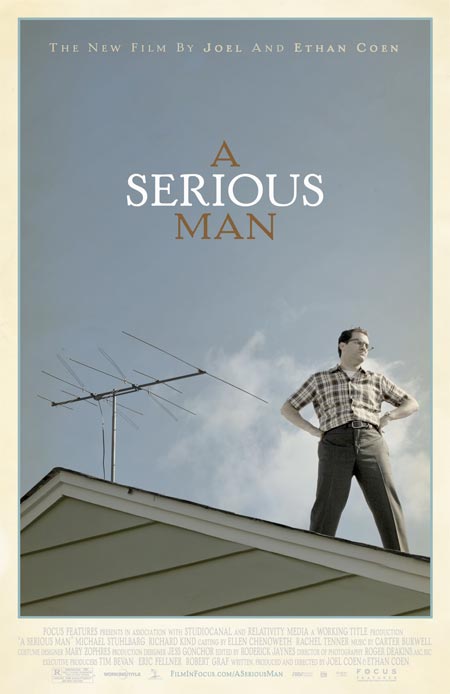
A late addition to my list of favourite films of the noughties: the Coen Brothers’ A Serious Man, still in cinemas. It’s a brilliant dark comedy about suffering, God and the meaning of life.

Set amongst a suburban mid-Western Jewish community in 1970, Larry Gopnik is a physics professor whose life suddenly unravels. His wife announces she is leaving him for a nauseating positive thinker, Sy, and forces him to move into a motel with his troubled brother. As things get worse and worse, he tries to make sense of it, consulting all three rabbis at his synagogue. Their answers to his questions suggest religion has no satisfactory answers to suffering.

Part of the genius is in the inventive, well observed interactions between characters, each of them a clever slightly cariactured distillation of human behaviour. The scenes with Larry’s redneck neighbour who is stealing a strip of Larry’s land are hilarious, as are those with the Korean student trying to bribe Larry. Perhaps best of all are the three rabbis, by turns a nervous and over-enthusiastic young rabbi; a middle-aged rabbi lacking conviction and satisfied living with ‘the mystery’ (‘Helping people? Well, that can’t hurt.’) and the ancient rabbi, lost in deep meditation, perhaps senile.

A Serious Man asks big questions without offering any answers, and that’s perhaps the strongest point of comparison to the Book of Job, which doesn’t offer too many answers either. (“I’m God and you’re not, so don’t complain,” is Job’s message; the message of A Serious Man is something like “suffering happens, you may find a pattern in it or you may not; depends on how you look at it.”)

There are few more serious or wittier films that I’ve ever seen. That said, a lot of people on the imdb.com board hated it, so you might be very disappointed. It’s one for fans of Synecdoche, New York and The Man Who Wasn’t There.

* I’m working on Thursdays next year, which means the end of Thursdays 3pm. Thanks for listening. It’s been a good project to keep these posts coming. Sometimes it’s felt like a chore, but other times it’s brought out new thoughts in me. I’m going to keep blogging and I may even start a Friday or Monday regular post.

[Thursday 3pm #36] By the orange trees

10 Thursday Dec 2009

Posted by Nathan Hobby in autobiographical, books, Series: Thursday 3pm feature posts (2009)

≈ 2 Comments

Tags

anne fadiman

So I missed a week and no-one commented. That’s a relief, in one sense. Last Thursday I was camping in the bush, a long way from a computer.

It was a semi-cleared area near Jarrahdale, and I pitched my tent near a row of four old orange trees. Animals – kangaroos, is my guess – had stripped all the oranges on the lower branches, but there were plenty higher up, slightly sour with hard to peel skin. Further over was a tall oak tree. Near my tent were pieces of an old china plate and broken bottles.

I tried to picture the house which must have stood there. There should be monuments in places like this. To think people might have lived whole lives in that space, and no-one even knows today.  Our ancestors are strangers who leave some traces, a mystery to us.

While sitting under the shade of a gum tree on Thursday afternoon, I finished Anne Fadiman’s excellent collection of personal bibliographic essays, Ex-Libris: Confessions of a Common Reader.  These are the kind of essays I aspire to in this blog. She writes about the experience of ‘marrying’ her book collection with her husband’s and the challenges of agreeing on ways to arrange books. She explores the ins and outs of annotating – or not annotating – books. (I am a lead pencil annotater. I have sympathy with people who consider it desecration.)

[Thursday 3pm #35] Nathan’s Top 30 Films of the Noughties

26 Thursday Nov 2009

Posted by Nathan Hobby in film review, lists, Series: Thursday 3pm feature posts (2009)

≈ 4 Comments

Tags

2000s, film and television, noughties

1. American Beauty (2000)
I need to watch this film again (I saw it four or five times early in the decade) and see if it still has the hold over me it had then. It is, by turns, a beautiful and savage look at suburban life.

2. The Science of Sleep (2007)
A film with the atmosphere of a dream in the best possible sense; Stephane pursues his neighbour Stephanie and his artistic ambition in a world with all the distortions and twists of dreams.

3. The Virgin Suicides (2000)
I love this film’s evocation of the 1970s and of adolescence. It is a film of rare beauty, humour and drama.

4. Synecdoche (2009)
A sad film about death and art, and a play which consumes the world.

4a. LATE ADDITION : A Serious Man (2009)
A comic film about suffering and the meaning of life, sharply witty.

5. I’m Not There (2007)
The lives of Bob Dylan told in myth; strange and wonderful.

6. Eternal Sunshine of the Spotless Mind (2004)
Would you erase all the memories of a failed romance if you could? Crazy and beautiful at the same time.

7. Me, you and everyone we know (2005)
A film about awkward people in love; quirky and warm with splendid dialogue.

8. Donnie Darko (2001)
I don’t pretend to understand it, but it’s a startling, inspiring journey with Donnie, an authentic and brave teenager.

9. Amazing Grace (2007)
The most mainstream of the films on this list, an inspiring biopic of William Wilberforce’s fight against slavery.

10. Amelie (2001)
Every second person’s favourite film is genuinely brilliant, a whimsical, exploration of the meaning of life.

11. Adaptation (2002)
Charlie Kaufman for the third time in this list; he was meant to adapt The Orchid Thief, a conventional non-fiction narrative, but instead he wrote a script about the whole idea of ‘adaptation’ and a writer battling to write the script for The Orchid Thief.

12. Atonement (2007)
A classy adaptation of one of my favourite books, retaining much of the tragedy and drama; also visually stunning.

13. 24 Hour Party People (2002)
Director Michael Winterbottom has crafted a brilliant postmodern biopic of Tony Wilson and his involvement with Joy Division, New Order, The Happy Mondays.

14. The Quiet American (2002)
An excellent adaptation of the Graham Greene novel; a sombre exploration of colonialism and personal ethics.

15. The Man Who Wasn’t There (2001)
The Coen brothers’ film noir about a barber who gets himself in over his head. The first time I watched, it was an all time favourite, but it had less impact on repeat viewings.

16. Death at a Funeral (2007)
The funniest film I saw all decade.

17. Slumdog Millionaire (2008)
As good as the hype – an energetic, pulsing thriller-drama.

18. Y Tu Mama Tambien (2001)
Two teenage boys go on a holiday with a married woman.

19. Palindromes (2004)
An awkwardly funny and disturbing film about abortion and paedophilia; I don’t think I’m brave enough to watch it again.

20. Memento (2000)
A crime film about a man with no short term memory, with a very effective narrative innovation.

21. Storytelling (2001)
I love the creative writing class scenes early in this film; a shocking and funny film about ‘fiction’ and ‘nonfiction’ from Todd Solondz (Palindromes).

22. Pan’s Labrinyth (2006)
A violent fable set in wartime Italy.

23. Match Point (2005)
The only Woody Allen film of the decade I liked, and I speak as a fan; a kind of Dostoveskian drama.

24. As It Is In Heaven (2004)
A heartwarming Swedish film about a composer who goes back to his small home town; I saw it in a tiny seaside cinema in NZ on our honeymoon.

25. Team America (2004)
A puerile, hilarious satire on the international politics of the decade from the South Park creators.

26. The Royal Tenenbaums (2001)
A kind of J.D. Salingeresque look at a crazy family from Wes Anderson.

27. Before the Devil Knows You’re Dead (2007)
A nasty thriller/ family drama brilliantly executed by octogenarian director Sydney Lumet; you’d need to be in the right mood to enjoy this.

28. Mullholland Dr (2001)
I don’t know what to think of David Lynch’s nightmares; there was a time I lived by them.

29. He Died With A Felafel In His Hand (2001)
A funny Australian look at share houses.

30. The Dark Knight (2008)
Batman as he should be; epic filmmaking at its best.
A strong contender for the number one place – Fight Club – was released in November 1999, just outside the decade. It was still playing at cinemas well into 2000 when I finally saw it. American Beauty was released in 1999 in the USA, but not until January 2000 in Australia. Some arbitrary decisions, then.

[Thursday 3pm #34] Paul Auster’s Invisible : a review

19 Thursday Nov 2009

Posted by Nathan Hobby in book review, Series: Thursday 3pm feature posts (2009)

≈ 1 Comment

Tags

Invisible, Paul Auster

It’s been a prolific decade for my favourite author, Paul Auster –he has just published his sixth novel of the noughties. As prolific as he’s been, he’s also published some of his weakest works –I don’t care for the crowd-pleasing Brooklyn Follies nor Travels in the Scriptorium, although at least they’re better than Timbuktu, his late nineties novel told through the eyes of a dog. I rate his new novel, Invisible, the second best of the six of the decade, after The Book of Illusions. It is the most typical of his whole career, with many of his recurring elements appearing – a mysterious stranger, a change of fortune, a struggling poet translating French texts, a random act of violence, and a framed narrative.

As almost always happens in Auster’s novels, the protagonist is a male New Yorker born in 1947 and a student at Columbia. Adam Walker is a college student and aspiring poet and the novel is about the defining year of his life, 1967.

Adam meets a mysterious stranger at a party – Rudolf Born – who makes him an offer that will change his life; Born will pay Adam to edit a literary magazine. Born is called away on business, and Adam is seduced by Born’s girlfriend, Margot. Yet it isn’t this that causes a rift between them, but Born’s violent stabbing of a mugger. Adam spends much of the rest of the novel hoping to see justice served on Born for the murder.

In between, he has lots of sex with his sister, and even though there’s been hints of incest in Auster’s work before (In The Country of Last Things, The Red Notebook, from memory) it is the sexual explicitness of this novel that is its most atypical feature. Usually Auster summarizes sex without going into much detail at all, but this time he is more anatomical.

Complicating the story is a complicated framing device. The first part about Walker meeting Born and things going wrong, is revealed to be the first chapter of a manuscript Walker has written in the present day and sent to his friend Jim, a famous writer. Walker is terminally ill and is trying to finish the memoir before he dies. (A situation which recalls Thomas Effing telling Fogg his life story in Moon Palace for his obituary, and Hector Mann bringing Zimmer to his ranch to see his secret films before he dies in The Book of Illusions.)  After Jim’s framing, the second part of the novel is told in second person to overcome Walker’s writer’s block. The third part of the novel is filled out by Jim from Walker’s rough notes. As Walker’s narrative ends, Jim does some detective work, tracking down the people involved and trying to solve some of the mysteries.

It is a compulsively readable story, fascinating and littered with insights into the way we make meaning of life and how we decide what to do with ourselves. In her review, Lionel Shriver contended that there is nothing to take away from the book, that it’s like a glass of lemonade. I think part of what she is noticing and what disappoints her is an insistence by Auster that his narratives attempt to mimic some of the randomness of life, with both its coincidence and its failure to resolve. I read a reviewer once describe Auster’s work as a handful of smooth stones rubbing against each other, but not yielding anything as simple as meaning.

Perhaps Auster has had a bad influence on me over the last nine years that I’ve been reading him. Particularly in my first two novels and in an abandoned novel or two, I attempted to emulate his randomness, thinking I could just add it as one more element in a palimpsest of all my favourite writers – a bit of Auster’s randomness, a bit of Joyce’s stream of consciousness, a bit of Dick’s madness – in the one narrative. Not possible. The whole narrative world has to be driven by randomness, if one wants to write about the music of chance.

[Thursday 3pm #33] Extract from the Library of Babel III

12 Thursday Nov 2009

Posted by Nathan Hobby in libraries, reading, Series: Thursday 3pm feature posts (2009)

≈ Leave a comment

Tags

Library of Babel

As he looked for books to reshelve, he would walk amongst the readers bent over their desks and imagine he could hear the murmur of their thoughts. All those words going through people’s heads, making some connection, some act of communication between writer and reader, sometimes across gaps of centuries. It was miraculous. With his thoughts on this, the reading area hummed and shouted with the glory of the silent communion.

All these people embarked on their own quests, their own projects, an aim, a question, a desire to read they kept inside their head. The library did not ask them why they came. They just came, walking in here to take certain books off the shelves and read.

Silent exterior, noisy interior. A beautiful place, the library.

[Thursday 3pm #32] The week in texts

05 Thursday Nov 2009

Posted by Nathan Hobby in film review

≈ 2 Comments

Tags

Don Watson, Lionel Shriver, nonfiction, Paul Auster

On Saturday night I saw The Imaginarium of Dr Parnassus, famous for being Heath Ledger’s final film. (Interestingly, to me at least, my cousin is married to his cousin.) I’m always disappointed by Terry Gilliam films – they promise a lot, have fascinating moments and concepts, but are undisciplined, unfocused. The struggling travelling caravan of the immortal Dr Parnassus making its way around London is fascinating and the strange worlds of people’s fantasies as they enter his mirror are enjoyable. Just don’t expect too much sense.

On Tuesday night I watched Darren Aronofsky’s 2008 film The Wrestler. I was underwhelmed. It’s a well directed, well acted drama about a washed up wrestler who has nothing to live for but his wrestling, with a parallel drawn between his physical performance in the ring and those of his stripper friend. It is strongly realist, in stark contrast to his other films, Pi, Requiem for a Dream and Fountain, all of which are surreal.

On Wednesday I read in The Australian Literary Review with great interest a writer I like a lot – Lionel Shriver – writing about my favourite writer, Paul Auster. She claims to know his work quite well, and praises him as a great storyteller. She puts her finger on one important quality of his work:

The word “readable” doesn’t do this quality justice. Auster has such a sweet, clear, inviting voice that his novels go down like lemonade. While his characters are vivid, his genius is plot, of which readers of literary fiction are too often starved.

But she thinks he falls short of Philip Roth; unlike Roth, one comes away from Auster – she contends – with an ‘absence of an intellectual, psychological or political souvenir’. His stories are just stories – no meat, just lemonade.

Hmmm. I think she’s wrong. At his best, Auster has a lot of psychological insight into the way we live our lives, the way we respond to choices and circumstances. His souvenirs – for me – are existential, clues to the conduct of life. A sense that someone else lives in the kind of world I live in. But I think I know what she means.

All through the week I’ve been reading Don Watson’s book about America. I’ve been dissatisfied, even a narrative like this is no substitute for reading a novel at the same time. (I had just given up on Geraldine Brooks’ People of the Book; I found her prose too annoying, slipping between colloquial and formal, and the feel of popular fiction, with its cliches and a certain kind of first person voice.) I have been thinking about moving to nonfiction for my next book after the library novel. I think it may bring together the two sides of my personality/ interests better than fiction – the researcher in me. But it wouldn’t be the kind of book Watson is writing. It would be less personal, and not have opinions in it.

Watson’s is a rambling travelogue, beautifully written, that keeps recurring around the centrality of fundamentalist Christianity to the experience of living in America. I have an endless fascination and horror with fundamentalist Christianity, and so I find this interesting, all the things he hears on the radio and sees on the telly, all the signs he sees about Jesus. There’s a lot more to it, of course, it’s just as much about politics and history and travel.

[Thursday 3pm #31] The Towering Inferno

29 Thursday Oct 2009

Posted by Nathan Hobby in film review, Series: Thursday 3pm feature posts (2009)

≈ 2 Comments

Tags

1970s, Towering Inferno

towering_inferno

On the night of the opening of the world’s tallest skyscraper – San Francisco’s elite all on the top floor at the party – a fire breaks out because of the shortcuts taken in the wiring. The principled architect (Paul Newman) and the brave fire chief (Steve McQueen) fight to get everyone out alive. It’s an all star-cast blockbuster from 1974, and it runs a marathonic 160 minutes or so.

The first time I started watching The Towering Inferno, I was about eleven and staying at my grandparents’ house. I used to love sleeping in their spare room, with the foldout couch and the television. (It seemed the ultimate decadence, to have a television in one’s room.) The movie was on commerical television and I came in late; one of the first things I saw was a couple catching on fire and falling through a window sixty floors up. I was hooked. For the next couple of hours, I fought against tiredness as the increasing commercials bloated its length. I didn’t make it through. I had to sleep.

I got it out on video in 2003, when I was living in the decaying sharehouse with my brother. About halfway through, the dodgy VCR I had bought secondhand (what was I thinking?) snared the tape and actually somehow recorded SBS on about thirty seconds worth, even though the plugs weren’t covered. The videostore didn’t charge me, which was kind of them (already videos were on their way out) but I still didn’t get to see the rest of it.

Then, last weekend my wife really wanted to see it, because it was about buildings and she works these days with buildings. People at work told her it was the film every project manager had to see. This time – in two installments – I watched the entire film.

There is something comforting for me to enter the seventies, this world that existed just before I was born. The Towering Inferno has just about every star of its time in it; it’s sad to think of their fates 35 years later. Steve McQueen died in 1980 – what a shock that would have been, the action hero of his time; he seems indestructible as the fire chief in this film. The other lead, Paul Newman, died a reasonably old man this year. (How can the action star of a blockbuster turn into ‘a reasonably old man’?) Fred Astaire, dead of course; that woman who we thought was Elizabeth Taylor is actually Jennifer Jones, but she’s not dead, just 90 and not so remembered. Faye Dunaway – her beauty in this film looks like it will last forever, but she’s now in her sixties. Then there’s O.J. Simpson, who doesn’t appear in so many films these days. Richard Chamberlain? I remember him best as the Indiana Jones rip-off (or vice-versa, given how old the books are), Alan Quartermain, in the 1980s; his star doesn’t shine brightly these days either.

I love the blinking lights of the computer; the wood panelling of the walls; the curious manner men speak to women – always trying to come up with a fresh line, as if that was the way to a woman’s heart. I love the strange sort of indolence that hangs over the scenes early in the film, the spacious sets they made, which just don’t ring true with what the interior of houses or hotels look like, not even in films today; the massive headphone radio the kid has over his ears so that he can’t hear what his mum is saying – ‘kids and their gadgets these days!’. I love the painted film posters they used to do.

I imagined I was watching the film at the drive-in, taking it seriously (not that I’m taking it unseriously, but I’m not watching it as it was made, I’m not watching it as a blockbuster, as the latest, greatest thing, which is what it is always meant to be), I watched it like it was new, and in those moments I was time travelling.

← Older posts
Newer posts →

Enter your email address to follow this blog and receive notifications of new posts by email.

Join 287 other subscribers

Nathan on Twitter

My Tweets

Categories

  • academic (9)
  • archives and sources (10)
  • autobiographical (62)
  • biographers (10)
  • biographical method (28)
  • biographical quests (18)
  • biographies (21)
    • political biography (2)
  • biographies of living subjects (2)
  • biographies of writers, artists & musicians (12)
  • biographies of writers, artists and musicians (20)
  • biography as a literary form (9)
  • biography in fiction (2)
  • biography in the news (2)
  • books (236)
    • authors (19)
    • book review (173)
    • reading (23)
  • Covid (2)
  • creative nonfiction (11)
  • daily life (2)
  • Daily Prompt (2)
  • death (21)
  • digital humanities (3)
  • family history (1)
  • fiction (8)
  • film and television biographies (5)
  • film review (48)
  • found objects (3)
  • historical biographies (1)
  • history (20)
  • In the steps of KSP (4)
  • John Curtin (13)
  • Katharine Susannah Prichard (114)
    • Glimpses of KSP (7)
    • My KSP biography (31)
      • deleted scenes (1)
  • Katharine Susannah Prichard's associates and connections (16)
  • Katharine Susannah Prichard's writings (34)
  • libraries (5)
  • life (20)
  • link (23)
  • links (41)
  • lists (28)
  • local history and heritage (1)
  • media (4)
  • memes and urban myths (1)
  • memoirs (10)
  • meta (2)
  • music (18)
  • news (9)
  • news and events (43)
  • obituary (1)
  • Old writing found on a floppy disk (1)
  • poetry (5)
  • politics and current affairs (26)
    • climate change (1)
  • prologues and introductions (2)
  • psychological aspects of biography (3)
  • quotes (22)
  • R.I.P. (10)
  • reading report (3)
  • religion (1)
  • religious biography (1)
  • research (5)
  • role of the biographer within the biography (2)
  • Series: A-Z of Katharine Susannah Prichard (26)
  • Series: Corona Diary (1)
  • Series: Saturday 10am (14)
  • Series: Short Stories (2016) (6)
  • Series: The Tourist (2013) (6)
  • Series: Thursday 3pm feature posts (2009) (35)
  • structure of biographies (3)
  • technology and the digital world (2)
  • television (4)
  • the nature of biography (4)
  • this blog (10)
  • Uncategorized (33)
  • Western Australia (26)
  • writing (41)

Archives

Recent Comments

amphisbaenathoroughly79c20f19aa's avataramphisbaenathoroughl… on John Curtin’s vision…
Nathan Hobby's avatarNathan Hobby on John Curtin’s vision…
karenlee thompson's avatarkarenlee thompson on John Curtin’s vision…
Nathan Hobby's avatarNathan Hobby on John Curtin’s vision…

Bookmarks

  • Adventures in Biography
  • ANZ LitLovers LitBlog
  • Bernice Barry
  • It only goes up to your knees
  • Jane Bryony Rawson
  • Jenn Plays Recorder
  • Katharine Susannah Prichard Writers' Centre
  • Laura Sewell Matter: Essayist and Biographer
  • Mutually said: Poets Vegan Anarchist Pacifist
  • Resident Judge
  • Speaking Thylacine
  • The Australian Legend
  • Timothy Parkin Poetry
  • Treefall Writing – Melinda Tognini
  • Whispering Gums
  • Wrapped up in books: the home of Guy Salvidge

Top Posts

  • The Joy of Knowledge Encyclopedia
  • Anger and Love by Justina Williams
  • The forgotten and the remembered: brief notes on the history of the Hodder & Stoughton £1000 Novel Competition
  • Paul Auster's Moon Palace : an overview
  • Biography workshop on 17 March 2018

Blog Stats

  • 235,227 hits

Tag Cloud

9/11 19th century 33 1920s 1921 1930s 1950s 1970s 1971 1981 2000s 2004 2011 2015 2017 20000 Days on Earth A.S. Byatt Aboriginals activism Adam Begley Adrian Mole adultery afterlife Agatha Christie Alan Hollinghurst Alberto Manguel Alfred Deakin Amazing Grace Americana Amy Grant An American Romance Andre Tchaikowsky Andrew McGahan angela myers anne fadiman Anne Rice Arabian Nights archives art arts funding A Serious Man Ash Wednesday ASIO atheism Atonement Australia Australian film Australian literature Australian Short Story Festival autism autobiography autodidact Barbara Vine beach Belle Costa da Greene Bell Jar best best-of Bible Big Issue Bill Callahan biographical ethics biographical quest genre biographies birthday birthdays Black Opal Bleak House Blinky Bill blogging blogs Blue Blades Bodega's Bunch bog Booker book launch booksale Borges Brenda Niall Brian Matthews Brian McLaren Britney Spears Burial Rites Burke and Wills buskers C.S. Lewis C.S. Lewis canon capitalism Carol Shields Carson McCullers Catcher in the Rye Catholicism celebrities Charles Dickens Charlie Kaufman childhood Child of the Hurricane children's books Choir of Gravediggers Christianity Christian writing Christina Stead Christmas Christopher Beha Cinque Terra Claire Tomalin classics cliches climate change Coen brothers coincidence Collie Collyer coming of age Communism concert Condensed Books consumerism Coonardoo Cormac McCarthy Corrections cosy fiction Dara Horn David Copperfield David Ireland David Marr David Suchet death Death of a president definition demolition Dennis LeHane dentist diaries divorce doctorow Doctor Who documentaries donald shriver Don DeLillo Don DeLillo Donna Mazza Donna Tartt Don Watson Dostovesky doubt drama dreams of revolution Drusilla Modjeska E.M. Forster ebooks editing Eichmann Eisenstein Elizabeth Kostova email empathy ensmallification existentialism faith Falling Man fame families fantasy fiction film and television folk football Frank Barscombe Fremantle Press G.K. Chesterton Gabrielle Carey Gallipoli genealogical fiction Genesis Geoff Nicholson George W. Bush Gerald Glaskin Gilead Golden Miles Goldfields Trilogy Graham Greene grandad great novels Greenmount Guinness World Records Guy Salvidge Hannah Arendt Hannah Kent Hans Koning Hans Koningsberger Harper Lee Haxby's Circus Hazel Rowley He-Man headers heaven Heidegger hell Henrietta Lacks Henry Morton Stanley Herman Hesse heroes Hey Dad! historical fiction history Holden Caulfield holidays Homer & Langley Home Song Stories House of Cards House of Zealots house of zealots Hugo Throssell humour Ian McEwan In between the sheets Indonesia Infamous Inside Llewyn Davis interstellar interview Intimate Strangers Invisible Ireland ISBNs Ishiguro itunes J.D. Salinger J.M. Coetzee J.S. Battye Janet Malcolm Jennifer Egan JFK JFK assassination Joanna Rakoff Joel Schumacher John Burbidge John Fowles John Howard John Kinsella John Updike John Updike Jonathan Franzen journal writing JSB Judgment Day Julia Baird Julian Barnes Kafka Kalgoorlie Kate Grenville Katherine Mansfield Kevin Brockmeier King's Park KSP Writers' Centre language last ride Laurie Steed Left Behind Leonard Cohen Leo Tolstoy Libra Library of Babel Library of Babel Lila Lily and Madeleine links Lionel Shriver lionel shriver lists literary fiction literature Lleyton Hewitt lost book Louisa Louisa Lawson Louis Esson louis nowra love letter Lubbock Lytton Strachey Madelaine Dickie Man Booker man in the dark Margaret Atwood Margaret River Press Marilynne Robinson mark sandman meaning of life Melbourne Mel Hall meme memorialisation memory MH17 Michael Faber Mike Riddell Miles Franklin mining boom missionaries moleskine Moon Palace morphine Mother Teresa movies Music of Chance My Brilliant Career names Napoleon Narnia narrative Narrow Road to the Deep North Narziss and Goldmund Natalie Portman Nathaniel Hobbie national anthem Nick Cave Nina Bawden non-fiction nonfiction noughties novelists novels obituaries obscurity On Chesil Beach Parade's End Paris Hilton Passion of the Christ past patriotism Paul Auster Paul de Man Perth Perth Writers Festival Peter Ackroyd Peter Cowan Writers Centre phd Philip K. Dick Philip Seymour Hoffman pierpontmorgan poetry slam politics popular fiction popular science Possession postapocalyptic postmodernism Pride prophetic imagination publications Pulp Purity Queen Victoria Rabbit Angstrom radio Radio National Randolph Stow rating: 5/10 rating: 6/10 rating: 7/10 rating: 8/10 rating: 9/10 rating: 10/10 ratings reading fiction autobiographically reading report Rebecca Skloot recap red wine reincarnation juvenile fiction rejection review - music reviewing rewriting Richard Flanagan Richard Ford Rick Moody Roaring Nineties Robert Banks Robert Hughes Robert Silverberg Robert Wadlow Robinson Crusoe Rolf Harris romance Rome ruins Russell Crowe Ruth Rendell Sarah Murgatroyd scalpers science fiction Science of Sleep secondhand books Secret River sermon illustration sex short stories Silent Woman Simone Lazaroo Simpsons Siri Hustvedt slavery Smashing Pumpkins social interactions social justice some people i hate sources South Australia souvenirs speculation speech speeches sport status anxiety Stephen Lawhead Stranger's Child subtitles Subtle Flame Sue Townsend suicide Surprised By Hope Suzanne Falkiner Sylvia Plath Synecdoche TAG Hungerford Award tapes teabags Ted Hughes The Children Act The Cure The Fur The Imitation Game theology The Pioneers The Revolutionary Thomas Disch Thomas Hardy Thomas Henry Prichard Thomas Mann thriller time Tim La Haye Tim Winton Tolstoy Tom Wright top 10 Towering Inferno Tracy Ryan Trove Truman Capote tshirts TS Spivet Twelve Years a Slave underrated writers Underworld unwritten biographies urban myth USA vampires Venice Victoria Cross Victoriana Victorian era Victorianism Victoria Park video Voltron w Wake in Fright Walkabout Walter M. Miller war War and Peace war on terror Water Diviner Wellington St Bus Station Westerly Western Australia West Wing What Happened to Sophie Wilder? Whitlams wikipedia Wild Oats of Hans William Wilberforce Winston Churchill Witches of Eastwick Working Bullocks workshop World War One writers writing Writing NSW youth Zadie Smith Zeitgeist Zelig

Enter your email address to follow this blog and receive notifications of new posts by email.

Join 287 other subscribers

Pages

  • About
  • My novel: The Fur
  • The Red Witch: A Biography of Katharine Susannah Prichard

Categories

  • academic (9)
  • archives and sources (10)
  • autobiographical (62)
  • biographers (10)
  • biographical method (28)
  • biographical quests (18)
  • biographies (21)
    • political biography (2)
  • biographies of living subjects (2)
  • biographies of writers, artists & musicians (12)
  • biographies of writers, artists and musicians (20)
  • biography as a literary form (9)
  • biography in fiction (2)
  • biography in the news (2)
  • books (236)
    • authors (19)
    • book review (173)
    • reading (23)
  • Covid (2)
  • creative nonfiction (11)
  • daily life (2)
  • Daily Prompt (2)
  • death (21)
  • digital humanities (3)
  • family history (1)
  • fiction (8)
  • film and television biographies (5)
  • film review (48)
  • found objects (3)
  • historical biographies (1)
  • history (20)
  • In the steps of KSP (4)
  • John Curtin (13)
  • Katharine Susannah Prichard (114)
    • Glimpses of KSP (7)
    • My KSP biography (31)
      • deleted scenes (1)
  • Katharine Susannah Prichard's associates and connections (16)
  • Katharine Susannah Prichard's writings (34)
  • libraries (5)
  • life (20)
  • link (23)
  • links (41)
  • lists (28)
  • local history and heritage (1)
  • media (4)
  • memes and urban myths (1)
  • memoirs (10)
  • meta (2)
  • music (18)
  • news (9)
  • news and events (43)
  • obituary (1)
  • Old writing found on a floppy disk (1)
  • poetry (5)
  • politics and current affairs (26)
    • climate change (1)
  • prologues and introductions (2)
  • psychological aspects of biography (3)
  • quotes (22)
  • R.I.P. (10)
  • reading report (3)
  • religion (1)
  • religious biography (1)
  • research (5)
  • role of the biographer within the biography (2)
  • Series: A-Z of Katharine Susannah Prichard (26)
  • Series: Corona Diary (1)
  • Series: Saturday 10am (14)
  • Series: Short Stories (2016) (6)
  • Series: The Tourist (2013) (6)
  • Series: Thursday 3pm feature posts (2009) (35)
  • structure of biographies (3)
  • technology and the digital world (2)
  • television (4)
  • the nature of biography (4)
  • this blog (10)
  • Uncategorized (33)
  • Western Australia (26)
  • writing (41)

Archives

Recent Comments

amphisbaenathoroughly79c20f19aa's avataramphisbaenathoroughl… on John Curtin’s vision…
Nathan Hobby's avatarNathan Hobby on John Curtin’s vision…
karenlee thompson's avatarkarenlee thompson on John Curtin’s vision…
Nathan Hobby's avatarNathan Hobby on John Curtin’s vision…

Bookmarks

  • Adventures in Biography
  • ANZ LitLovers LitBlog
  • Bernice Barry
  • It only goes up to your knees
  • Jane Bryony Rawson
  • Jenn Plays Recorder
  • Katharine Susannah Prichard Writers' Centre
  • Laura Sewell Matter: Essayist and Biographer
  • Mutually said: Poets Vegan Anarchist Pacifist
  • Resident Judge
  • Speaking Thylacine
  • The Australian Legend
  • Timothy Parkin Poetry
  • Treefall Writing – Melinda Tognini
  • Whispering Gums
  • Wrapped up in books: the home of Guy Salvidge

Top Posts

  • The Joy of Knowledge Encyclopedia
  • Anger and Love by Justina Williams
  • The forgotten and the remembered: brief notes on the history of the Hodder & Stoughton £1000 Novel Competition
  • Paul Auster's Moon Palace : an overview
  • Biography workshop on 17 March 2018

Blog Stats

  • 235,227 hits

Tag Cloud

9/11 19th century 33 1920s 1921 1930s 1950s 1970s 1971 1981 2000s 2004 2011 2015 2017 20000 Days on Earth A.S. Byatt Aboriginals activism Adam Begley Adrian Mole adultery afterlife Agatha Christie Alan Hollinghurst Alberto Manguel Alfred Deakin Amazing Grace Americana Amy Grant An American Romance Andre Tchaikowsky Andrew McGahan angela myers anne fadiman Anne Rice Arabian Nights archives art arts funding A Serious Man Ash Wednesday ASIO atheism Atonement Australia Australian film Australian literature Australian Short Story Festival autism autobiography autodidact Barbara Vine beach Belle Costa da Greene Bell Jar best best-of Bible Big Issue Bill Callahan biographical ethics biographical quest genre biographies birthday birthdays Black Opal Bleak House Blinky Bill blogging blogs Blue Blades Bodega's Bunch bog Booker book launch booksale Borges Brenda Niall Brian Matthews Brian McLaren Britney Spears Burial Rites Burke and Wills buskers C.S. Lewis C.S. Lewis canon capitalism Carol Shields Carson McCullers Catcher in the Rye Catholicism celebrities Charles Dickens Charlie Kaufman childhood Child of the Hurricane children's books Choir of Gravediggers Christianity Christian writing Christina Stead Christmas Christopher Beha Cinque Terra Claire Tomalin classics cliches climate change Coen brothers coincidence Collie Collyer coming of age Communism concert Condensed Books consumerism Coonardoo Cormac McCarthy Corrections cosy fiction Dara Horn David Copperfield David Ireland David Marr David Suchet death Death of a president definition demolition Dennis LeHane dentist diaries divorce doctorow Doctor Who documentaries donald shriver Don DeLillo Don DeLillo Donna Mazza Donna Tartt Don Watson Dostovesky doubt drama dreams of revolution Drusilla Modjeska E.M. Forster ebooks editing Eichmann Eisenstein Elizabeth Kostova email empathy ensmallification existentialism faith Falling Man fame families fantasy fiction film and television folk football Frank Barscombe Fremantle Press G.K. Chesterton Gabrielle Carey Gallipoli genealogical fiction Genesis Geoff Nicholson George W. Bush Gerald Glaskin Gilead Golden Miles Goldfields Trilogy Graham Greene grandad great novels Greenmount Guinness World Records Guy Salvidge Hannah Arendt Hannah Kent Hans Koning Hans Koningsberger Harper Lee Haxby's Circus Hazel Rowley He-Man headers heaven Heidegger hell Henrietta Lacks Henry Morton Stanley Herman Hesse heroes Hey Dad! historical fiction history Holden Caulfield holidays Homer & Langley Home Song Stories House of Cards House of Zealots house of zealots Hugo Throssell humour Ian McEwan In between the sheets Indonesia Infamous Inside Llewyn Davis interstellar interview Intimate Strangers Invisible Ireland ISBNs Ishiguro itunes J.D. Salinger J.M. Coetzee J.S. Battye Janet Malcolm Jennifer Egan JFK JFK assassination Joanna Rakoff Joel Schumacher John Burbidge John Fowles John Howard John Kinsella John Updike John Updike Jonathan Franzen journal writing JSB Judgment Day Julia Baird Julian Barnes Kafka Kalgoorlie Kate Grenville Katherine Mansfield Kevin Brockmeier King's Park KSP Writers' Centre language last ride Laurie Steed Left Behind Leonard Cohen Leo Tolstoy Libra Library of Babel Library of Babel Lila Lily and Madeleine links Lionel Shriver lionel shriver lists literary fiction literature Lleyton Hewitt lost book Louisa Louisa Lawson Louis Esson louis nowra love letter Lubbock Lytton Strachey Madelaine Dickie Man Booker man in the dark Margaret Atwood Margaret River Press Marilynne Robinson mark sandman meaning of life Melbourne Mel Hall meme memorialisation memory MH17 Michael Faber Mike Riddell Miles Franklin mining boom missionaries moleskine Moon Palace morphine Mother Teresa movies Music of Chance My Brilliant Career names Napoleon Narnia narrative Narrow Road to the Deep North Narziss and Goldmund Natalie Portman Nathaniel Hobbie national anthem Nick Cave Nina Bawden non-fiction nonfiction noughties novelists novels obituaries obscurity On Chesil Beach Parade's End Paris Hilton Passion of the Christ past patriotism Paul Auster Paul de Man Perth Perth Writers Festival Peter Ackroyd Peter Cowan Writers Centre phd Philip K. Dick Philip Seymour Hoffman pierpontmorgan poetry slam politics popular fiction popular science Possession postapocalyptic postmodernism Pride prophetic imagination publications Pulp Purity Queen Victoria Rabbit Angstrom radio Radio National Randolph Stow rating: 5/10 rating: 6/10 rating: 7/10 rating: 8/10 rating: 9/10 rating: 10/10 ratings reading fiction autobiographically reading report Rebecca Skloot recap red wine reincarnation juvenile fiction rejection review - music reviewing rewriting Richard Flanagan Richard Ford Rick Moody Roaring Nineties Robert Banks Robert Hughes Robert Silverberg Robert Wadlow Robinson Crusoe Rolf Harris romance Rome ruins Russell Crowe Ruth Rendell Sarah Murgatroyd scalpers science fiction Science of Sleep secondhand books Secret River sermon illustration sex short stories Silent Woman Simone Lazaroo Simpsons Siri Hustvedt slavery Smashing Pumpkins social interactions social justice some people i hate sources South Australia souvenirs speculation speech speeches sport status anxiety Stephen Lawhead Stranger's Child subtitles Subtle Flame Sue Townsend suicide Surprised By Hope Suzanne Falkiner Sylvia Plath Synecdoche TAG Hungerford Award tapes teabags Ted Hughes The Children Act The Cure The Fur The Imitation Game theology The Pioneers The Revolutionary Thomas Disch Thomas Hardy Thomas Henry Prichard Thomas Mann thriller time Tim La Haye Tim Winton Tolstoy Tom Wright top 10 Towering Inferno Tracy Ryan Trove Truman Capote tshirts TS Spivet Twelve Years a Slave underrated writers Underworld unwritten biographies urban myth USA vampires Venice Victoria Cross Victoriana Victorian era Victorianism Victoria Park video Voltron w Wake in Fright Walkabout Walter M. Miller war War and Peace war on terror Water Diviner Wellington St Bus Station Westerly Western Australia West Wing What Happened to Sophie Wilder? Whitlams wikipedia Wild Oats of Hans William Wilberforce Winston Churchill Witches of Eastwick Working Bullocks workshop World War One writers writing Writing NSW youth Zadie Smith Zeitgeist Zelig

Blog at WordPress.com.

  • Subscribe Subscribed
    • Nathan Hobby, a biographer in Perth
    • Join 287 other subscribers
    • Already have a WordPress.com account? Log in now.
    • Nathan Hobby, a biographer in Perth
    • Subscribe Subscribed
    • Sign up
    • Log in
    • Report this content
    • View site in Reader
    • Manage subscriptions
    • Collapse this bar
 

Loading Comments...