• About
  • The Red Witch: A Biography of Katharine Susannah Prichard
  • My novel: The Fur

Nathan Hobby, a biographer in Perth

~ The lives of John Curtin & Katharine Susannah Prichard, the art of biography, and other things

Nathan Hobby, a biographer in Perth

Author Archives: Nathan Hobby

Link: the immortal cells of Henrietta Lacks

30 Sunday Dec 2012

Posted by Nathan Hobby in death, link

≈ Leave a comment

Tags

death

My novel-in-progress is about im/mortalities; so it’s fascinating to stumble upon the story of Henrietta Lacks, a woman who died in 1951, but whose rare cells have been replicated in laboratories around the world to the point where there are 50 million tons of them. And this without her permission or her familly’s benefit.  The tattered black and white photo of her on this post is haunting.

Cremation busts

10 Monday Dec 2012

Posted by Nathan Hobby in death

≈ 3 Comments

Tags

death, Library of Babel

ashes-urn

It is probably not a healthy thing for me to be writing a novel about death, given my preoccupation with it. And why did I google ‘cremation’ just then in the name of research?

I didn’t find quite what I was looking for, but this instead:

Now we can create a custom cremation urn for ashes in the image of your loved one or favorite celebrity or hero, even President Obama!

So you can either have a bust made of a celebrity and store your ashes in that, or a spooky likeness of yourself made to sit forever on the mantlepiece watching your family? Such a strange concept, that you would be interred in the likeness of another, a person you never met. It is bizarre in a folk-religious way, the ultimate outcome of our celebrity worship.

I wish we were better at memorialising. In my novel, Tom contemplates the macabre possibility of preserving people’s heads and having them sit on the mantlepiece. I wouldn’t want that, in case you’re wondering. But I hate the thought of bodies – faces particularly – decaying and lost.

The marble or copper busts of Great Men made in the past seem to me, in some ways, a fitting memorialisation. But these advertised ones are, paradoxically, too realistic (in a tacky way), causing what the nerd from 30 Rock and John Safran inform me is the ‘uncanny valley’.

If I was earlier into my novel, I would have to incorporate these busts, but it’s too late for that.

A Brief Epistle to Mr Auster

30 Friday Nov 2012

Posted by Nathan Hobby in Daily Prompt

≈ 3 Comments

Tags

Paul Auster

WordPress daily prompt: Picture the one person in the world you really wish were reading your blog. Write her or him a letter.

Dear Paul Auster,

I know for a fact you won’t be reading this, and I highly suspect you dislike blogs. I think I read somewhere that you stay right away from the internet. Maybe that’s how you keep writing books. But pretend you were reading this, it would be written just for you.

It’s probably difficult to spot your influence on my fiction, but for a time I feel like I saw the whole world through your eyes. That was a decade ago, when I living in this same suburb I’ve just returned to. I wish my early twenties could have gone on forever, and I suspect you feel much the same. That was the period where I would be walking down the street and find strange letters on the footpath, photographs in parks. I used to spend a lot of time on buses and in the city centre, and seek after coincidences. I was MS Fogg, and I was Nashe.

(There you go, if you want to spot an influence, how about the ending of The Fur? I ripped that right out of Moon Palace, without even realising it. Our protagonists take a long, long walk across the country to complete their coming of age. MS Fogg walked further than Michael. Hey, how about that – Michael Sullivan = MS = MS Fogg – I never saw that before.)

I wonder what conclusions you’ve come to about God. It’s really not apparent from your writing, you know. But then again, I can never pick an atheist from their fiction.

I wonder if you ever feel like the gambler who won? You put everything in life on writing working out. You lived those hungry years on crusts of bread and translation work, were saved by the inheritance from  your dead father, but more than that, were saved because of success and because of brilliance. What of those who stake everything on it and it doesn’t pay off?

You already answered that, I suppose, in The Music of Chance – you gamble everything and you lose, you might be imprisoned by some eccentric men and made to build a stone wall, and every time it seems you’re going to get free, your sentence stretches on further.

Anyway, I’m reading Winter Journal at the moment, when I should be reading other things for my thesis.  I tried to appreciate every sentence as I read the first pages. A new book from a writer in his sixties: this will only happen so many more times. I really do dread the day you die. I remind myself how old you are every now and again – 65 and counting – and reassure myself that the odds are there’ll be quite a few more yet. But I was thinking Updike had another decade in him, and look what happened to him. I wanted another Rabbit book, I wanted them to go on forever – I’m sure he was thinking about it. On that note, more than anything, I need you to write about MS Fogg again – we learned about the fate of his friend, David Zimmer, but that feels like you were taunting me. Please tell me what happened to old MS!

You don’t know how obsessed I got thinking about the once chance I would have to speak to you – it was at the Adelaide Writers’ Festival, and I lined up with all the bookclub ladies in forty degree heat, and for months I’d been trying to come up with some one-liner which would make you want to be my friend. How pathetic! I got ten seconds in the end, and at least I got to tell you you are my favourite writer. I consoled myself afterwards with the knowledge that it’s probably better the way it is, with the friendship running one way only. It doesn’t get so messy this way.

Yours faithfully, NH.

On unwrapping my Moleskine notebook

20 Tuesday Nov 2012

Posted by Nathan Hobby in autobiographical

≈ 3 Comments

Tags

ISBNs, journal writing, moleskine

When I started keeping a journal, I used the cheapest exercise books I could find, 50c Newspower ones. I was fourteen, and the pages are now yellowed and brittle. I was allergic to aesthetics or quality then, function was all. I was also much poorer than I am now.

Today, my first Moleskine notebook arrived from Book Depository. At $16, it’s a lot less than you can buy it for in Australia. It truly is a beautiful notebook, properly bound and using acid-free paper. Will it inspire better words? Maybe; but I find it hard to write anything in my journal these days. Perhaps it is the fault of blogging. Perhaps I have lost the spiritual discipline of writing just for myself. (There are other factors.)

Two things struck me about my Moleskine notebook.

Firstly, it has an ISBN. I wonder what limits there are on ISBNs if a blank notebook can have one?

Secondly, it offers a conundrum to its owner with its front page saying ‘In case of loss please return to… As a reward: $…’

How much are our unique, private writings worth to us? I would say: they are priceless; they are worthless. There is nothing more wonderful and horrible for me than reading back over old journals. Sometimes I surprise myself; often I disappoint myself.

Perhaps one should write in it: ‘$1 (or $10?) for every page which is filled in’.  Perhaps one should write a great price in it, and then write to live up to it.

Whatever I decide (and I shall probably leave it blank) I have at least decided my private writings are worth more than a 50c exercise book.

Torie O’Shea, you’re nasty: my encounter with a ‘cosy’ novel

28 Sunday Oct 2012

Posted by Nathan Hobby in book review

≈ Leave a comment

Tags

Americana, biographical quest genre, cosy fiction, empathy, genealogical fiction, Jonathan Franzen, popular fiction, suicide

Researching a dissertation, I’ve ended up reading some things I wouldn’t normally read. That can be a good thing, although my experience reading some popular fiction has been an unhappy one so far. At the moment, I’m pursuing the idea of ‘genealogical fiction’, and came across the Torie O’Shea series, about a genealogist, written by Rett Macpherson. Several of the blurbs on the back cover proclaim the series as a masterpiece of the ‘cosy’; another says ‘a slice of Americana as warm and comforting as apple pie a la mode’, with the Americana bit being true and the second half being true for a particular type of reader in America’s mid-west, I’m sure.

The one I’m reading is Thicker Than Water, and it’s actually better than another ‘cosy’ novel about a biographer I tried to read. I had found Torie O’Shea annoying but not objectionable. Every twenty pages she proclaims her need for ‘caffeine and sugar’ (in that order), and downs a Dr Pepper. I think this is her ‘quirk’ – it creates character, presumably. One of the blurbs claims there is a ‘characteristic blend of wit and sarcasm’, but for me it’s about as witty as listening to middle-class, middle-aged people banter in a supermarket, and laugh exaggeratedly.

I could forgive this – humour is a taste, and I bet fans of Torie O’Shea don’t find Jonathan Franzen funny – even and especially though he writes in the same milieu. What horrified me was a scene late in the book where Torie O’Shea decides to visit an acquaintance, Leigh, in hospital who has failed in a suicide attempt.

First, Torie and her husband

made a few jokes about my mother winning a year’s supply of bagels. In fact, I think Rudy and I sort of overdid it on the bagel jokes, and suddenly there was an awkward silence. That very thing I wanted to avoid. (177)

At this point, I was glad Torie wasn’t visiting me in hospital regaling me with her banter. But Leigh misjudges her audience and asks them if she will go to hell if she commits suicide. This already makes them uneasy, and the final straw comes when Leigh adds ‘I just don’t see the point [of life].’ To this, Torie narrates:

Time was up. I couldn’t do this one second longer. We said good-bye and wished her well…. Finally Rudy said, “Why did we come to visit her, again?”

“Rudy.”

“That was God-awful, Torie. Absolutely horrible.”

“With my position in town, and especially with our new inheritance – not to mention we’re her landlords – it’s sort of expected of us.”

“Are you serious?”

“It comes with the territory, Rudy. Get used to it.” (177-178)

End of section. There are no authorial hints that Torie and her husband have failed terribly in the empathy stakes, no censure from another character, nothing to make me conclude anything other than the fact that readers are meant to share Torie’s frustration with this ‘unstable’ woman and congratulate her on at least making an effort and telling a few bagel jokes.

I have a few chapters to go. Perhaps the priest character who was conveniently waiting in the confessional several chapters ago will reappear and tell Torie how nasty she is. But I’m not counting on it. ‘Cosy’ is only cosy for those on the inside of the American dream.

A Biographical Quest of Australian Immortalities: Ice by Louis Nowra

05 Friday Oct 2012

Posted by Nathan Hobby in book review

≈ 1 Comment

Tags

biographical quest genre, Library of Babel, louis nowra

In Ice, A 19th century entrepreneur is obsessed with overcoming death, after losing his father at two and his beloved first wife a year into their marriage. In the present day, a man writes the entrepeneur’s biography from the notes left by his comatose wife, hoping the story he has created will jolt her to consciousness. It’s disturbing for me to discover that a prominent Australian writer has already published a novel on similar themes to the one I’m writing. From a purely selfish point of view, you’ll forgive me for being glad Ice is not definitive enough to preclude another novel with resemblances of theme and milieu.

Nowra’s 2008 novel was shortlisted for the Miles Franklin, but had mixed reviews. I think the criticisms are valid, but I was still fascinated by its Australian treatment of death and immortalities in the Victorian era.  David Free (Quadrant, December 2009: p.23) is insightful about the novel’s flaws:

This stinginess with dialogue is connected to Nowra’s central vice: his practice of summarising the events of his story rather than dramatising them. His unit of conveying information isn’t the scene, but the drab prose précis. Again, this seems a bizarre technical sacrifice for a novelist to make. If reading a novel about an historical figure sounds like a more enticing proposition than reading a 300-page encyclopaedia entry about him, that’s because we expect the novelist to render his narrative in vivid scenes, to roll up his sleeves and plunge into the business of fictional evocation. Nowra not only doesn’t do this; he doesn’t even seem to try.

In trying to cover 58 years in the life of the central character, Malcolm McEacharn, summary is the default mode. It doesn’t read exactly like an encyclopedia or even a conventional biography, because we are brought inside Malcolm and other character’s minds; but it does read like fiction which is not fully imagined.

[SPOILER ALERT] Yet it’s crammed with fascinating plot developments, ‘tall-tales’, as one reviewer wrote, building on the actual life of Malcolm McEacharn. The iceberg Malcolm tows into Sydney Harbour at the beginning of the novel has, at its core, a preserved sailor. Malcolm attends seances to find his dead wife; collects bottled foetuses of every creature; digs up the bones of his father.

Lesbian Bioquest: The Carradine Diary by Virginia Smith

24 Monday Sep 2012

Posted by Nathan Hobby in book review

≈ 1 Comment

Tags

biographical quest genre

It’s hard to find much trace of Virginia Smith’s The Carradine Diary online. It was her second novel, published in 2004 by Diva Books in London soon after her death in a car crash. Trove lists just one copy in Australian libraries, in the St Kilda Public Library. I picked up a secondhand copy spending a gift voucher at Elizabeth’s Books. I bought it guessing from its blurb that it was a good example of the biographical quest genre I’m researching.

Indeed, The Carradine Diary is a ‘textbook’ example. The British narrator, Abby, travels to Canada to illustrate the biography of a famed (and fictional) early twentieth century children’s novelist, Lucy Pritchard, creator of the children’s character, Hector Price. The biographer is Mo, an old friend of Gayle, Abby’s partner. Abby sets off on a car trip to the places Lucy lived so she can draw key landmarks for the book. She finds herself attracted to a tourguide named Elise at the old schoolhouse where Lucy taught for a year; a year in which, supposedly, very little happened in Lucy’s life. When Abby’s car breaks down, Elise asks her to stay with her, in the same house where Lucy boarded a century earlier. Elise’s family is in conflict over a diary written by Lucy and only recently discovered. Elise’s mother attempts to stop Abby reading the diary, but Abby manages to read it in stages at the same time as struggling to make up her mind about what to do about her intense attraction to Elise. Her own forbidden love echoes the passionate affair Lucy writes about a century earlier with one of Elise’s ancestors.

There are further twists – probably too many of them – and far too much vacillation in the final chapters, as Abby keeps changing her mind over her dilemmas. I suspect this would have been smoothed out had Smith lived. She writes well, and it is an interesting novel.

*

“Virginia Smith” was her married name; but we read in the editor’s introduction that Virginia had left her husband a few years earlier and was in a committed relationship with a woman. A posthumous collection of poems was published under her maiden name “Virginia Warbey”. It was a sad and fascinating piece of web-bioquesting for me to come across this anonymous comment under a review for the poetry collection:

Its very interesting how people assume so much.
Virginia wasnt planning a new poetry collection at all – she felt she had gone beyond poetry and had moved on to other things….
She had also left the writers group because she felt she didnt really get out of it what she should have gotten out of it.
Her new novel, that remains unfinished, by her own admission, was her best work by far.
And, in all honesty and hindsight, Virginia is probably cringing at Ratified.

It seems her legacy is contested by someone who knew her very well. If this was a bioquest novel, a committed biographer would unearth the truth about her life, echoing a crisis in the biographer’s own life. But this is as far as I, at least, will get.

An annual poetry competition is run in her name.

Account of an unremarkable day

13 Thursday Sep 2012

Posted by Nathan Hobby in autobiographical

≈ 6 Comments

I resolved not to turn on the television this morning. Breakfast television is an addiction which brings little pleasure, but narrows my world. To be sucked into the boredom of ABC News Breakfast (which has made even the bright Karina Carvalho dull) or into the inane banter of Channels 7 and 9 is to start the day with a sense that the world is less than it actually is. I did something else as I ate breakfast, or at least I think I did; I can’t actually remember.

Continuing my virtuous day, I rode my bike along the river for half an hour. I remember thinking the inevitable thought I often get, that exercise, like vitamin supplements, is unnatural and shows something is wrong with the way we live. Or maybe it was more existential: despite this beautiful day – which I promise you dear reader even gloomy me enjoyed – I am riding to an arbitrary point only to turn around and come back. There is a kind of futility in it, or else a kind of extravagance.

Surely one of the daily challenges of a sensitive person at work is the infectious vibes which go through the air. I catch everyone’s hostility or panic or sadness. And this is partly why work usually exhausts me. I thought today was going to be full of stress vibes, but it wasn’t, to my relief.

An old acquaintance stopped by my library; I hadn’t seen him in ten years. This happens often enough in the place I work. I live in the past a lot. Meeting people I once knew reanimates the past. It is, so often, difficult to give an account of intervening years.

And there we have four thoughts of this unremarkable day, recorded for once because blogs which freeze are sad, and my keyboard has gone rusty. Or not; I have been writing,  squeezing out of my soul 1000 new words on the novel a couple of times a week, and have nothing else to say, until I force myself.

The Cruelty of the Game: David Ireland, ‘The Great Unknown’

11 Wednesday Apr 2012

Posted by Nathan Hobby in authors, writing

≈ 3 Comments

Tags

David Ireland, obscurity, rejection

Writing is a cruel game. Whatever I can say about the years of unreward, about a promising start terminated, others, more established, have had crueller fates.

In The Weekend Australian Magazine on 7 April 2012 was the story of David Ireland, three-time winner of the Miles Franklin in the 1970s and now ‘The Great Unknown’. I’ve seen him on the list of Miles Franklin winners, tried to read his last published novel, and wondered what became of him. What became of him is that he can’t get published any longer: in the last two decades he has written seven novels that publishers will not publish. He has them in the drawer of his desk.

The article tries to explain his fate. Partly, he is out of fashion, his brutal, strange, working-class novels just not what publishers are looking for. His last published novel, The Chosen, was reviewed badly in 1997. And then there is his shocking unpublished torture-novel, “Desire” that ‘probably ended, or at least stalled, his career as a published author”.

Ireland is quoted as saying ‘I don’t live or die by whether things are published, I live or die by whether I want to keep writing’. He is a true writer, then. I have little motivation to go on writing without being published, without my words having an audience. It is a crippling fear, when one’s confidence is gone, and a voice says that the new project, all the years sunk into it, might also come to nothing.

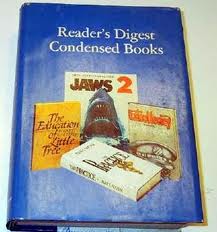
Reader’s Digest Condensed Books: ‘as difficult to dispose of as bins of radioactive waste’

11 Sunday Mar 2012

Posted by Nathan Hobby in books

≈ 6 Comments

Tags

Big Issue, booksale, Condensed Books

Image

One of the few things my library’s booksale won’t accept is Reader’s Digest Condensed Books. And yet they always turn up at the bottom of boxes amidst more worthy books; or a poor elderly person has lugged them from the other side of the river, and so we receive delivery of whole boxes of them. Fiona-Scott Norman, writing in The Big Issue 402, is perceptive, although typically merciless:

… the pointless horror of Reader’s Digest Condensed Books. Forty-seven years (1950-1997) of ‘simplifying’ bestsellers by cutting out style, passages that didn’t drive the plot and anything faintly racy… It is telling that these nutritionless, ‘uniquitous’ [?] tomes are now light years beyond valueless, and as difficult to dispose of as bins of radioactive waste. you canot sell them, you cannot give them away; op shops do not take them. They do not exude ‘retro chic’. They are soulless junk.

And yet I understand the impulse behind condensed books. I find too many books too long. I wish writers had cut them down, pared them till they are reduced to their essence. Of course, the condensations don’t reflect this, but instead a popular perception that plot is all there is when it comes to novels.

Interestingly, I think Fiona did her research on Wikipedia, but didn’t read carefully enough; from what I gather, Condensed Books continue as Reader’s Digest Select Editions.

← Older posts
Newer posts →

Enter your email address to follow this blog and receive notifications of new posts by email.

Join 287 other subscribers

Nathan on Twitter

My Tweets

Categories

  • academic (9)
  • archives and sources (10)
  • autobiographical (62)
  • biographers (10)
  • biographical method (28)
  • biographical quests (18)
  • biographies (21)
    • political biography (2)
  • biographies of living subjects (2)
  • biographies of writers, artists & musicians (12)
  • biographies of writers, artists and musicians (20)
  • biography as a literary form (9)
  • biography in fiction (2)
  • biography in the news (2)
  • books (236)
    • authors (19)
    • book review (173)
    • reading (23)
  • Covid (2)
  • creative nonfiction (11)
  • daily life (2)
  • Daily Prompt (2)
  • death (21)
  • digital humanities (3)
  • family history (1)
  • fiction (8)
  • film and television biographies (5)
  • film review (48)
  • found objects (3)
  • historical biographies (1)
  • history (20)
  • In the steps of KSP (4)
  • John Curtin (13)
  • Katharine Susannah Prichard (114)
    • Glimpses of KSP (7)
    • My KSP biography (31)
      • deleted scenes (1)
  • Katharine Susannah Prichard's associates and connections (16)
  • Katharine Susannah Prichard's writings (34)
  • libraries (5)
  • life (20)
  • link (23)
  • links (41)
  • lists (28)
  • local history and heritage (1)
  • media (4)
  • memes and urban myths (1)
  • memoirs (10)
  • meta (2)
  • music (18)
  • news (9)
  • news and events (43)
  • obituary (1)
  • Old writing found on a floppy disk (1)
  • poetry (5)
  • politics and current affairs (26)
    • climate change (1)
  • prologues and introductions (2)
  • psychological aspects of biography (3)
  • quotes (22)
  • R.I.P. (10)
  • reading report (3)
  • religion (1)
  • religious biography (1)
  • research (5)
  • role of the biographer within the biography (2)
  • Series: A-Z of Katharine Susannah Prichard (26)
  • Series: Corona Diary (1)
  • Series: Saturday 10am (14)
  • Series: Short Stories (2016) (6)
  • Series: The Tourist (2013) (6)
  • Series: Thursday 3pm feature posts (2009) (35)
  • structure of biographies (3)
  • technology and the digital world (2)
  • television (4)
  • the nature of biography (4)
  • this blog (10)
  • Uncategorized (33)
  • Western Australia (26)
  • writing (41)

Archives

Recent Comments

amphisbaenathoroughly79c20f19aa's avataramphisbaenathoroughl… on John Curtin’s vision…
Nathan Hobby's avatarNathan Hobby on John Curtin’s vision…
karenlee thompson's avatarkarenlee thompson on John Curtin’s vision…
Nathan Hobby's avatarNathan Hobby on John Curtin’s vision…

Bookmarks

  • Adventures in Biography
  • ANZ LitLovers LitBlog
  • Bernice Barry
  • It only goes up to your knees
  • Jane Bryony Rawson
  • Jenn Plays Recorder
  • Katharine Susannah Prichard Writers' Centre
  • Laura Sewell Matter: Essayist and Biographer
  • Mutually said: Poets Vegan Anarchist Pacifist
  • Resident Judge
  • Speaking Thylacine
  • The Australian Legend
  • Timothy Parkin Poetry
  • Treefall Writing – Melinda Tognini
  • Whispering Gums
  • Wrapped up in books: the home of Guy Salvidge

Top Posts

  • Paul Auster's Moon Palace : an overview
  • The Joy of Knowledge Encyclopedia
  • The 28th, 29th, and 30th prime ministers: a memoir
  • Comic-book biography?
  • The untold story of Critchley Parker Sr

Blog Stats

  • 235,207 hits

Tag Cloud

9/11 19th century 33 1920s 1921 1930s 1950s 1970s 1971 1981 2000s 2004 2011 2015 2017 20000 Days on Earth A.S. Byatt Aboriginals activism Adam Begley Adrian Mole adultery afterlife Agatha Christie Alan Hollinghurst Alberto Manguel Alfred Deakin Amazing Grace Americana Amy Grant An American Romance Andre Tchaikowsky Andrew McGahan angela myers anne fadiman Anne Rice Arabian Nights archives art arts funding A Serious Man Ash Wednesday ASIO atheism Atonement Australia Australian film Australian literature Australian Short Story Festival autism autobiography autodidact Barbara Vine beach Belle Costa da Greene Bell Jar best best-of Bible Big Issue Bill Callahan biographical ethics biographical quest genre biographies birthday birthdays Black Opal Bleak House Blinky Bill blogging blogs Blue Blades Bodega's Bunch bog Booker book launch booksale Borges Brenda Niall Brian Matthews Brian McLaren Britney Spears Burial Rites Burke and Wills buskers C.S. Lewis C.S. Lewis canon capitalism Carol Shields Carson McCullers Catcher in the Rye Catholicism celebrities Charles Dickens Charlie Kaufman childhood Child of the Hurricane children's books Choir of Gravediggers Christianity Christian writing Christina Stead Christmas Christopher Beha Cinque Terra Claire Tomalin classics cliches climate change Coen brothers coincidence Collie Collyer coming of age Communism concert Condensed Books consumerism Coonardoo Cormac McCarthy Corrections cosy fiction Dara Horn David Copperfield David Ireland David Marr David Suchet death Death of a president definition demolition Dennis LeHane dentist diaries divorce doctorow Doctor Who documentaries donald shriver Don DeLillo Don DeLillo Donna Mazza Donna Tartt Don Watson Dostovesky doubt drama dreams of revolution Drusilla Modjeska E.M. Forster ebooks editing Eichmann Eisenstein Elizabeth Kostova email empathy ensmallification existentialism faith Falling Man fame families fantasy fiction film and television folk football Frank Barscombe Fremantle Press G.K. Chesterton Gabrielle Carey Gallipoli genealogical fiction Genesis Geoff Nicholson George W. Bush Gerald Glaskin Gilead Golden Miles Goldfields Trilogy Graham Greene grandad great novels Greenmount Guinness World Records Guy Salvidge Hannah Arendt Hannah Kent Hans Koning Hans Koningsberger Harper Lee Haxby's Circus Hazel Rowley He-Man headers heaven Heidegger hell Henrietta Lacks Henry Morton Stanley Herman Hesse heroes Hey Dad! historical fiction history Holden Caulfield holidays Homer & Langley Home Song Stories House of Cards House of Zealots house of zealots Hugo Throssell humour Ian McEwan In between the sheets Indonesia Infamous Inside Llewyn Davis interstellar interview Intimate Strangers Invisible Ireland ISBNs Ishiguro itunes J.D. Salinger J.M. Coetzee J.S. Battye Janet Malcolm Jennifer Egan JFK JFK assassination Joanna Rakoff Joel Schumacher John Burbidge John Fowles John Howard John Kinsella John Updike John Updike Jonathan Franzen journal writing JSB Judgment Day Julia Baird Julian Barnes Kafka Kalgoorlie Kate Grenville Katherine Mansfield Kevin Brockmeier King's Park KSP Writers' Centre language last ride Laurie Steed Left Behind Leonard Cohen Leo Tolstoy Libra Library of Babel Library of Babel Lila Lily and Madeleine links Lionel Shriver lionel shriver lists literary fiction literature Lleyton Hewitt lost book Louisa Louisa Lawson Louis Esson louis nowra love letter Lubbock Lytton Strachey Madelaine Dickie Man Booker man in the dark Margaret Atwood Margaret River Press Marilynne Robinson mark sandman meaning of life Melbourne Mel Hall meme memorialisation memory MH17 Michael Faber Mike Riddell Miles Franklin mining boom missionaries moleskine Moon Palace morphine Mother Teresa movies Music of Chance My Brilliant Career names Napoleon Narnia narrative Narrow Road to the Deep North Narziss and Goldmund Natalie Portman Nathaniel Hobbie national anthem Nick Cave Nina Bawden non-fiction nonfiction noughties novelists novels obituaries obscurity On Chesil Beach Parade's End Paris Hilton Passion of the Christ past patriotism Paul Auster Paul de Man Perth Perth Writers Festival Peter Ackroyd Peter Cowan Writers Centre phd Philip K. Dick Philip Seymour Hoffman pierpontmorgan poetry slam politics popular fiction popular science Possession postapocalyptic postmodernism Pride prophetic imagination publications Pulp Purity Queen Victoria Rabbit Angstrom radio Radio National Randolph Stow rating: 5/10 rating: 6/10 rating: 7/10 rating: 8/10 rating: 9/10 rating: 10/10 ratings reading fiction autobiographically reading report Rebecca Skloot recap red wine reincarnation juvenile fiction rejection review - music reviewing rewriting Richard Flanagan Richard Ford Rick Moody Roaring Nineties Robert Banks Robert Hughes Robert Silverberg Robert Wadlow Robinson Crusoe Rolf Harris romance Rome ruins Russell Crowe Ruth Rendell Sarah Murgatroyd scalpers science fiction Science of Sleep secondhand books Secret River sermon illustration sex short stories Silent Woman Simone Lazaroo Simpsons Siri Hustvedt slavery Smashing Pumpkins social interactions social justice some people i hate sources South Australia souvenirs speculation speech speeches sport status anxiety Stephen Lawhead Stranger's Child subtitles Subtle Flame Sue Townsend suicide Surprised By Hope Suzanne Falkiner Sylvia Plath Synecdoche TAG Hungerford Award tapes teabags Ted Hughes The Children Act The Cure The Fur The Imitation Game theology The Pioneers The Revolutionary Thomas Disch Thomas Hardy Thomas Henry Prichard Thomas Mann thriller time Tim La Haye Tim Winton Tolstoy Tom Wright top 10 Towering Inferno Tracy Ryan Trove Truman Capote tshirts TS Spivet Twelve Years a Slave underrated writers Underworld unwritten biographies urban myth USA vampires Venice Victoria Cross Victoriana Victorian era Victorianism Victoria Park video Voltron w Wake in Fright Walkabout Walter M. Miller war War and Peace war on terror Water Diviner Wellington St Bus Station Westerly Western Australia West Wing What Happened to Sophie Wilder? Whitlams wikipedia Wild Oats of Hans William Wilberforce Winston Churchill Witches of Eastwick Working Bullocks workshop World War One writers writing Writing NSW youth Zadie Smith Zeitgeist Zelig

Enter your email address to follow this blog and receive notifications of new posts by email.

Join 287 other subscribers

Pages

  • About
  • My novel: The Fur
  • The Red Witch: A Biography of Katharine Susannah Prichard

Categories

  • academic (9)
  • archives and sources (10)
  • autobiographical (62)
  • biographers (10)
  • biographical method (28)
  • biographical quests (18)
  • biographies (21)
    • political biography (2)
  • biographies of living subjects (2)
  • biographies of writers, artists & musicians (12)
  • biographies of writers, artists and musicians (20)
  • biography as a literary form (9)
  • biography in fiction (2)
  • biography in the news (2)
  • books (236)
    • authors (19)
    • book review (173)
    • reading (23)
  • Covid (2)
  • creative nonfiction (11)
  • daily life (2)
  • Daily Prompt (2)
  • death (21)
  • digital humanities (3)
  • family history (1)
  • fiction (8)
  • film and television biographies (5)
  • film review (48)
  • found objects (3)
  • historical biographies (1)
  • history (20)
  • In the steps of KSP (4)
  • John Curtin (13)
  • Katharine Susannah Prichard (114)
    • Glimpses of KSP (7)
    • My KSP biography (31)
      • deleted scenes (1)
  • Katharine Susannah Prichard's associates and connections (16)
  • Katharine Susannah Prichard's writings (34)
  • libraries (5)
  • life (20)
  • link (23)
  • links (41)
  • lists (28)
  • local history and heritage (1)
  • media (4)
  • memes and urban myths (1)
  • memoirs (10)
  • meta (2)
  • music (18)
  • news (9)
  • news and events (43)
  • obituary (1)
  • Old writing found on a floppy disk (1)
  • poetry (5)
  • politics and current affairs (26)
    • climate change (1)
  • prologues and introductions (2)
  • psychological aspects of biography (3)
  • quotes (22)
  • R.I.P. (10)
  • reading report (3)
  • religion (1)
  • religious biography (1)
  • research (5)
  • role of the biographer within the biography (2)
  • Series: A-Z of Katharine Susannah Prichard (26)
  • Series: Corona Diary (1)
  • Series: Saturday 10am (14)
  • Series: Short Stories (2016) (6)
  • Series: The Tourist (2013) (6)
  • Series: Thursday 3pm feature posts (2009) (35)
  • structure of biographies (3)
  • technology and the digital world (2)
  • television (4)
  • the nature of biography (4)
  • this blog (10)
  • Uncategorized (33)
  • Western Australia (26)
  • writing (41)

Archives

Recent Comments

amphisbaenathoroughly79c20f19aa's avataramphisbaenathoroughl… on John Curtin’s vision…
Nathan Hobby's avatarNathan Hobby on John Curtin’s vision…
karenlee thompson's avatarkarenlee thompson on John Curtin’s vision…
Nathan Hobby's avatarNathan Hobby on John Curtin’s vision…

Bookmarks

  • Adventures in Biography
  • ANZ LitLovers LitBlog
  • Bernice Barry
  • It only goes up to your knees
  • Jane Bryony Rawson
  • Jenn Plays Recorder
  • Katharine Susannah Prichard Writers' Centre
  • Laura Sewell Matter: Essayist and Biographer
  • Mutually said: Poets Vegan Anarchist Pacifist
  • Resident Judge
  • Speaking Thylacine
  • The Australian Legend
  • Timothy Parkin Poetry
  • Treefall Writing – Melinda Tognini
  • Whispering Gums
  • Wrapped up in books: the home of Guy Salvidge

Top Posts

  • Paul Auster's Moon Palace : an overview
  • The Joy of Knowledge Encyclopedia
  • The 28th, 29th, and 30th prime ministers: a memoir
  • Comic-book biography?
  • The untold story of Critchley Parker Sr

Blog Stats

  • 235,207 hits

Tag Cloud

9/11 19th century 33 1920s 1921 1930s 1950s 1970s 1971 1981 2000s 2004 2011 2015 2017 20000 Days on Earth A.S. Byatt Aboriginals activism Adam Begley Adrian Mole adultery afterlife Agatha Christie Alan Hollinghurst Alberto Manguel Alfred Deakin Amazing Grace Americana Amy Grant An American Romance Andre Tchaikowsky Andrew McGahan angela myers anne fadiman Anne Rice Arabian Nights archives art arts funding A Serious Man Ash Wednesday ASIO atheism Atonement Australia Australian film Australian literature Australian Short Story Festival autism autobiography autodidact Barbara Vine beach Belle Costa da Greene Bell Jar best best-of Bible Big Issue Bill Callahan biographical ethics biographical quest genre biographies birthday birthdays Black Opal Bleak House Blinky Bill blogging blogs Blue Blades Bodega's Bunch bog Booker book launch booksale Borges Brenda Niall Brian Matthews Brian McLaren Britney Spears Burial Rites Burke and Wills buskers C.S. Lewis C.S. Lewis canon capitalism Carol Shields Carson McCullers Catcher in the Rye Catholicism celebrities Charles Dickens Charlie Kaufman childhood Child of the Hurricane children's books Choir of Gravediggers Christianity Christian writing Christina Stead Christmas Christopher Beha Cinque Terra Claire Tomalin classics cliches climate change Coen brothers coincidence Collie Collyer coming of age Communism concert Condensed Books consumerism Coonardoo Cormac McCarthy Corrections cosy fiction Dara Horn David Copperfield David Ireland David Marr David Suchet death Death of a president definition demolition Dennis LeHane dentist diaries divorce doctorow Doctor Who documentaries donald shriver Don DeLillo Don DeLillo Donna Mazza Donna Tartt Don Watson Dostovesky doubt drama dreams of revolution Drusilla Modjeska E.M. Forster ebooks editing Eichmann Eisenstein Elizabeth Kostova email empathy ensmallification existentialism faith Falling Man fame families fantasy fiction film and television folk football Frank Barscombe Fremantle Press G.K. Chesterton Gabrielle Carey Gallipoli genealogical fiction Genesis Geoff Nicholson George W. Bush Gerald Glaskin Gilead Golden Miles Goldfields Trilogy Graham Greene grandad great novels Greenmount Guinness World Records Guy Salvidge Hannah Arendt Hannah Kent Hans Koning Hans Koningsberger Harper Lee Haxby's Circus Hazel Rowley He-Man headers heaven Heidegger hell Henrietta Lacks Henry Morton Stanley Herman Hesse heroes Hey Dad! historical fiction history Holden Caulfield holidays Homer & Langley Home Song Stories House of Cards House of Zealots house of zealots Hugo Throssell humour Ian McEwan In between the sheets Indonesia Infamous Inside Llewyn Davis interstellar interview Intimate Strangers Invisible Ireland ISBNs Ishiguro itunes J.D. Salinger J.M. Coetzee J.S. Battye Janet Malcolm Jennifer Egan JFK JFK assassination Joanna Rakoff Joel Schumacher John Burbidge John Fowles John Howard John Kinsella John Updike John Updike Jonathan Franzen journal writing JSB Judgment Day Julia Baird Julian Barnes Kafka Kalgoorlie Kate Grenville Katherine Mansfield Kevin Brockmeier King's Park KSP Writers' Centre language last ride Laurie Steed Left Behind Leonard Cohen Leo Tolstoy Libra Library of Babel Library of Babel Lila Lily and Madeleine links Lionel Shriver lionel shriver lists literary fiction literature Lleyton Hewitt lost book Louisa Louisa Lawson Louis Esson louis nowra love letter Lubbock Lytton Strachey Madelaine Dickie Man Booker man in the dark Margaret Atwood Margaret River Press Marilynne Robinson mark sandman meaning of life Melbourne Mel Hall meme memorialisation memory MH17 Michael Faber Mike Riddell Miles Franklin mining boom missionaries moleskine Moon Palace morphine Mother Teresa movies Music of Chance My Brilliant Career names Napoleon Narnia narrative Narrow Road to the Deep North Narziss and Goldmund Natalie Portman Nathaniel Hobbie national anthem Nick Cave Nina Bawden non-fiction nonfiction noughties novelists novels obituaries obscurity On Chesil Beach Parade's End Paris Hilton Passion of the Christ past patriotism Paul Auster Paul de Man Perth Perth Writers Festival Peter Ackroyd Peter Cowan Writers Centre phd Philip K. Dick Philip Seymour Hoffman pierpontmorgan poetry slam politics popular fiction popular science Possession postapocalyptic postmodernism Pride prophetic imagination publications Pulp Purity Queen Victoria Rabbit Angstrom radio Radio National Randolph Stow rating: 5/10 rating: 6/10 rating: 7/10 rating: 8/10 rating: 9/10 rating: 10/10 ratings reading fiction autobiographically reading report Rebecca Skloot recap red wine reincarnation juvenile fiction rejection review - music reviewing rewriting Richard Flanagan Richard Ford Rick Moody Roaring Nineties Robert Banks Robert Hughes Robert Silverberg Robert Wadlow Robinson Crusoe Rolf Harris romance Rome ruins Russell Crowe Ruth Rendell Sarah Murgatroyd scalpers science fiction Science of Sleep secondhand books Secret River sermon illustration sex short stories Silent Woman Simone Lazaroo Simpsons Siri Hustvedt slavery Smashing Pumpkins social interactions social justice some people i hate sources South Australia souvenirs speculation speech speeches sport status anxiety Stephen Lawhead Stranger's Child subtitles Subtle Flame Sue Townsend suicide Surprised By Hope Suzanne Falkiner Sylvia Plath Synecdoche TAG Hungerford Award tapes teabags Ted Hughes The Children Act The Cure The Fur The Imitation Game theology The Pioneers The Revolutionary Thomas Disch Thomas Hardy Thomas Henry Prichard Thomas Mann thriller time Tim La Haye Tim Winton Tolstoy Tom Wright top 10 Towering Inferno Tracy Ryan Trove Truman Capote tshirts TS Spivet Twelve Years a Slave underrated writers Underworld unwritten biographies urban myth USA vampires Venice Victoria Cross Victoriana Victorian era Victorianism Victoria Park video Voltron w Wake in Fright Walkabout Walter M. Miller war War and Peace war on terror Water Diviner Wellington St Bus Station Westerly Western Australia West Wing What Happened to Sophie Wilder? Whitlams wikipedia Wild Oats of Hans William Wilberforce Winston Churchill Witches of Eastwick Working Bullocks workshop World War One writers writing Writing NSW youth Zadie Smith Zeitgeist Zelig

Blog at WordPress.com.

  • Subscribe Subscribed
    • Nathan Hobby, a biographer in Perth
    • Join 287 other subscribers
    • Already have a WordPress.com account? Log in now.
    • Nathan Hobby, a biographer in Perth
    • Subscribe Subscribed
    • Sign up
    • Log in
    • Report this content
    • View site in Reader
    • Manage subscriptions
    • Collapse this bar
 

Loading Comments...