• About
  • The Red Witch: A Biography of Katharine Susannah Prichard
  • My novel: The Fur

Nathan Hobby, a biographer in Perth

~ The lives of John Curtin & Katharine Susannah Prichard, the art of biography, and other things

Nathan Hobby, a biographer in Perth

Author Archives: Nathan Hobby

Stella #2: Miles’ trips to the dentists

21 Friday Feb 2014

Posted by Nathan Hobby in daily life, reading report

≈ Leave a comment

Tags

dentist, Miles Franklin

Miles Franklin evidently had very bad teeth. Trips to the dentist punctuate her biography. Perhaps I’ve reached the final one, though, because – now in her early forties – she’s just had all the teeth taken out and received false teeth. (The horror of having all of one’s teeth pulled filled me up, reading that last night before bed.)

The question for the biographer: how much to tell about trips to the dentists? In Miles’ case, the biographer is working off extensive, daily diaries, and I’m sure they are full of Miles’ dental agony, of which we are only fed the smallest amount. I wonder, though, if it falls in the category of worth mentioning early on, along with a brief sketch of dental conditions in Federation Australia (and why teeth might be such an obsession), and then not mentioning again until she gets them pulled out?

It is part of the dilemma of conveying a sense of someone’s life – what’s the balance between the everyday and the dramatic?

Lionel Shriver on Literature and Religion

20 Thursday Feb 2014

Posted by Nathan Hobby in Uncategorized

≈ Leave a comment

Tags

atheism, Christianity, Lionel Shriver, Perth Writers Festival, speeches

Tonight I attended the Perth Writers Festival opening address from novelist Lionel Shriver on Literature and Religion. I have long wanted to hear more about Shriver’s thoughts on religion, knowing that she is an atheist with a father who is a prominent theologian.

I had imagined she had at least had a period of belief in her childhood and youth only to reject it; but by her own account, she never believed. She began questioning Christianity by the age of eight and at thirteen had to be pulled (by her hair, she adds) to church.

For her, religious belief is incomprehensible, and that has why she has almost never written about it. (Her one sympathetic religious character, the elderly Gabriel in So Much For All That, loses his faith in God over the course of the novel.) While I feel atheism makes far more sense to me than to most people of faith (as in, I get why people are atheists), her lack of any belief in the possibility of God ever is a little incomprehensible to me, especially when she was brought up in a home steeped with God-talk.

She remarked at one point that religion takes away the ambiguity of the world, the mystery of existence, which is one of the pleasures of life. Of course, faith should have its own mystery and ambiguity. And her atheism could be seen to lack these qualities.

Shriver disproves a theory I’ve harboured in my mind: that it’s unintelligent fundamentalism which produces atheist children; her parents are both intelligent, engaged people, with, she says, high IQs. The moderate Presbyterian faith they brought her up in was not a fundamentalist one.

I was unsurprised by Shriver’s stridency against religion. Her writing is always strident, always serious (even when it’s trying not to be), and often didactic. She was all these things tonight. She also lived up to the strengths of her fiction – insightful and even generous as she spoke of the common ground she has defined between the way her father has lived his life and the way she’s lived hers.

KSP’s The Wild Oats of Han

16 Sunday Feb 2014

Posted by Nathan Hobby in book review, Katharine Susannah Prichard, Katharine Susannah Prichard's writings

≈ 3 Comments

Tags

Australian literature, childhood, children's books, Wild Oats of Hans

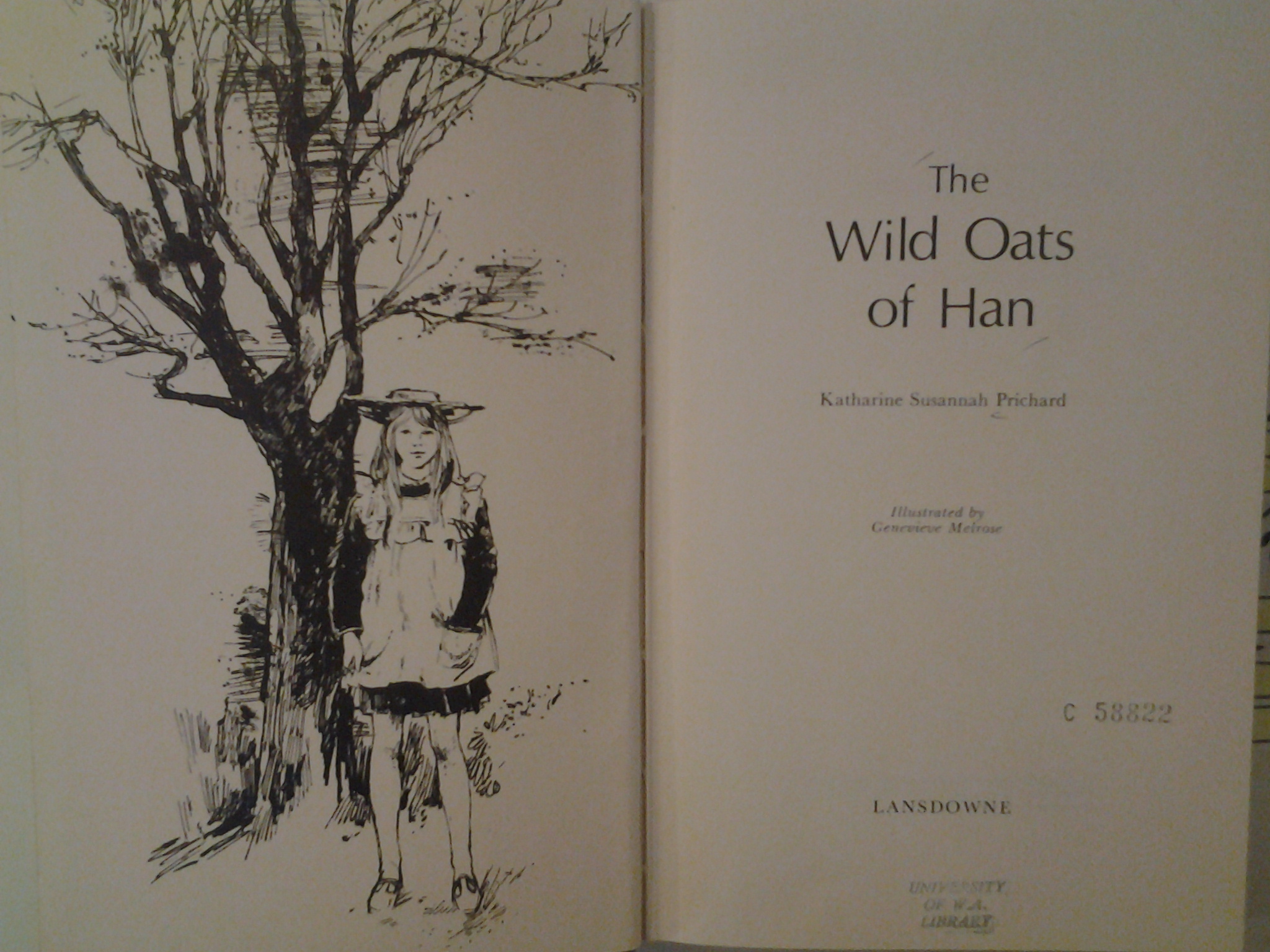
20140216_181840

I’m trying to read the fiction of Katharine Susannah Prichard at least roughly in order, but of course that’s never as straightforward as it sounds. The Wild Oats of Han wasn’t published until 1928, but it was actually written in 1908, meaning that perhaps I should have it read it first; I’m reading it second.

Its genre is complicated, too. It’s presented as a children’s novel, but (my 1968 edition at least) is introduced with a note from KSP saying it ‘is truly, really story’, an idiosyncratic way to say it really happened. It is perhaps a memoir of childhood written in the form of fiction. Regardless, it is beautiful.

In this book, KSP’s prose is lyrical and captures the mind of a child incredibly well. Han is a dreamy, rebellious girl, a fascinating character, a girl who ‘scarcely knew the world of the real from the world of the unreal: both were blended in the crystal of her mind.’ (16) A mentor figure, Sam the woodcutter, tells her that ‘wild oats is a crop most people sow when they live like children’. (56) (The meaning has surely narrowed over the years.) Han determinedly sows her oats, skipping school to glory in the beauty of the bush; enchanted by the circus; battling her nemesis, Miss Whittler; in love with the family and friends around her. It is episodic, each short chapter almost self-contained, with only a loose progression of the overall narrative. Things change in the last few chapters, as the circumstances of her parents (absent characters for most of the novel) impede on her idyllic life, and she must go ‘down into the great mysterious world they had talked so much of, to take her part in the joy and the labour and the sorrow of it.’ (160)

Jack Beasley comments that the novel ‘is more a story about children for adults, than for children themselves’ (A Gallop of Fire, 31), and I agree with him. Its achievement lies in its evocation of the enchanted world of a child’s mind, which is not necessarily something a child can appreciate – only adults in retrospect; it reminds me in this respect of Randolph Stow’s Merry Go Round in the Sea. Early in Wild Oats, Han comes across a cave which amazes her:

Han went to school the next day. But the smell of the hills was in her nose: it was like a taste in her mouth. Memory of the cave haunted her. She had a mind-picture of the great underground room, so vast and deep that, leaning over the edge, she could not see how far it went, only the bones glimmering on the floor in the darkness. (31)

A children’s novel would require that there really be a human skeleton to discover at the bottom of the cave, or at least that some great adventure occur there. Yet Wild Oats evokes the gap between our childhood expectations of adventure gained from stories, and the reality that adventure is more a state of mind.

Eyesore, I saw: memories of the Wellington St Bus Station

14 Friday Feb 2014

Posted by Nathan Hobby in autobiographical, Western Australia

≈ 6 Comments

Tags

demolition, Perth, Wellington St Bus Station

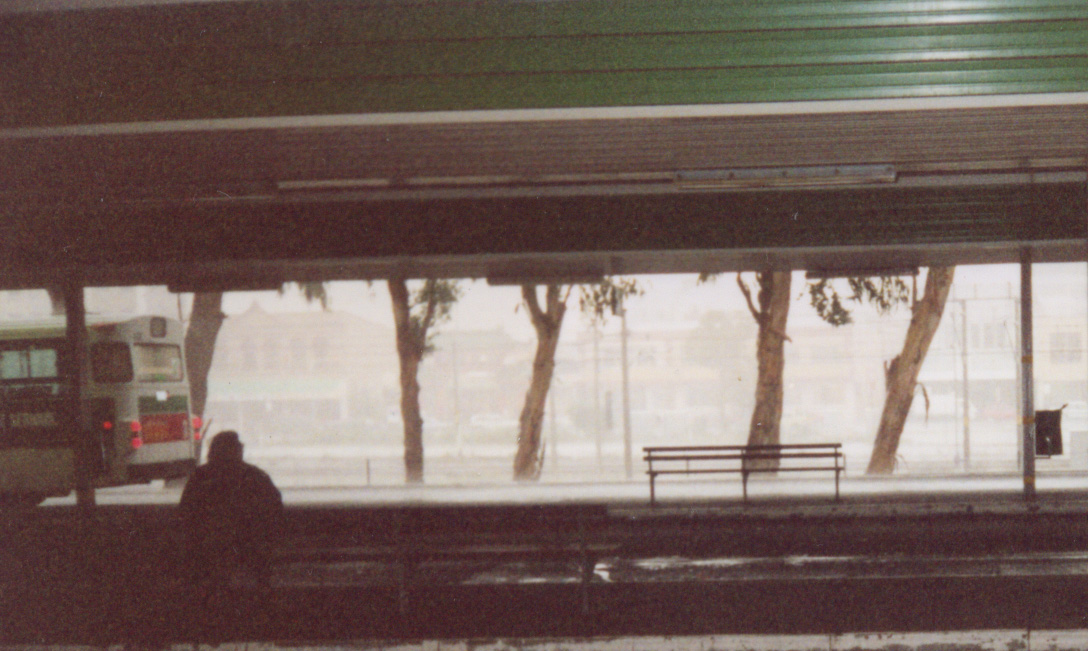
WellingtonStBusStation2001

They began demolishing the Wellington St Bus Station yesterday. I might be the only person sad about this, and in my case, it’s all for sentimental reasons. I’ve spent a lot of time at that bus station since I moved to Perth as an eighteen year old in 1999. It has been an ugly, dingy thing of concrete and tin all that time.

For the first time in ages, I caught a bus into the city a few Saturdays ago, forgot to get off at my stop, and ended up at the station. I didn’t even realise it was its final day, but it was an appropriate co-incidence. The kiosk I worked at for four years was shut up. The place was deserted. I walked through, and tried to breathe it all in for a last time.

The station was opened in 1973, a year which has seemed pivotal to me. The year the fur hit Western Australia in my novel, the year my favourite poet W.H. Auden died, the year my ex-girlfriend was born, the year Peter Parker’s girlfriend, Gwen Stacy died in the Amazing Spider-Man.

I worked in that little kiosk within the station every Saturday (except the week of Christmas) from 1999 to 2003. History will not remember it. It was a nondescript place, inexplicably named “R&J Gourmet Deli”, even though the owner’s name was Anne, and it sold nothing more gourmet than a ham and salad roll alongside every standard variety of cool drink and chocolate bar.

The photo above is taken from the counter. I’m glad I wrote on the back. ‘Sat 18/6/01 This morning at work it just started pouring. It was delicious, all that wet.’ That would have been a few weeks after my Ian Pop’s funeral, the first time I’d lost anyone.

I went through the gamut of emotions, cooped up in the kiosk all day each Saturday. It helped pit me against the world, working as everyone else seemed to be at leisure. I felt, in turn, depression and fascination with the world I observed.

It was the characters I remember most strongly. Victor was an elderly Burmese man, who wore an old suit and would come to buy a cup of tea each day. He was usually on his way to sit in a park or the cathedral and meditate on the teachings of Buddha and Jesus. He would take my hand and offer me his blessing, often repeating his favourite saying – ‘Better a day spent in virtue and meditation than a lifetime in vice.’ On my shelf I still have a little book he gave me one day of the sayings of Buddha.

There was another guy, I can’t remember his name, who was a relentlessly optimistic small time crook. He loved to show off to me, but in a rather unassuming way. He was a short guy, with a lot of swagger, a lot of friendliness, and an American baseball jacket. One day he declared he had a new girlfriend; she was fifteen, he proudly told me. The next week he said they were trying to get pregnant. I asked him if that was a good idea.

And then there was Gerry, the self-declared ‘world’s happiest bus driver’. He’d been a car dealer, lost the lot in the recession in the nineties, and blamed Keating, who he hated daily. But his therapist had helped him recover, and now he went around loudly driving buses, being very deliberately happy.

I would listen to Radio National and write poems on pie bags. I would breathe in the fumes, and get over two break-ups in those four years. I’d eat too much chocolate, and go from being a skinny kid to overweight. I knew exactly what I wanted in those years, everything was so very clear.

Sheila Chisholm

10 Monday Feb 2014

Posted by Nathan Hobby in Katharine Susannah Prichard, links

≈ Leave a comment

The fascinating Strange Flowers blog reviews the new biography Sheila by Robert Wainwright (Allen and Unwin, 2014). She was an Australian who became a high society figure between the wars in Britain, after marrying a lord who was recovering from war wounds in a hospital bed next to her brother. The parallels to Katharine Susannah Prichard are interesting – another Australian of a similar age (and the same year of death) who met a husband in the hospitals of the Great War. Despite the glitz around Sheila, perhaps KSP’s life was more interesting; another review complains:

Overall, I found the book rather superficial, a list of fabulous social events and prominent people. I was interested, but wanted more depth, but I suspect there just weren’t enough sources available.

Beyond, in this case, a potential lack of depth in the subject herself, lack of sources is surely the thing which defeats or at least hinders many biographies.

Echoes of Genesis: Katharine Susannah Prichard’s The Pioneers

06 Thursday Feb 2014

Posted by Nathan Hobby in book review, Katharine Susannah Prichard, Katharine Susannah Prichard's writings

≈ 4 Comments

Tags

Australian literature, Genesis, The Pioneers, Thomas Hardy

In some ways KSP’s first published novel, The Pioneers (1915), resembles the Book of Genesis. It begins with a couple – Donald and Mary Cameron (initially ‘the woman’) – coming to the end of an arduous journey and establishing a homestead in the bush, a homestead which is the foundation for what will become a town over the course of the novel. They are not so much Adam and Eve as Abraham and Sarah – the ambitious, inflexible patriarch and his resourceful wife working cunningly yet virtuously behind the scenes, including when it comes to matching their only son with a wife. A cleansing fire strikes the town early on, perhaps echoing the flood in Genesis. The characters feel, to an extent, archetypal.

Yet we shouldn’t push the comparison too far – I doubt it’s a conscious framework for KSP, and the novel resembles the work of Thomas Hardy as much as anything else, with the familiar plot of a struggle between suitors for the hand of the village’s most beautiful young woman, Deirdre, the novel’s second heroine. Furthermore, the novel changes tone, and the long middle is an involved, heavily plotted cattle-muster caper, not resembling Genesis at all. It is only in the final chapters, as Deirdre, resolves the long tussle between three suitors, that the novel recaptures the poignancy of its beginning. Mary’s final words in the novel reveal its vision:

“Oh God,” she whispered breathlessly, “we broke the earth, we sowed the seed. Let theirs be the harvest – the joy of life and the fullness thereof.” (316)

For a writer who was to be known for her sympathetic engagement with Aborigines, it is interesting to note that this early novel shows no evidence of what is to come. The minor Aboriginal character who accompanies the stockmen is not given a name, referred to instead as ‘the black boy.’

KSP was also to become a Communist; there is a degree of class consciousness in this novel, but only a degree. It centres mainly on the injustice of prejudice against former convicts, one of whom, the Schoolmaster, is an educated Irishman imprisoned for political reasons. In the epilogue, set fifteen years later, Dan, grandson of Mary, remembers her charge to him as he visits her grave:

“Then she told me about prisons here in the early days, mother, and terrible stories of how people lived in the old country. ‘They may talk about your birthstain by and by, Dan,’ she said, ‘but that will not trouble you, because it was not this country made the stain. This country has been the redeemer and blotted out all those old stains.'” (320)

It is an interesting, fast-moving story, still remarkably readable today, 99 years later, even if it feels a little sentimental and melodramatic. KSP’s prose is beautiful in places, and you can sense her determinedly evoking an Australia of a couple of generations earlier.

The book has been reprinted in recent years, but can also be found as an ebook through Project Gutenberg. I read it in PDF format on my tablet, so that the typesetting was exactly the same as the first edition, and even the pages were appropriately yellowed.

Biography in forty-five minutes: “The Mystery of Agatha Christie with David Suchet”

05 Wednesday Feb 2014

Posted by Nathan Hobby in biographical quests, film and television biographies

≈ 2 Comments

Tags

Agatha Christie, David Suchet, documentaries

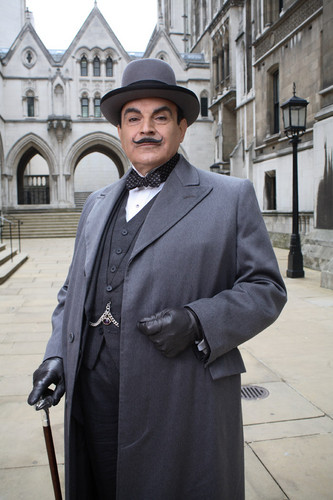
poirot

In this 45 minute television documentary, actor David Suchet recounts the life of the author who created the detective (Poirot) who made him famous – Agatha Christie. It’s structured as a biographical quest, although there isn’t actually that much mystery around Christie beyond her famous disappearance in 1930, and unlike biographical quest fiction, there are no real discoveries or breakthroughs made. It is actually just an appropriate and convenient way to look at her life through the eyes of what the academic Jon Thiem might call an ‘epigone’, in the guise (undoubtedly basically true) of Suchet realising he has never really learned the life story of the woman behind his character.

There is only so much you can do in trying to convey an entire life in 45 minutes, and this documentary succeeds admirably, while showing clearly the limits of the form compared to a typical biography, which might be 800 pages long. There is little sense of competing interpretations of her life, despite the fact that Suchet moves between interviewing three different biographers of Christie for different periods of her life. It’s all very democratic, and each of them is interesting in their own way, but they surely have quite different understandings of their subject, and yet they’re stitched together as if they offer one seamless account.

In any biography, it is important to give some sense of the time and place, and documentary as a form offers the chance to use stock footage and the music of an era as a audiovisual shortcut, evoking viewers’ pre-existing understanding of the period. It’s done beautifully and skilfully in this example. It takes the place of the biographer’s challenge of giving a cultural and historical context in words, the balance between too much information and not enough; the trick of guessing just what knowledge one can assume on the reader’s part.

It seems to me the structure of the documentary is shaped a lot by who they could track down to interview about a particular time in the author’s life, and hence a strange detour of an interview with Tom Adams, who painted interesting covers for Christie’s paperbacks for years, only for him to reveal at the end of his segment that he never actually met her. It has an appropriateness, because neither did Suchet, and in a full scale biography, it might belong in some way in a chapter on the reception and presence of the subject in other artists’ lives – yet for a carefully timed documentary, it seems an unusual choice. Why not more time with her grandson, or her late daughter, or even with the archival interviews they have of Christie herself? Perhaps there’s nothing that’s visually interesting enough; every biographer is restricted by their sources, and the documentary biographer by the constraint of making something to watch and listen to.

The death of Philip Seymour Hoffman

03 Monday Feb 2014

Posted by Nathan Hobby in death, film review, R.I.P.

≈ Leave a comment

Tags

death, film and television, Philip Seymour Hoffman

Since I saw that Philip Seymour Hoffman, my favourite actor, was dead on the television news-ticker this morning, my mind has kept hiccuping: PSH is dead! Initially the hiccups were strong and happened every five minutes; by now, they’re less frequent and less violent.

Is it grief I feel when a celebrity I admire dies? Is it a less intense version of what happens when someone I know dies? Or something else entirely, given the ‘relationship’ with the celebrity runs only one way? I don’t know.

*

(Note on the news ticker, saying ‘breaking news’: it was a delayed broadcast from the east, three hours old, and the presenters didn’t even know about it, the news hadn’t hit them yet. This is what happens when WA is three hours behind the east: sometimes a time bubble opens up, and one becomes aware of watching something from the past, different in an important way to the present.)

*

Hoffman was amazing – he appears in so  many of my favourite films, lighting up so many of them. We watch him age in Synecdoche, New York, and it feels like we have followed him through a lifetime. We want him to be innocent in Doubt. We live in fear of him in Punch-Drunk Love. I don’t think it’s going too far to say he was the quintessential face of film in the first thirteen years of the century.


Stella #1: The prologue

01 Saturday Feb 2014

Posted by Nathan Hobby in biographical method, prologues and introductions, reading report

≈ 1 Comment

Tags

Miles Franklin

stella

[First in a series of reading reports, tracing my progress through Jill Roe’s Stella Miles Franklin: A Biography (Pan McMillan, 2008)]

Jill Roe opens her massive biography of Stella Miles Franklin with a simple two page prologue which manages to carry much information lightly. She tells the story of Stella’s mother riding by horse to her own mother’s house to give birth in 1879. In doing so, she maps out the territory of southern NSW which one senses will be essential as the backdrop of Stella’s life. She gives a brief account of Stella’s ancestry by unpacking her name, covering details which could go on for boring pages in a less well crafted biography.

Surely acknowledging the limits of the archives well is a key part of a good biography, and in the prologue the gaps are noted: she took a different route ‘for reasons unknown, possibly to do with the weather’ and ‘it is not recorded whether she was accompanied’. Perhaps these signals can provoke the reader to imagining the scene better and to assuming some responsibility as co-re-creators of the life of the subject as they read.

A resolute woman: Katharine Susannah Prichard in Wild Weeds and Windflowers

28 Tuesday Jan 2014

Posted by Nathan Hobby in book review, Katharine Susannah Prichard

≈ Leave a comment

Executive Councillor

Wild Weeds and Wind Flowers: The Life and Letters of Katharine Susannah Prichard / by Ric Throssell (Angus & Robertson, 1975)

Wild Weeds is a biography of Katharine Susannah Prichard (1883-1969), one of Australia’s most important novelists, but just as much it is a memoir, written with the intimate care and investment of a son who loved his mother deeply. The foreword is valuable as an explanation of intent and of KSP’s troubled relationship to biography. Throssell starts by writing that ‘Katharine persuaded herself to write about her own life in sheer self-defence.’ Throssell’s biography also often feels like a defence against the misreadings and intrusions of literary critics, and against the criticism her life-long communism drew. He writes in the foreword:

I cannot attempt a dispassionate study. I can pretend to no cold, academic impartiality. Mine is a personal picture. I make no literary evaluation of my mother’s work; no assessment of the rights and wrongs of the political beliefs which were an essential part of her writing and her life. That is for others to do, or for the most impartial observer of all: time.

A biography of KSP could run much longer; 250 pages can only sum up some of the significant phases of a long and interesting life. Throssell notes that the early chapters up to the death in 1933 of Hugo Throssell (KSP’s husband and Ric’s father) are derived from KSP’s autobiography. KSP’s childhood was one of moving around from Fiji to Tasmania to Melbourne, following her father’s unstable journalistic career; he was to kill himself in 1907, an event KSP could not speak of, even to her son, until the end of her life. It is difficult to know how much more light Throssell could have shed on a pivotal, unknown moment in his mother’s life.

KSP’s adventurous years as a journalist in London end with her marrying the Victoria Cross winner, Hugo Throssell, in 1919 and moving back to his home state of Western Australia. She was to make it her home, even in the long decades after his death.

John Hamilton’s recent biography of Hugo Throssell add an extra dimension to the years of their marriage, and the tragedy of his suicide in 1933. The child’s eye view Ric Throssell provides of his father’s last days is poignant. The ability of him and his mother to carry on afterwards is remarkable.

Throssell does not return to Western Australia after World War Two, and there is a sense of the pain of that geographical distance between mother and son in much of the rest of the narrative.

Throssell spends more time on KSP’s Goldfields trilogy than any of her other works. This is justifiable simply in terms of the fact that it took up more of her life than any other work. But it is also because Throssell is arguing the trilogy’s significance in the face of the mixed reception it got.

The political aspects of KSP’s life appear mainly late in the book as two discrete chapters reaching back to her early life. KSP’s increasing isolation as one of the few faithful Communists seems tied to the disappointments in the reception of her later work. If I read correctly, there is a sense in the 1950s and 1960s of her and her work being ‘out of fashion’. It is painful to read of the aging woman stung by misunderstandings and attacks on her work by the first generation of research students writing on her. The first clearly hurt the most – she had helped him with both his research and his writing only to be subjected to a speculative Freudian reading about her father.

KSP emerges in this book as a resolute, generous woman, an artist and a believer right up to the end. She lived a worthy and inspirational life and Wild Weeds and Windflowers is a valuable portrait, unique for being written by someone who knew her so intimately.

← Older posts
Newer posts →

Enter your email address to follow this blog and receive notifications of new posts by email.

Join 287 other subscribers

Nathan on Twitter

My Tweets

Categories

  • academic (9)
  • archives and sources (10)
  • autobiographical (62)
  • biographers (10)
  • biographical method (28)
  • biographical quests (18)
  • biographies (21)
    • political biography (2)
  • biographies of living subjects (2)
  • biographies of writers, artists & musicians (12)
  • biographies of writers, artists and musicians (20)
  • biography as a literary form (9)
  • biography in fiction (2)
  • biography in the news (2)
  • books (236)
    • authors (19)
    • book review (173)
    • reading (23)
  • Covid (2)
  • creative nonfiction (11)
  • daily life (2)
  • Daily Prompt (2)
  • death (21)
  • digital humanities (3)
  • family history (1)
  • fiction (8)
  • film and television biographies (5)
  • film review (48)
  • found objects (3)
  • historical biographies (1)
  • history (20)
  • In the steps of KSP (4)
  • John Curtin (13)
  • Katharine Susannah Prichard (114)
    • Glimpses of KSP (7)
    • My KSP biography (31)
      • deleted scenes (1)
  • Katharine Susannah Prichard's associates and connections (16)
  • Katharine Susannah Prichard's writings (34)
  • libraries (5)
  • life (20)
  • link (23)
  • links (41)
  • lists (28)
  • local history and heritage (1)
  • media (4)
  • memes and urban myths (1)
  • memoirs (10)
  • meta (2)
  • music (18)
  • news (9)
  • news and events (43)
  • obituary (1)
  • Old writing found on a floppy disk (1)
  • poetry (5)
  • politics and current affairs (26)
    • climate change (1)
  • prologues and introductions (2)
  • psychological aspects of biography (3)
  • quotes (22)
  • R.I.P. (10)
  • reading report (3)
  • religion (1)
  • religious biography (1)
  • research (5)
  • role of the biographer within the biography (2)
  • Series: A-Z of Katharine Susannah Prichard (26)
  • Series: Corona Diary (1)
  • Series: Saturday 10am (14)
  • Series: Short Stories (2016) (6)
  • Series: The Tourist (2013) (6)
  • Series: Thursday 3pm feature posts (2009) (35)
  • structure of biographies (3)
  • technology and the digital world (2)
  • television (4)
  • the nature of biography (4)
  • this blog (10)
  • Uncategorized (33)
  • Western Australia (26)
  • writing (41)

Archives

Recent Comments

amphisbaenathoroughly79c20f19aa's avataramphisbaenathoroughl… on John Curtin’s vision…
Nathan Hobby's avatarNathan Hobby on John Curtin’s vision…
karenlee thompson's avatarkarenlee thompson on John Curtin’s vision…
Nathan Hobby's avatarNathan Hobby on John Curtin’s vision…

Bookmarks

  • Adventures in Biography
  • ANZ LitLovers LitBlog
  • Bernice Barry
  • It only goes up to your knees
  • Jane Bryony Rawson
  • Jenn Plays Recorder
  • Katharine Susannah Prichard Writers' Centre
  • Laura Sewell Matter: Essayist and Biographer
  • Mutually said: Poets Vegan Anarchist Pacifist
  • Resident Judge
  • Speaking Thylacine
  • The Australian Legend
  • Timothy Parkin Poetry
  • Treefall Writing – Melinda Tognini
  • Whispering Gums
  • Wrapped up in books: the home of Guy Salvidge

Top Posts

  • Paul Auster's Moon Palace : an overview
  • The 28th, 29th, and 30th prime ministers: a memoir
  • The Joy of Knowledge Encyclopedia
  • Comic-book biography?
  • The untold story of Critchley Parker Sr

Blog Stats

  • 235,192 hits

Tag Cloud

9/11 19th century 33 1920s 1921 1930s 1950s 1970s 1971 1981 2000s 2004 2011 2015 2017 20000 Days on Earth A.S. Byatt Aboriginals activism Adam Begley Adrian Mole adultery afterlife Agatha Christie Alan Hollinghurst Alberto Manguel Alfred Deakin Amazing Grace Americana Amy Grant An American Romance Andre Tchaikowsky Andrew McGahan angela myers anne fadiman Anne Rice Arabian Nights archives art arts funding A Serious Man Ash Wednesday ASIO atheism Atonement Australia Australian film Australian literature Australian Short Story Festival autism autobiography autodidact Barbara Vine beach Belle Costa da Greene Bell Jar best best-of Bible Big Issue Bill Callahan biographical ethics biographical quest genre biographies birthday birthdays Black Opal Bleak House Blinky Bill blogging blogs Blue Blades Bodega's Bunch bog Booker book launch booksale Borges Brenda Niall Brian Matthews Brian McLaren Britney Spears Burial Rites Burke and Wills buskers C.S. Lewis C.S. Lewis canon capitalism Carol Shields Carson McCullers Catcher in the Rye Catholicism celebrities Charles Dickens Charlie Kaufman childhood Child of the Hurricane children's books Choir of Gravediggers Christianity Christian writing Christina Stead Christmas Christopher Beha Cinque Terra Claire Tomalin classics cliches climate change Coen brothers coincidence Collie Collyer coming of age Communism concert Condensed Books consumerism Coonardoo Cormac McCarthy Corrections cosy fiction Dara Horn David Copperfield David Ireland David Marr David Suchet death Death of a president definition demolition Dennis LeHane dentist diaries divorce doctorow Doctor Who documentaries donald shriver Don DeLillo Don DeLillo Donna Mazza Donna Tartt Don Watson Dostovesky doubt drama dreams of revolution Drusilla Modjeska E.M. Forster ebooks editing Eichmann Eisenstein Elizabeth Kostova email empathy ensmallification existentialism faith Falling Man fame families fantasy fiction film and television folk football Frank Barscombe Fremantle Press G.K. Chesterton Gabrielle Carey Gallipoli genealogical fiction Genesis Geoff Nicholson George W. Bush Gerald Glaskin Gilead Golden Miles Goldfields Trilogy Graham Greene grandad great novels Greenmount Guinness World Records Guy Salvidge Hannah Arendt Hannah Kent Hans Koning Hans Koningsberger Harper Lee Haxby's Circus Hazel Rowley He-Man headers heaven Heidegger hell Henrietta Lacks Henry Morton Stanley Herman Hesse heroes Hey Dad! historical fiction history Holden Caulfield holidays Homer & Langley Home Song Stories House of Cards House of Zealots house of zealots Hugo Throssell humour Ian McEwan In between the sheets Indonesia Infamous Inside Llewyn Davis interstellar interview Intimate Strangers Invisible Ireland ISBNs Ishiguro itunes J.D. Salinger J.M. Coetzee J.S. Battye Janet Malcolm Jennifer Egan JFK JFK assassination Joanna Rakoff Joel Schumacher John Burbidge John Fowles John Howard John Kinsella John Updike John Updike Jonathan Franzen journal writing JSB Judgment Day Julia Baird Julian Barnes Kafka Kalgoorlie Kate Grenville Katherine Mansfield Kevin Brockmeier King's Park KSP Writers' Centre language last ride Laurie Steed Left Behind Leonard Cohen Leo Tolstoy Libra Library of Babel Library of Babel Lila Lily and Madeleine links Lionel Shriver lionel shriver lists literary fiction literature Lleyton Hewitt lost book Louisa Louisa Lawson Louis Esson louis nowra love letter Lubbock Lytton Strachey Madelaine Dickie Man Booker man in the dark Margaret Atwood Margaret River Press Marilynne Robinson mark sandman meaning of life Melbourne Mel Hall meme memorialisation memory MH17 Michael Faber Mike Riddell Miles Franklin mining boom missionaries moleskine Moon Palace morphine Mother Teresa movies Music of Chance My Brilliant Career names Napoleon Narnia narrative Narrow Road to the Deep North Narziss and Goldmund Natalie Portman Nathaniel Hobbie national anthem Nick Cave Nina Bawden non-fiction nonfiction noughties novelists novels obituaries obscurity On Chesil Beach Parade's End Paris Hilton Passion of the Christ past patriotism Paul Auster Paul de Man Perth Perth Writers Festival Peter Ackroyd Peter Cowan Writers Centre phd Philip K. Dick Philip Seymour Hoffman pierpontmorgan poetry slam politics popular fiction popular science Possession postapocalyptic postmodernism Pride prophetic imagination publications Pulp Purity Queen Victoria Rabbit Angstrom radio Radio National Randolph Stow rating: 5/10 rating: 6/10 rating: 7/10 rating: 8/10 rating: 9/10 rating: 10/10 ratings reading fiction autobiographically reading report Rebecca Skloot recap red wine reincarnation juvenile fiction rejection review - music reviewing rewriting Richard Flanagan Richard Ford Rick Moody Roaring Nineties Robert Banks Robert Hughes Robert Silverberg Robert Wadlow Robinson Crusoe Rolf Harris romance Rome ruins Russell Crowe Ruth Rendell Sarah Murgatroyd scalpers science fiction Science of Sleep secondhand books Secret River sermon illustration sex short stories Silent Woman Simone Lazaroo Simpsons Siri Hustvedt slavery Smashing Pumpkins social interactions social justice some people i hate sources South Australia souvenirs speculation speech speeches sport status anxiety Stephen Lawhead Stranger's Child subtitles Subtle Flame Sue Townsend suicide Surprised By Hope Suzanne Falkiner Sylvia Plath Synecdoche TAG Hungerford Award tapes teabags Ted Hughes The Children Act The Cure The Fur The Imitation Game theology The Pioneers The Revolutionary Thomas Disch Thomas Hardy Thomas Henry Prichard Thomas Mann thriller time Tim La Haye Tim Winton Tolstoy Tom Wright top 10 Towering Inferno Tracy Ryan Trove Truman Capote tshirts TS Spivet Twelve Years a Slave underrated writers Underworld unwritten biographies urban myth USA vampires Venice Victoria Cross Victoriana Victorian era Victorianism Victoria Park video Voltron w Wake in Fright Walkabout Walter M. Miller war War and Peace war on terror Water Diviner Wellington St Bus Station Westerly Western Australia West Wing What Happened to Sophie Wilder? Whitlams wikipedia Wild Oats of Hans William Wilberforce Winston Churchill Witches of Eastwick Working Bullocks workshop World War One writers writing Writing NSW youth Zadie Smith Zeitgeist Zelig

Enter your email address to follow this blog and receive notifications of new posts by email.

Join 287 other subscribers

Pages

  • About
  • My novel: The Fur
  • The Red Witch: A Biography of Katharine Susannah Prichard

Categories

  • academic (9)
  • archives and sources (10)
  • autobiographical (62)
  • biographers (10)
  • biographical method (28)
  • biographical quests (18)
  • biographies (21)
    • political biography (2)
  • biographies of living subjects (2)
  • biographies of writers, artists & musicians (12)
  • biographies of writers, artists and musicians (20)
  • biography as a literary form (9)
  • biography in fiction (2)
  • biography in the news (2)
  • books (236)
    • authors (19)
    • book review (173)
    • reading (23)
  • Covid (2)
  • creative nonfiction (11)
  • daily life (2)
  • Daily Prompt (2)
  • death (21)
  • digital humanities (3)
  • family history (1)
  • fiction (8)
  • film and television biographies (5)
  • film review (48)
  • found objects (3)
  • historical biographies (1)
  • history (20)
  • In the steps of KSP (4)
  • John Curtin (13)
  • Katharine Susannah Prichard (114)
    • Glimpses of KSP (7)
    • My KSP biography (31)
      • deleted scenes (1)
  • Katharine Susannah Prichard's associates and connections (16)
  • Katharine Susannah Prichard's writings (34)
  • libraries (5)
  • life (20)
  • link (23)
  • links (41)
  • lists (28)
  • local history and heritage (1)
  • media (4)
  • memes and urban myths (1)
  • memoirs (10)
  • meta (2)
  • music (18)
  • news (9)
  • news and events (43)
  • obituary (1)
  • Old writing found on a floppy disk (1)
  • poetry (5)
  • politics and current affairs (26)
    • climate change (1)
  • prologues and introductions (2)
  • psychological aspects of biography (3)
  • quotes (22)
  • R.I.P. (10)
  • reading report (3)
  • religion (1)
  • religious biography (1)
  • research (5)
  • role of the biographer within the biography (2)
  • Series: A-Z of Katharine Susannah Prichard (26)
  • Series: Corona Diary (1)
  • Series: Saturday 10am (14)
  • Series: Short Stories (2016) (6)
  • Series: The Tourist (2013) (6)
  • Series: Thursday 3pm feature posts (2009) (35)
  • structure of biographies (3)
  • technology and the digital world (2)
  • television (4)
  • the nature of biography (4)
  • this blog (10)
  • Uncategorized (33)
  • Western Australia (26)
  • writing (41)

Archives

Recent Comments

amphisbaenathoroughly79c20f19aa's avataramphisbaenathoroughl… on John Curtin’s vision…
Nathan Hobby's avatarNathan Hobby on John Curtin’s vision…
karenlee thompson's avatarkarenlee thompson on John Curtin’s vision…
Nathan Hobby's avatarNathan Hobby on John Curtin’s vision…

Bookmarks

  • Adventures in Biography
  • ANZ LitLovers LitBlog
  • Bernice Barry
  • It only goes up to your knees
  • Jane Bryony Rawson
  • Jenn Plays Recorder
  • Katharine Susannah Prichard Writers' Centre
  • Laura Sewell Matter: Essayist and Biographer
  • Mutually said: Poets Vegan Anarchist Pacifist
  • Resident Judge
  • Speaking Thylacine
  • The Australian Legend
  • Timothy Parkin Poetry
  • Treefall Writing – Melinda Tognini
  • Whispering Gums
  • Wrapped up in books: the home of Guy Salvidge

Top Posts

  • Paul Auster's Moon Palace : an overview
  • The 28th, 29th, and 30th prime ministers: a memoir
  • The Joy of Knowledge Encyclopedia
  • Comic-book biography?
  • The untold story of Critchley Parker Sr

Blog Stats

  • 235,192 hits

Tag Cloud

9/11 19th century 33 1920s 1921 1930s 1950s 1970s 1971 1981 2000s 2004 2011 2015 2017 20000 Days on Earth A.S. Byatt Aboriginals activism Adam Begley Adrian Mole adultery afterlife Agatha Christie Alan Hollinghurst Alberto Manguel Alfred Deakin Amazing Grace Americana Amy Grant An American Romance Andre Tchaikowsky Andrew McGahan angela myers anne fadiman Anne Rice Arabian Nights archives art arts funding A Serious Man Ash Wednesday ASIO atheism Atonement Australia Australian film Australian literature Australian Short Story Festival autism autobiography autodidact Barbara Vine beach Belle Costa da Greene Bell Jar best best-of Bible Big Issue Bill Callahan biographical ethics biographical quest genre biographies birthday birthdays Black Opal Bleak House Blinky Bill blogging blogs Blue Blades Bodega's Bunch bog Booker book launch booksale Borges Brenda Niall Brian Matthews Brian McLaren Britney Spears Burial Rites Burke and Wills buskers C.S. Lewis C.S. Lewis canon capitalism Carol Shields Carson McCullers Catcher in the Rye Catholicism celebrities Charles Dickens Charlie Kaufman childhood Child of the Hurricane children's books Choir of Gravediggers Christianity Christian writing Christina Stead Christmas Christopher Beha Cinque Terra Claire Tomalin classics cliches climate change Coen brothers coincidence Collie Collyer coming of age Communism concert Condensed Books consumerism Coonardoo Cormac McCarthy Corrections cosy fiction Dara Horn David Copperfield David Ireland David Marr David Suchet death Death of a president definition demolition Dennis LeHane dentist diaries divorce doctorow Doctor Who documentaries donald shriver Don DeLillo Don DeLillo Donna Mazza Donna Tartt Don Watson Dostovesky doubt drama dreams of revolution Drusilla Modjeska E.M. Forster ebooks editing Eichmann Eisenstein Elizabeth Kostova email empathy ensmallification existentialism faith Falling Man fame families fantasy fiction film and television folk football Frank Barscombe Fremantle Press G.K. Chesterton Gabrielle Carey Gallipoli genealogical fiction Genesis Geoff Nicholson George W. Bush Gerald Glaskin Gilead Golden Miles Goldfields Trilogy Graham Greene grandad great novels Greenmount Guinness World Records Guy Salvidge Hannah Arendt Hannah Kent Hans Koning Hans Koningsberger Harper Lee Haxby's Circus Hazel Rowley He-Man headers heaven Heidegger hell Henrietta Lacks Henry Morton Stanley Herman Hesse heroes Hey Dad! historical fiction history Holden Caulfield holidays Homer & Langley Home Song Stories House of Cards House of Zealots house of zealots Hugo Throssell humour Ian McEwan In between the sheets Indonesia Infamous Inside Llewyn Davis interstellar interview Intimate Strangers Invisible Ireland ISBNs Ishiguro itunes J.D. Salinger J.M. Coetzee J.S. Battye Janet Malcolm Jennifer Egan JFK JFK assassination Joanna Rakoff Joel Schumacher John Burbidge John Fowles John Howard John Kinsella John Updike John Updike Jonathan Franzen journal writing JSB Judgment Day Julia Baird Julian Barnes Kafka Kalgoorlie Kate Grenville Katherine Mansfield Kevin Brockmeier King's Park KSP Writers' Centre language last ride Laurie Steed Left Behind Leonard Cohen Leo Tolstoy Libra Library of Babel Library of Babel Lila Lily and Madeleine links Lionel Shriver lionel shriver lists literary fiction literature Lleyton Hewitt lost book Louisa Louisa Lawson Louis Esson louis nowra love letter Lubbock Lytton Strachey Madelaine Dickie Man Booker man in the dark Margaret Atwood Margaret River Press Marilynne Robinson mark sandman meaning of life Melbourne Mel Hall meme memorialisation memory MH17 Michael Faber Mike Riddell Miles Franklin mining boom missionaries moleskine Moon Palace morphine Mother Teresa movies Music of Chance My Brilliant Career names Napoleon Narnia narrative Narrow Road to the Deep North Narziss and Goldmund Natalie Portman Nathaniel Hobbie national anthem Nick Cave Nina Bawden non-fiction nonfiction noughties novelists novels obituaries obscurity On Chesil Beach Parade's End Paris Hilton Passion of the Christ past patriotism Paul Auster Paul de Man Perth Perth Writers Festival Peter Ackroyd Peter Cowan Writers Centre phd Philip K. Dick Philip Seymour Hoffman pierpontmorgan poetry slam politics popular fiction popular science Possession postapocalyptic postmodernism Pride prophetic imagination publications Pulp Purity Queen Victoria Rabbit Angstrom radio Radio National Randolph Stow rating: 5/10 rating: 6/10 rating: 7/10 rating: 8/10 rating: 9/10 rating: 10/10 ratings reading fiction autobiographically reading report Rebecca Skloot recap red wine reincarnation juvenile fiction rejection review - music reviewing rewriting Richard Flanagan Richard Ford Rick Moody Roaring Nineties Robert Banks Robert Hughes Robert Silverberg Robert Wadlow Robinson Crusoe Rolf Harris romance Rome ruins Russell Crowe Ruth Rendell Sarah Murgatroyd scalpers science fiction Science of Sleep secondhand books Secret River sermon illustration sex short stories Silent Woman Simone Lazaroo Simpsons Siri Hustvedt slavery Smashing Pumpkins social interactions social justice some people i hate sources South Australia souvenirs speculation speech speeches sport status anxiety Stephen Lawhead Stranger's Child subtitles Subtle Flame Sue Townsend suicide Surprised By Hope Suzanne Falkiner Sylvia Plath Synecdoche TAG Hungerford Award tapes teabags Ted Hughes The Children Act The Cure The Fur The Imitation Game theology The Pioneers The Revolutionary Thomas Disch Thomas Hardy Thomas Henry Prichard Thomas Mann thriller time Tim La Haye Tim Winton Tolstoy Tom Wright top 10 Towering Inferno Tracy Ryan Trove Truman Capote tshirts TS Spivet Twelve Years a Slave underrated writers Underworld unwritten biographies urban myth USA vampires Venice Victoria Cross Victoriana Victorian era Victorianism Victoria Park video Voltron w Wake in Fright Walkabout Walter M. Miller war War and Peace war on terror Water Diviner Wellington St Bus Station Westerly Western Australia West Wing What Happened to Sophie Wilder? Whitlams wikipedia Wild Oats of Hans William Wilberforce Winston Churchill Witches of Eastwick Working Bullocks workshop World War One writers writing Writing NSW youth Zadie Smith Zeitgeist Zelig

Blog at WordPress.com.

  • Subscribe Subscribed
    • Nathan Hobby, a biographer in Perth
    • Join 287 other subscribers
    • Already have a WordPress.com account? Log in now.
    • Nathan Hobby, a biographer in Perth
    • Subscribe Subscribed
    • Sign up
    • Log in
    • Report this content
    • View site in Reader
    • Manage subscriptions
    • Collapse this bar
 

Loading Comments...